Year: 1995
Runtime: 119 min
Language: Japanese
Director: Isao Takahata
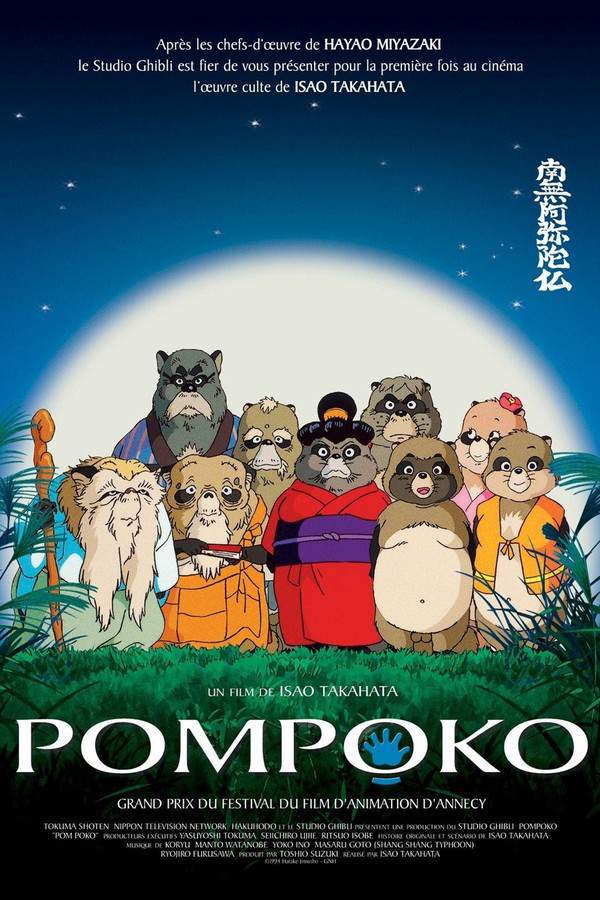
Driven by a deep connection to their forest home, a lively group of raccoons use their shape-shifting abilities to playfully disrupt and challenge the plans of developers who threaten to destroy their habitat. They employ clever disguises and mischievous tactics in an attempt to protect the natural world they cherish.
Warning: spoilers below!
Haven’t seen Pom Poko yet? This summary contains major spoilers. Bookmark the page, watch the movie, and come back for the full breakdown. If you're ready, scroll on and relive the story!
Read the complete plot breakdown of Pom Poko (1995), including all key story events, major twists, and the ending explained in detail. Discover what really happened—and what it all means.
In the late 1960s Japan, a group of tanuki faces a grave danger due to a massive suburban development project named New Tama encroaching on their forest home in the Tama Hills on the outskirts of Tokyo. This project threatens to fragment their territory and deplete their resources. As the narrative unfolds in the early 1990s, amidst the burgeoning Heisei era, the situation for the tanuki worsens. With their living space shrinking and food growing scarcer each passing year, the tanuki are driven to conflict with one another over the dwindling resources. However, urged by their wise matriarch Oroku, they decide to band together and resist the impending development.
Leading the charge in this resistance are several brave tanuki, including the fierce chief Gonta, the wise elder Seizaemon, the resourceful youngster Shoukichi, and the sagacious Oroku. They tap into and relearn their mystical illusion skills, previously forgotten, to orchestrate a series of distractions and sabotage against the construction efforts. These bold tactics lead to injuries and even fatalities among workers, prompting many to abandon their posts. Yet, despite the tanuki’s valiant efforts, new workers continuously take their place.
Desperate for aid, the tanuki send messengers to seek out legendary elders from distant lands. After years of waiting, one such messenger returns, accompanied by a trio of revered elders from Shikoku, where the tanuki still live harmoniously without threats of development. To instill respect for the supernatural once more, they craft a grand ghost parade, intended to make the humans believe the area is haunted. Tragically, the effort takes a toll when one elder dies from the strain, his spirit departing during a raigō. The parade’s impact is squandered when a local theme park owner falsely claims it was a publicity stunt.
Following this setback, the unity of the tanuki breaks down; they splinter into smaller factions, each adopting different tactics. One faction, under Gonta, resorts to eco-terrorism, leading to a catastrophic confrontation with law enforcement. In a heroic last stand, Gonta merges with other tanuki to form a monstrous tsurube-otoshi, ultimately sacrificing themselves to halt a massive truck. Meanwhile, another group seeks media attention through television appeals, while one elder descends into senility and starts a Buddhist dance cult, leading to a perilous voyage to their doom, while another contemplates forging bonds with humanity, following the paths of the last transforming kitsune.
In a final act of rebellion, the remaining tanuki conjure a breathtaking illusion that briefly restores their former habitat’s glory, evoking nostalgia for what is lost. Yet, as their strength wanes, the tanuki, skilled in illusion but weary, start to blend into human society, leaving behind those unable to transform. Although their media campaign fails to halt construction, it garners public sympathy, compelling developers to allocate a few small parks for their protection. Yet, these parks prove insufficient for the non-transforming tanuki, who struggle to navigate urban life, scavenging for food amid the chaos of human traffic or embracing the countryside, where they compete with resident tanuki.
In a poignant turn of events, Shoukichi, now living within the human realm, encounters a non-transformed tanuki slipping into a narrow passage. Curiosity leads him to follow, discovering a serene clearing where familiar faces gather. Overjoyed, Shoukichi transforms back into a tanuki, reuniting with his companions. As his friend Ponkichi turns to the audience, he earnestly implores humans to show compassion towards tanuki and other animals lacking transformation abilities, advocating for the preservation of their habitats. The scene fades, revealing a golf course swallowed by suburban sprawl, an eye-opening reminder of the consequences of unchecked development.
Last Updated: November 16, 2024 at 18:48
Discover curated groups of movies connected by mood, themes, and story style. Browse collections built around emotion, atmosphere, and narrative focus to easily find films that match what you feel like watching right now.
Communities use ancient magic and trickery to fight the encroachment of progress.Explore movies like Pom Poko where communities use ancient magic and folklore to resist modern development. These films blend environmental themes with mythical elements, offering bittersweet tales of resistance, adaptation, and the poignant clash between tradition and progress.
These narratives follow a community as it rallies against an existential threat, using its unique cultural or magical strengths. The conflict often escalates from mischievous pranks to more serious confrontations, leading to a resolution that involves sacrifice, adaptation, or a bittersweet acknowledgment of change.
Movies are grouped here by their shared focus on a collective struggle against modernization, the imaginative use of folklore as a narrative device, and a tone that balances whimsical antics with the serious, melancholic stakes of cultural and environmental loss.
Animated animal stories with deep, bittersweet themes about community and survival.Find movies similar to Pom Poko that use animal characters to tell profound, bittersweet stories. These animated allegories explore environmentalism, community, and change with a mix of humor and heartbreak, perfect for viewers who appreciate depth in family-friendly animation.
The narrative follows an animal community facing a crisis that mirrors human society's challenges. The journey is character-driven, blending comedic moments born from the animals' nature with serious dramatic stakes. The ending is typically nuanced, offering neither a perfect victory nor utter defeat, but a realistic, bittersweet compromise.
These films share a specific tone mix: they are accessible and often humorous yet ultimately serious in their thematic concerns. They use the animal perspective to create allegories that are both universal and deeply moving, resulting in a consistently bittersweet viewing experience.
Don't stop at just watching — explore Pom Poko in full detail. From the complete plot summary and scene-by-scene timeline to character breakdowns, thematic analysis, and a deep dive into the ending — every page helps you truly understand what Pom Poko is all about. Plus, discover what's next after the movie.
Track the full timeline of Pom Poko with every major event arranged chronologically. Perfect for decoding non-linear storytelling, flashbacks, or parallel narratives with a clear scene-by-scene breakdown.
Discover the characters, locations, and core themes that shape Pom Poko. Get insights into symbolic elements, setting significance, and deeper narrative meaning — ideal for thematic analysis and movie breakdowns.
Get a quick, spoiler-free overview of Pom Poko that covers the main plot points and key details without revealing any major twists or spoilers. Perfect for those who want to know what to expect before diving in.
Visit What's After the Movie to explore more about Pom Poko: box office results, cast and crew info, production details, post-credit scenes, and external links — all in one place for movie fans and researchers.