

Plot Explained Spoilers guaranteed!
Plot Explained

Browse by genre

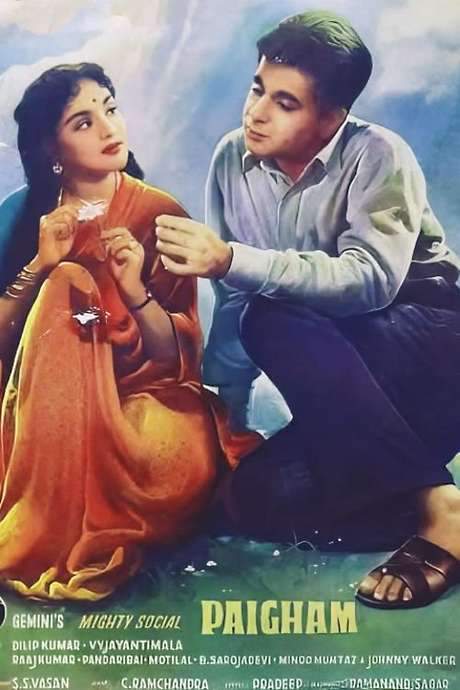
Paigham (1959) movie poster

Characters & Themes

Paigham (1959) Characters, Setting & Themes Explained

Release, runtime and language
1959 · 183 mins · Hindi
Directed by
S. S. Vasan
Starring
B. Saroja Devi, Johnny Walker, Dilip Kumar, Pandari Bai, S.N. Banerjee, Raaj Kumar

Mrs. Lal, a widow, shares a home with sons Ram and Ratan, daughter Sheela, and Ram’s wife Parvati and their children. Ram works in a mill; Ratan studies engineering in Calcutta. Returning, Ratan joins the mill, falls for typist Manju, angering Malti, daughter. When Sewakram defrauds workers, Ratan starts a union, which his brother Ram opposes.

On this page (7)
  1. 1 Where to watch
  2. 2 Characters explained (9)
  3. 3 Where & when it takes place
  4. 4 Themes & meaning (3)
  5. 5 Character & meaning questions
  6. 6 Movie threads
  7. 7 Every angle

Where to watch

Where to Watch Paigham (1959)

Where can you watch Paigham? Stream, rent or buy it in the US, including on Amazon Video: current JustWatch availability with up-to-date prices.

Streaming availability powered by JustWatch

9 main characters · contains spoilers

Paigham Characters Explained: Who Is Who

The main characters of Paigham (1959), heroes and villains: what drives them, how they change over the course of the story and what each of them reveals about the film's bigger ideas.

  • Malti Sewakram (B. Saroja Devi)

    Malti is the mill owner's daughter who sits at the center of the social and business conflict. Her loyalties are torn between family interests and genuine care for the workers and the man she loves. She embodies the tension between aristocratic privilege and evolving social conscience.

    • 👩‍💼 Family ties
    • 💖 Love vs loyalty
    • 🏛️ Social pressure
  • Ram Lal (Raaj Kumar)

    Ram Lal remains fiercely loyal to the mill and its traditions. He opposes the idea of a workers’ union and ejects his brother-in-law when the conflict escalates. His stance anchors the family’s resistance to reform and highlights the costs of rigid allegiance.

    • 👨‍👩‍👧 Family duty
    • 💼 Mill loyalty
    • 🗣️ Conflict with reform
  • Ratan Lal (Dilip Kumar)

    Ratan Lal returns from Calcutta, offers a new vision for the mill, and falls in love with Manju. He takes a stand against defrauding practices and seeks to organize the workers for fair treatment. His actions drive the social upheaval that the family must navigate.

    • 💖 Romance
    • 🧭 Progressive reform
    • 🛡️ Protective brotherly figure
  • Parvati (Pandari Bai)

    Parvati is Ram Lal’s wife and a steady moral presence in the household. She embodies traditional values while navigating the shifting loyalties within the family. Her stance helps anchor the family amid the strike and social pressures.

    • 👪 Family matriarch
    • 🧭 Moral center
    • 🧵 Social expectations
  • Manju (Vyjayanthimala)

    Manju is a typist who becomes the love interest of Ratan Lal. Her relationship with Ratan navigates class and professional boundaries while challenging the assumptions of the mill's social circle. She represents hope and personal choice amidst upheaval.

    • 💘 Romance
    • 💼 Social mobility
    • 🗣️ Voice of reason
  • Mrs. Lal (Pratima Devi)

    Mrs. Lal is the widowed matriarch who heads the bustling household. She embodies duty and resilience, striving to keep the family together as economic pressures mount. Her leadership anchors the narrative through generations of change.

    • 👵 Family leader
    • 🏠 Household economy
    • 💪 Resilience
  • Seth Sewakram (Motilal)

    Seth Sewakram is the mill owner who wields power over workers and the town’s social order. His defrauding practices and resistance to unionization reveal how wealth can corrode ethics. His clashes with Ratan Lal set the story’s central conflict into motion.

    • 💰 Wealth
    • 🏭 Corporate power
    • 🛡️ Authority
  • Kundan (Kurupanju)

    Kundan is engaged to Sheela, a social tie that represents prestige and the town’s expectations. The engagement’s collapse exposes the fragility of reputations and the pressure to conform. He embodies conventional social values that resist change.

    • 💍 Social status
    • 🧩 Tradition vs change
    • 🔗 Marriage
  • Sheela

    Sheela is Ram Lal’s sister whose engagement to Kundan exposes the community’s reliance on arranged ties and reputational concerns. Her storyline highlights how personal choices are constrained by social norms. The cancellation of the engagement marks a blow to family prestige.

    • 👩‍👧 Family ties
    • 🏛️ Social pressure
    • 💔 Reputation

Last updated: February 19, 2026 at 23:48

Was this helpful?

Setting

Where and When Does Paigham Take Place?

The setting of Paigham (1959): the year and time period, the places and locations, and how they shape the characters, the mood and the tension of the story.

Time period

Location

Calcutta, Mill Town

The story unfolds in a bustling mill town where the textile mill is the economic heartbeat. The urban setting creates social hierarchies and a tight-knit community that feels the pressure of duty and reputation. Calcutta's broader social backdrop also influences the romance and labor tensions that drive the plot.

  • 🏭 Industrial
  • 👪 Family life
  • 🏙️ Urban setting

Last updated: February 19, 2026 at 23:48

Was this helpful?

3 major themes

Paigham Meaning: Themes & Message Explained

What is Paigham (1959) really about? The emotional, social and philosophical themes the film keeps returning to, its symbolism and the message beneath the surface.

  • Labor & Strike

    The plot centers on workers' grievances at the mill, Ratan's push for fair practices, and the resulting strike. It examines power dynamics between industry owners and laborers, and how reform can collide with entrenched interests. Loyalties within the Lal family and their community are tested as justice and survival hang in the balance.

  • Family vs Duty

    The Lal family is divided by competing loyalties—toward kin, the mill, and the broader community. Personal happiness clashes with economic pressure and social expectations. The film uses household fractures to explore how duty can override affection, and vice versa. Reconciliation becomes the central resolve that threads through the narrative.

  • Power & Wealth

    Seth Sewakram's control of the mill reveals how wealth can bend relationships and suppress reform. The narrative traces how money-backed authority resists unionization and accountability. The scramble for profit clashes with ethical responsibility, driving the conflict forward. The outcome hinges on a shift in power dynamics within the town.

Last updated: February 19, 2026 at 23:48

Was this helpful?

Character & theme questions

Paigham Characters & Meaning: Your Questions Answered

The questions people ask about Paigham (1959): who the characters really are, their relationships, what the symbols mean, where it takes place and what the movie is really about. Each answer contains spoilers.

Q1

Where is Paigham set?

Paigham is set in a bustling mill town centered around a textile mill, which serves as the economic heartbeat of the community. Calcutta's broader social backdrop influences the romance and labor tensions that drive the plot.

Foreshadowing: The mill's central role is established early, showing it as both employer and community anchor.

  • mill town
  • setting
  • textile mill
  • Calcutta
Q2

When does the story take place?

The movie does not specify an exact era, but the industrial setting, labor disputes, and social dynamics suggest a mid-20th century context typical of post-independence Indian urban cinema.

  • time period
  • era
  • 1950s
Q3

What is the Labor & Strike theme about?

The film centers on workers' grievances at the mill, with Ratan pushing for fair practices and organizing a strike. It examines power dynamics between industry owners and laborers, showing how reform collides with entrenched interests when Seth Sewakram defrauds the workers.

Foreshadowing: Ratan's return from Calcutta with new ideas sets the stage for challenging the mill's practices.

  • labor
  • strike
  • union
  • workers
  • mill
Q4

What does Family vs Duty mean in Paigham?

The Lal family is divided by competing loyalties, toward family, the mill, and the community. Personal happiness clashes with economic pressure and social expectations. The film explores how duty can override affection, with reconciliation threading through the narrative as the central resolve.

Foreshadowing: The tension between Ram's loyalty to the mill and Ratan's reformist ideas creates the family fracture.

  • family
  • duty
  • loyalty
  • reconciliation
Q5

How is Power & Wealth explored in the movie?

Seth Sewakram's control of the mill reveals how wealth bends relationships and suppresses reform. His defrauding practices and resistance to unionization show how money-backed authority corrodes ethics. The scramble for profit clashes with ethical responsibility, driving the central conflict.

Foreshadowing: Sewakram's control is established early, making his eventual resistance to workers' demands predictable.

  • power
  • wealth
  • Seth Sewakram
  • authority
Q6

Who is Malti in Paigham?

Malti is Seth Sewakram's daughter who sits at the center of the social and business conflict. Her loyalties are torn between family interests and genuine care for the workers and the man she loves. She embodies the tension between aristocratic privilege and an evolving social conscience.

Foreshadowing: Malti's connection to both the workers and her father's interests creates the central emotional conflict.

  • Malti
  • Sewakram
  • mill owner's daughter
Q7

What role does Ram Lal play?

Ram Lal is the elder son who remains fiercely loyal to the mill and its traditions. He opposes the idea of a workers' union and ejects his brother-in-law when the conflict escalates. His stance anchors the family's resistance to reform and highlights the costs of rigid allegiance.

Foreshadowing: Ram's traditional values are evident from his initial characterization.

  • Ram Lal
  • elder brother
  • mill loyalist
Q8

Who is Ratan Lal in the story?

Ratan Lal is the younger son who returns from Calcutta where he studied engineering. He brings a new vision for the mill and falls in love with typist Manju. He takes a stand against defrauding practices and organizes the workers for fair treatment, driving the social upheaval.

Foreshadowing: Ratan's education in Calcutta foreshadows his progressive ideas.

  • Ratan Lal
  • engineer
  • union leader
  • Manju
Q9

Who is Manju in Paigham?

Manju is a typist at the mill who becomes Ratan Lal's love interest. Her relationship with Ratan navigates class and professional boundaries while challenging the assumptions of the mill's social circle. She represents hope and personal choice amidst the social upheaval.

Foreshadowing: The typist role positions Manju as an outsider challenging the social order.

  • Manju
  • typist
  • Ratan's love
Q10

What is Mrs. Lal's role in the film?

Mrs. Lal is the widowed matriarch who heads the bustling household containing her sons Ram and Ratan, daughter Sheela, and Ram's wife Parvati. She embodies duty and resilience, striving to keep the family together as economic pressures mount from the labor conflict.

Foreshadowing: Her leadership is established as the anchor holding the family through generational change.

  • Mrs. Lal
  • matriarch
  • family head
Q11

Who is Seth Sewakram?

Seth Sewakram is the mill owner who wields power over workers and the town's social order. His defrauding practices and resistance to unionization reveal how wealth can corrupt ethics. His clashes with Ratan Lal set the story's central conflict into motion.

Foreshadowing: Sewakram's authority is established early, making his antagonistic role clear.

  • Seth Sewakram
  • mill owner
  • antagonist
Q12

What social hierarchies does the movie show?

The mill town setting creates clear social hierarchies, the mill owner and his family occupy the top position, followed by white-collar workers like Manju the typist, then the blue-collar laborers. The urban setting fosters a tight-knit community that feels the pressure of duty and reputation.

Foreshadowing: The class distinctions are visible from the opening scenes.

  • social hierarchy
  • class
  • mill workers
  • community

Movie threads

More Movies Like Paigham, by Mood & Story

Curated lists built around what makes Paigham tick: the same mood, the same kind of story or the same emotional payoff. Each list explains why these movies belong together.

Movies about family divided by ideology like Paigham

Brothers divided by workplace justice while maintaining family bonds. Discover films where siblings or family members clash over workplace justice and social movements, similar to Paigham's narrative of brothers divided by labor rights. These movies explore how familial bonds withstand ideological differences.

  • family conflict
  • social justice
  • brotherhood
  • ideological clash
  • tense drama
  • moral dilemma
  • Tone: tense, dramatic
  • Pacing: steady, character-driven
Why these movies?

The story pattern: These stories typically begin with a close family unit disrupted by external social conflicts, where different members take opposing stances. The tension escalates as personal relationships are tested, culminating in a resolution that often finds common ground through shared humanity rather than complete ideological alignment.

Why they belong together: They share the compelling dynamic of intimate relationships strained by broader social issues, creating emotional stakes that resonate deeply with viewers who appreciate both family drama and social commentary.

Movies about labor rights awakening like Paigham

Young idealist confronts workplace exploitation while navigating personal relationships. Explore films similar to Paigham where a protagonist discovers workplace exploitation and leads the fight for justice. These stories blend personal growth with social activism in industrial settings.

  • social justice
  • awakening
  • corruption
  • union organizing
  • moral courage
  • workplace drama
  • Tone: dramatic, tense
  • Pacing: steady, methodical
Why these movies?

The story pattern: The narrative follows a protagonist who returns to or enters a community/industry and gradually uncovers systemic exploitation. Their awakening leads to organizing efforts that face resistance from established powers, while personal relationships complicate their commitment to the cause.

Why they belong together: They capture the compelling transformation of ordinary individuals into activists, combining personal drama with meaningful social commentary that resonates with viewers interested in justice-oriented storytelling.

Every angle

Paigham (1959) Explained: Plot, Timeline & Characters

Everything about Paigham in one place: what happens in the plot summary, the timeline in chronological order, the characters and meaning and a spoiler-free summary. What's After the Movie adds the cast, box office and post-credit scenes.

Coming soon on iOS and Android

The Plot Explained Movie Summary App

Plot summaries, endings explained and timelines on your phone. Catch up on any movie in minutes, save your favorites and never miss a twist again.

Be the first to know when we launch. Your email stays private, always.

Learn more about the app