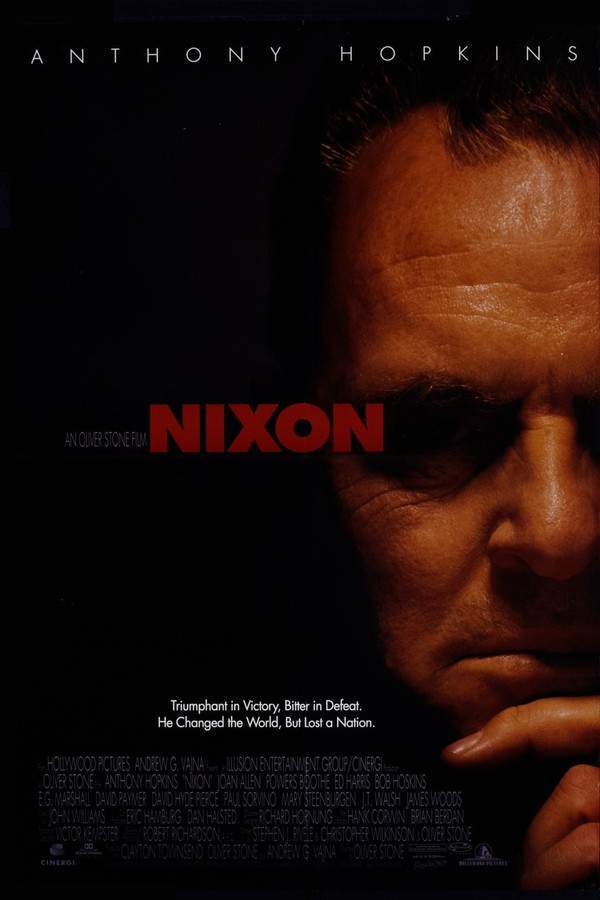









Nixon

Nixon

Year: 1995

Runtime: 192 min

Language: English

Director: Oliver Stone

Budget: $44M

BiographyDrama

A complex and revealing portrait of Richard Nixon is presented, with Anthony Hopkins delivering a nuanced performance as the 37th President. The film explores his early life, personal relationships, and significant political achievements alongside devastating setbacks. It offers a non-linear look at his career, ultimately leading to the profound impact of the Watergate scandal and its aftermath, portraying a complicated figure with both strengths and flaws.

Warning: spoilers below!

Haven’t seen Nixon yet? This summary contains major spoilers. Bookmark the page, watch the movie, and come back for the full breakdown. If you're ready, scroll on and relive the story!

Timeline – Nixon (1995)

Trace every key event in Nixon (1995) with our detailed, chronological timeline. Perfect for unpacking nonlinear stories, spotting hidden connections, and understanding how each scene builds toward the film’s climax. Whether you're revisiting or decoding for the first time, this timeline gives you the full picture.

1

Watergate break-in and arrests

In June 1972, White House Plumbers break into the Democratic National Committee headquarters at the Watergate complex. The botched operation triggers a years-long political scandal and a mounting series of investigations and arrests. The incident marks the starting point of the crisis that dominates the film.

June 17, 1972 Watergate complex, Washington, D.C.
2

Nixon activates the taping system

Nixon starts the audio-taping system, turning his presidency into a self-recorded chronicle. The tapes ignite a loop of recollections that frame the scandal. This device drives the film's structure and reveals the pressures behind key choices.

Late 1960s–1972 White House
3

Smoking Gun tape session

In a key flashback, Nixon meets with Haldeman and Ehrlichman while Dean departs, and Nixon records the so-called 'smoking gun' tape. The conversation exposes covert methods used to protect the White House and undermines trust within his inner circle. The scene crystallizes a turning point as exposure becomes inevitable.

June 23, 1972 White House
4

Hoover's death referenced

The tapes reference the death of J. Edgar Hoover, using it as emotional undercurrent and a symbol of an era ending. It heightens the tension inside the White House as investigators close in. The moment widens the scope from personal to national implications.

May 1972 Washington, D.C.
5

Kissinger's role and leaks debate

Henry Kissinger is depicted as a pivotal, controversial figure whose loyalty is questioned by Nixon and his staff. The film probes whether Kissinger leaks information to protect his image or remains a trusted adviser. Nixon wrestles with how to manage their fraught relationship.

Early 1970s White House
6

Nixon's childhood and brothers' deaths

The film returns to Nixon's childhood, showing how the loss of two brothers to tuberculosis shaped his ambition and temperament. These memories provide a psychological context for his later decisions. The sequence links personal grief to a driven political persona.

1930s Nixon family home
7

Nixon's health and medication during the crisis

During the crisis, Nixon's health—phlebitis and pneumonia—is depicted along with heavy use of medications. The portrayal suggests that physical strain and chemical aids affected judgment and stamina. These details contribute to the portrait of a leader under siege.

Early 1970s
8

Bay of Pigs and JFK assassination references

The film hints at Nixon's role in Cold War actions and the Bay of Pigs invasion, suggesting those actions helped set in motion forces that culminated in the Kennedy assassination and later Watergate. The implication ties past covert actions to the present turmoil. It frames Watergate as part of a longer arc of power and secrecy.

1961–1963 Washington, D.C.
9

Nixon's resignation and departure on Army One

Facing overwhelming scandal, Nixon resigns as president and departs the White House lawn aboard a helicopter, signaling the end of his tenure. The moment is presented as a personal surrender and a historical hinge. The event closes the White House era with a stark visual of departure.

August 9, 1974 White House lawn, Washington, D.C.
10

State funeral footage and subsequent attendance

The film intercuts real footage of Nixon's state funeral in Yorba Linda, showing prominent ex-presidents and the sitting president in attendance. The sequence connects the film to the broader arc of American history. It emphasizes the lasting legacy and the public memorial of a controversial figure.

April 1994 Yorba Linda, California
11

End credits montage and national reflection

The closing montage shows living ex-presidents—Ford, Carter, Reagan, Bush—and Bill Clinton in attendance during the funeral sequence, situating Nixon's life within the continuum of the American presidency. The film invites reflection on how Watergate reshaped leadership and public trust. It frames the crisis as a turning point in modern American politics.

April 1994 Washington, D.C. and Yorba Linda
12

Personal life under strain: alcohol and prescriptions

The narrative implies that Nixon and his wife faced alcohol use and prescription medication challenges during the crisis. This personal dimension adds depth to the portrait of a leader under extraordinary pressure. It underscores how private vulnerabilities intersect with public responsibility.

1970s White House

Last Updated: October 09, 2025 at 15:37

Mobile App Preview

Coming soon on iOS and Android

The Plot Explained Mobile App

From blockbusters to hidden gems — dive into movie stories anytime, anywhere. Save your favorites, discover plots faster, and never miss a twist again.

Sign up to be the first to know when we launch. Your email stays private — always.

Explore Movie Threads

Discover curated groups of movies connected by mood, themes, and story style. Browse collections built around emotion, atmosphere, and narrative focus to easily find films that match what you feel like watching right now.

Political downfall tragedies like Nixon

Intense stories of powerful figures collapsing under the weight of their own flaws.If you liked the intense, tragic arc of Nixon, explore more movies like it that delve into the downfall of powerful figures. These films share a heavy emotional weight, complex character studies, and a tense, melancholic atmosphere centered on political or personal collapse.

tensesomberoppressivefatalisticanxiousreflectiveclaustrophobic

Narrative Summary

Stories in this thread typically follow a protagonist at the peak of their power who is undermined by a critical personal flaw—such as paranoia, ambition, or addiction—and a cascading public scandal. The narrative often builds with a sense of fatalistic dread towards a sad or bleak conclusion that examines the ruins of a legacy.

Why These Movies?

These movies are grouped together because they share a core focus on the dramatic arc of a downfall. They create a similar viewing experience defined by high tension, psychological depth, a non-heroic protagonist, and a heavy, often melancholic mood that leaves a lasting impact.


Complex character portraits under pressure like Nixon

Non-linear explorations of flawed individuals grappling with past trauma and present crises.For viewers who appreciated the nuanced character study in Nixon, this section highlights similar movies with complex psychological portraits. These films use variable pacing and non-linear storytelling to explore the deep-seated flaws and traumas of their protagonists under immense pressure.

reflectivesomberpsychologicalmelancholicanxiousoppressivefatalistic

Narrative Summary

The narrative pattern involves intertwining timelines to reveal how a character's past—their personal trauma, regrets, and key relationships—directly fuels their actions and ultimate fate in a high-pressure present-day situation. The structure itself reflects the character's fractured psychology and the inescapable nature of their flaws.

Why These Movies?

These films are united by their primary focus on a multi-layered, flawed protagonist. They share a complex narrative structure, a heavy, introspective mood, and a central theme of a person being crushed by the combined weight of their history and their current circumstances.

Unlock the Full Story of Nixon

Don't stop at just watching — explore Nixon in full detail. From the complete plot summary and scene-by-scene timeline to character breakdowns, thematic analysis, and a deep dive into the ending — every page helps you truly understand what Nixon is all about. Plus, discover what's next after the movie.

Nixon Summary

Read a complete plot summary of Nixon, including all key story points, character arcs, and turning points. This in-depth recap is ideal for understanding the narrative structure or reviewing what happened in the movie.

Nixon Summary

Characters, Settings & Themes in Nixon

Discover the characters, locations, and core themes that shape Nixon. Get insights into symbolic elements, setting significance, and deeper narrative meaning — ideal for thematic analysis and movie breakdowns.

Characters, Settings & Themes in Nixon

Nixon Spoiler-Free Summary

Get a quick, spoiler-free overview of Nixon that covers the main plot points and key details without revealing any major twists or spoilers. Perfect for those who want to know what to expect before diving in.

Nixon Spoiler-Free Summary

More About Nixon

Visit What's After the Movie to explore more about Nixon: box office results, cast and crew info, production details, post-credit scenes, and external links — all in one place for movie fans and researchers.

More About Nixon