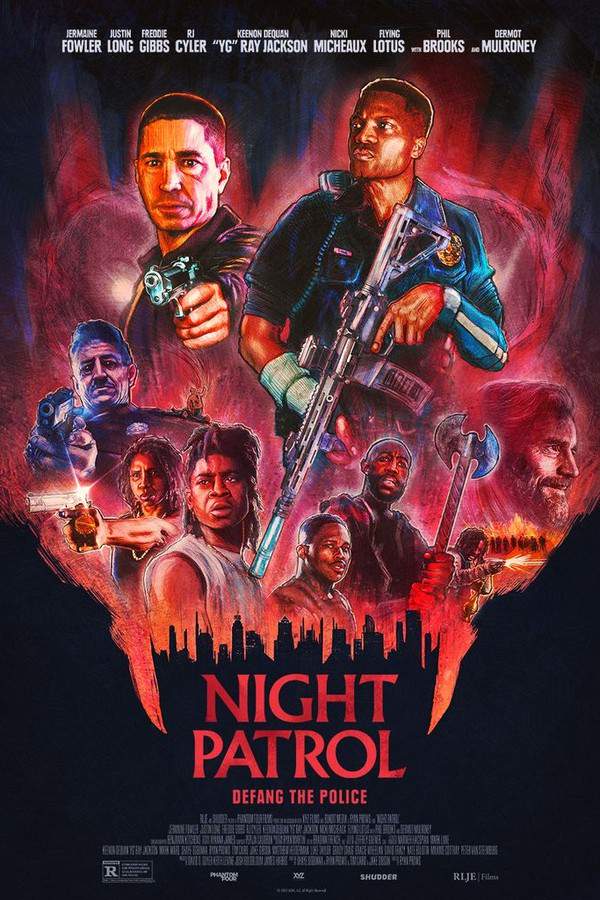
The climax of Night Patrol transforms from a gritty crime thriller into a supernatural showdown rooted in ancestral power. After the vampire police unit decimates the Bloods and leaves Wazi's mother, Ayanda, mortally wounded, she reveals their family's Zulu heritage before dying. In the burning apartment, Wazi discovers a warrior's suit, his glowing green ring, and a magical spear—artifacts that transform him from a terrified witness into a formidable fighter. He emerges to face the Night Patrol, killing several officers before confronting Ethan, his brother's former partner who has been forcibly turned into a vampire. Though Ethan attacks him from the air, Wazi drives the Zulu spear through him and survives the fall, though he is left gravely injured.
The film's final moments carry heavy thematic weight. Wazi awakens inside the police station with the spear tip embedded in his chest, facing a Black officer who delivers a chilling reality: Wazi will be blamed for everything because the vampires wear uniforms. The system protects its own, regardless of the atrocities committed. This sets up the film's haunting conclusion, where Wazi is locked in a room surrounded by the remaining vampire cops. As the spear tip begins to glow once more, the warrior spirit inside him stirs, leaving viewers with a powerful image of resistance against institutional darkness.
Ethan's arc serves as a tragic counterpoint to Wazi's empowerment. Throughout the film, Ethan exists in a moral gray area—he joins the Night Patrol to honor his deceased father, unaware that his father is actually alive and leading the vampire unit. When Ethan hesitates to kill Primo during his initiation, Marcus forces his hand, and later, his own father turns him into a vampire against his will. Ethan becomes a puppet, killing Xavier to quench his newfound thirst. Yet the remnants of his conscience emerge when he kills Marcus, suggesting that Ethan was never fully lost to the darkness. His final confrontation with Wazi is less a battle between hero and villain than a collision of two young men destroyed by a corrupt system—one wielding ancestral power, the other consumed by it.
The ending resonates far beyond its supernatural elements. Director Ryan Prows uses the vampire metaphor to explore real-world issues of police brutality and systemic racism. The Night Patrol's indiscriminate violence against Black residents—targeting the elderly, women, and even infants—mirrors historical and contemporary injustices. Ayanda's distrust of Xavier, her own son who joined the LAPD, speaks to the complicated relationship between Black communities and law enforcement. When Wazi stands alone against a room full of officers, the film crystallizes its message: the fight against institutional oppression often falls on individuals who must draw strength from their heritage and community to survive. The glowing spear represents more than magical weaponry—it embodies the enduring power of cultural identity in the face of erasure and violence.