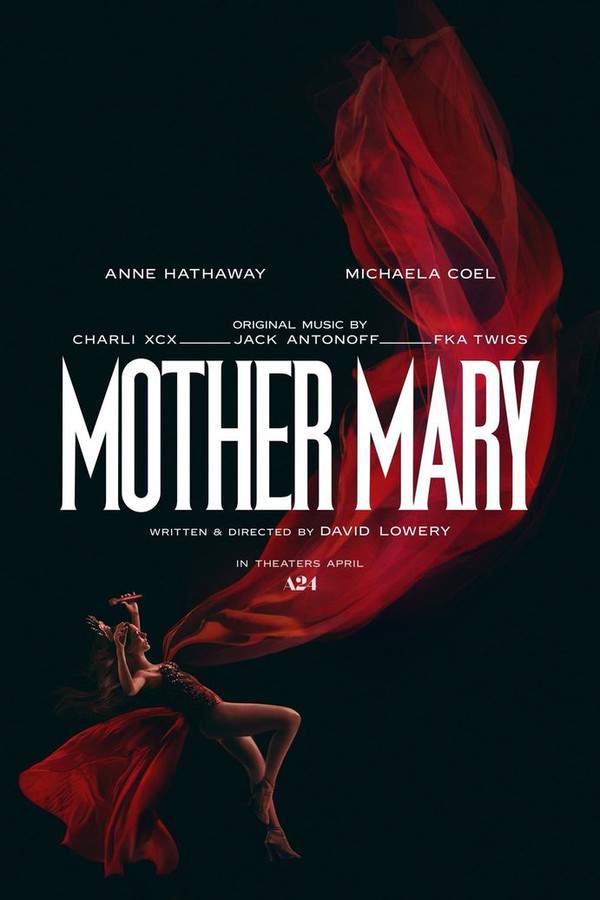
Sam Anselm [Michaela Coel] speaks bitterly to an unseen listener, laying bare a sentiment that they deserve neither love nor hate. The film then shifts to a dazzling scene with pop icon Mother Mary [Anne Hathaway], who performs her song “Burial” to a chorus of devoted fans. She’s planning a bold comeback after a troubling onstage fall that had rumors swirling about a possible suicide attempt. In the days leading to her return, a wave of anxiety hits as she frets over the dress she must wear, a piece that must somehow feel like her again. Her travels take her to London, where the urgency of the moment pushes her toward a reunion with the designer she hasn’t seen in over a decade.
Mary’s path leads her to the studio of Sam, guided by Sam’s assistant Hilda [Hunter Schafer]. The reunion stirs a tangled mix of history and ambition: Mary asks for something new, something truer to her current self, and makes it clear she expects Sam to outshine the younger star scheduled to open the show, Miel Contrera [Alba Baptista]. Sam sees an opportunity to push boundaries and asks Mary to reveal the dance she envisions for the dress, though Mary refuses to let the song play out of spite. The dance is performed in silence, and Sam begins to sketch a striking concept—a dress whose train is crafted from fragments of past gowns, a wearable archive that could carry Mary’s legacy forward.
As the conversation deepens, Mary opens up about the rift between them. She explains the sense of being shut out of Mary’s inner circle after her rise to superstardom, a wound Sam also recalls—the time she attended one of Mary’s shows and felt unacknowledged in return. The mood darkens as Sam shares a more haunting memory: a tooth extraction during which she saw a red, ghost-like figure cloaked in shadow. Mary confesses she has seen that same red apparition before, and the conversation broadens to a shared history with a fan named Imogen [FKA Twigs], whom Mary once joined for a seance with a circle of other women: Nikki [Kaia Gerber], Tessa [Jessica Brown Findlay], Kyla [Isaura Barbé-Brown], and Emily [Atheena Frizzell]. The group chants, and a spirit is summoned, possessing Imogen. The possession is visceral: Imogen’s hand reaches out to Mary and withdraws, a cut appearing on Mary’s skin as the spirit makes its presence felt. The red ghost returns during a performance, invading Mary’s wound and nearly overpowering her, only for her to escape once again.
Haunted by the memory and the ongoing threat, Mary admits she cannot escape the spirit no matter how hard she tries to repress it. Seeing the danger, Sam resolves to intervene with a ritual that will confront the entity directly. She arranges a circle on the floor with her sewing tools and invites Mary to revisit the fabric of their shared past—the dresses Sam once crafted for her, the moments when their collaboration sparked something essential. The ritual unfolds with a ritualistic intensity: Mary cuts her chest with scissors, and the spirit is drawn out, emerging as a vast, crimson cloth that stretches and roams the room. The rest of Sam’s team—faced with the extraordinary sight—arrives in astonishment as the ritual reaches its pinnacle.
In the aftermath, Mary begins to recover, and Sam sets to work on the new dress. Mary is soon escorted to her vehicle, but not before she offers a sincere apology for the wrong she may have done in their history, a gesture that hints at healing and renewed respect. The momentum shifts again when Hilda shares a vision of Mary wearing Sam’s dress, a vision that includes a halo—a detail that is also part of Sam’s own concept. The final image lingers on the red dress, now completed from the fabric born of the red spirit, signaling a powerful fusion of their past struggles and a forward path for both women.
Throughout the film, the threads of rivalry and reconciliation run through a narrative that blends fashion, performance, and the supernatural. The tension between legacy and reinvention is explored not just in the costumes but in the fragile, creative bond between designer and star. The film builds its atmosphere on visual motifs—the ghostly red, the circle of tools, the contrast between silence and spectacle—and uses them to probe notions of influence, recognition, and the price of fame. As the story closes, the red dress stands as a symbol of the ordeal and its aftershocks: a garment woven from memory, conflict, and a newly shared sense of possibility.