




Plot Explained Spoilers guaranteed!
Plot Explained

Browse by genre

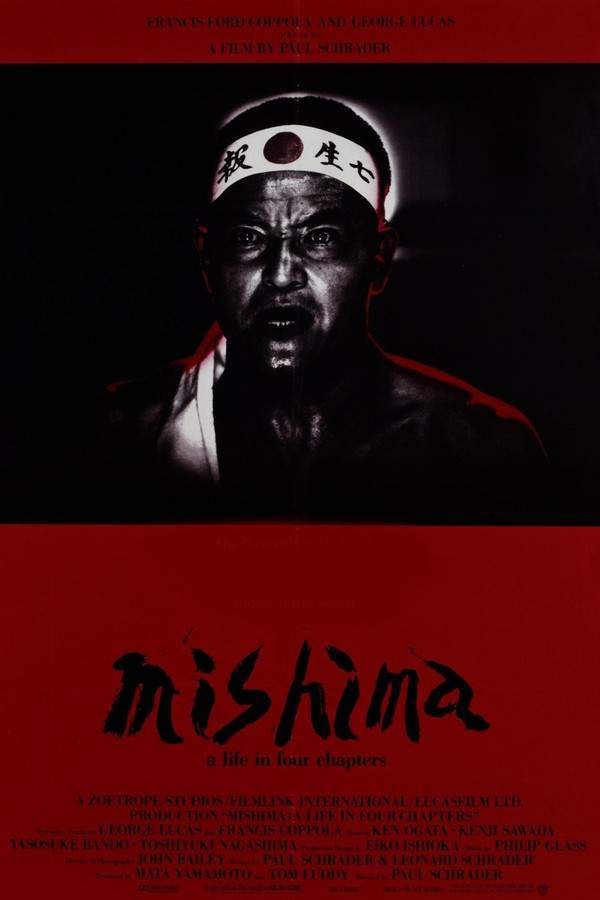
Mishima: A Life in Four Chapters (1985) movie poster

Timeline

Mishima: A Life in Four Chapters (1985) Timeline Explained – Every Event in Order

Release, runtime and language
1985 · 120 min · English
JustWatch #9,915 385
Directed by
Paul Schrader
Starring
Ken Ogata, Gô Rijû, Hiroshi Mikami, Junkichi Orimoto, Junya Fukuda, Masato Aizawa

The film explores the life of Japanese author Yukio Mishima, presented in four distinct sections. The initial segments focus on his literary works and creative process, while the final chapter depicts the dramatic events surrounding his death on November 25, 1970. It offers a portrait of a complex and controversial figure.

On this page (6)
  1. 1 Where to watch
  2. 2 Events in order (12)
  3. 3 Timeline questions answered
  4. 4 Movie threads
  5. 5 Movies like Mishima: A Life in Four Chapters
  6. 6 Every angle

Where to watch

Where to Watch Mishima: A Life in Four Chapters (1985)

Where can you watch Mishima: A Life in Four Chapters? Stream, rent or buy it in the US, including on Amazon Video, Apple TV Store and Fandango At Home: current JustWatch availability with up-to-date prices.

Streaming availability powered by JustWatch

12 events in order · contains spoilers

Mishima: A Life in Four Chapters Timeline: Events in Chronological Order

Every key event of Mishima: A Life in Four Chapters (1985) in order, scene by scene, with when and where it takes place. Use it to untangle flashbacks, time jumps and parallel storylines, to refresh your memory before the sequel or to find the exact scene you are thinking of.

  1. Final Day of Yukio Mishima

    The film begins on November 25, 1970, marking the last day of Yukio Mishima's life. He completes a manuscript and dons a uniform of his own design, ready to meet his fate.

    When
    November 25, 1970
  2. Formation of the Tatenokai

    Mishima gathers four of his devoted followers from the Tatenokai, his private army. This group embodies his radical vision for restoring traditional values and the Emperor's power in Japan.

  3. Mishima's Childhood

    Through flashbacks, the film reveals Mishima's troubled childhood as a frail boy. These early experiences shape his identity and cement his ambitions as a writer and artist.

  4. Dedication to Physical Culture

    In adulthood, Mishima becomes obsessed with physical perfection, exploring themes of masculinity. This obsession drives his disdain for the materialism of modern Japan, fueling his traditionalist beliefs.

  5. Establishment of Tatenokai's Ideals

    Mishima founds the Tatenokai, promoting his vision of a Japan rooted in traditional values and imperial leadership. His fervent nationalism is expressed through his writings and public persona.

  6. Dramatization of 'The Temple of the Golden Pavilion'

    One chapter of Mishima's narrative includes the dramatization of 'The Temple of the Golden Pavilion'. A stuttering man becomes overwhelmed by the temple's beauty, leading him to set it ablaze in despair.

  7. Dramatization of 'Kyoko's House'

    In another segment, 'Kyoko's House' portrays a tumultuous affair between a middle-aged woman and her young lover. This relationship ultimately descends into tragedy, exacerbated by dependency.

  8. Dramatization of 'Runaway Horses'

    The third dramatization, 'Runaway Horses', follows a group of young nationalists plotting to topple the government. This revolutionary zeal culminates in a leader's tragic suicide, marking a turning point in their cause.

  9. Chapter Segmentation

    The narrative is elegantly divided into four chapters: Beauty, Art, Action, and Harmony of Pen and Sword. This structure highlights the complex interplay between Mishima's life and his literary works.

  10. Hostage Situation with General

    As the climax unfolds, Mishima and his followers stage a hostage situation involving a General of the Japan Self-Defense Forces. He passionately addresses the soldiers, calling for their support in restoring the Emperor's sovereignty.

  11. Soldiers' Apathy

    Despite Mishima's fervent address, his passionate plea is met with derision and apathy from the soldiers. This public rejection deeply impacts him, showcasing the disconnect between his ideals and reality.

  12. Mishima's Act of Seppuku

    In a devastating turn, Mishima retreats to the General's office and commits seppuku, encapsulating his loyalty to his ideals. This act serves as both a personal resolution and a tragic statement about his beliefs.

Last updated: November 16, 2024 at 15:51

Was this helpful?

Timeline questions answered

Mishima: A Life in Four Chapters Timeline Explained: Your Questions Answered

When does it happen, and why in that order? The questions people ask about the chronology of Mishima: A Life in Four Chapters (1985): time jumps, flashbacks, cause and effect between scenes and the correct order of events, each answered with spoilers.

Q1

Why did Yukio Mishima form the Tatenokai?

Mishima founded the Tatenokai (Shield Society) as his private army to advocate for the restoration of the Emperor as Japan's rightful leader. This radical step came after his growing disdain for modern Japan's materialism and his belief that the country had strayed from traditional values. The group represented his extremist vision of traditionalism and his commitment to taking direct political action rather than just writing about his beliefs.

Foreshadowing: Earlier scenes show Mishima's deep dissatisfaction with post-war Japan and his growing conviction that literary words alone were insufficient to effect change.

  • tatenokai
  • private army
  • emperor
  • traditionalism
  • japan nationalism
Q2

What was Yukio Mishima's ideology?

Mishima's ideology was a blend of extreme nationalism and traditionalism centered on restoring imperial rule in Japan. He believed modern Japan had become corrupt and materialistic, abandoning its spiritual heritage. This worldview was fueled by his fascination with masculinity, physical perfection, and what he saw as the degenerating values of post-war society. He advocated for a return to classical Japanese virtues and the Emperor's sovereign authority.

Foreshadowing: His obsessive dedication to physical culture in adulthood reflects his belief in the unity of mind and body, a core tenet of his ideological framework.

  • nationalism
  • traditionalism
  • imperialism
  • ideology
  • emperor japan
Q3

Why did Mishima commit seppuku after the failed hostage situation?

Mishima committed seppuku because his passionate appeal to the Japan Self-Defense Forces soldiers to restore the Emperor was met with derision and apathy. After delivering his speech calling for them to join his cause, the soldiers' rejection represented the complete failure of his political mission. Rather than accept capture or live with the shame of rejection, he chose ritual suicide as the ultimate expression of loyalty to his ideals, a deliberate final statement that aligned with his lifelong fascination with death and aestheticized violence.

Foreshadowing: Throughout the film, Mishima's writings explore themes of suicide, martyrdom, and the beauty of death, particularly in Runaway Horses where the leader commits ritual suicide.

  • seppuku
  • suicide
  • ritual death
  • honor
  • ideals japan
Q4

How do the dramatized novels relate to Mishima's real life?

The three dramatized novels, The Temple of the Golden Pavilion, Kyoko's House, and Runaway Horses, function as thematic mirrors to Mishima's own life and psychology. The stuttering protagonist overwhelmed by beauty who burns the temple reflects Mishima's own tumultuous relationship with artistic perfection. The tragic sadomasochistic relationship in Kyoko's House parallels his complex views on desire and destruction. Runaway Horses directly foreshadows his own failed political coup and suicidal end, depicting young nationalists who attempt revolution and suffer the same fate he would later experience.

Foreshadowing: The chapter titles, Beauty, Art, Action, and Harmony of Pen and Sword, progressively align the fictional narratives with stages of Mishima's actual life trajectory.

  • novels
  • books
  • biography
  • thematic connection
  • story within story
Q5

Why was Yukio Mishima obsessed with physical perfection?

Mishima became obsessed with physical culture as a response to his frail childhood and his belief that true masculinity required a perfected body. This obsession stemmed from his conviction that modern Japanese men had become weak and decadent. By transforming his body through rigorous training, he sought to embody the ideal Japanese masculinity he believed was necessary to restore his nation's spirit. This physical transformation was inseparable from his ideological transformation, they were two facets of his quest for perfection and rejection of modernity's perceived weakness.

Foreshadowing: Early flashbacks show Mishima as a sickly, frail child who was bullied and felt physically inadequate, establishing the personal origin of his later obsession.

  • bodybuilding
  • masculinity
  • physical culture
  • fitness
  • transformation
Q6

Why did the soldiers reject Mishima's impassioned speech?

The soldiers rejected Mishima's speech because they were fundamentally disconnected from his ideological worldview. Despite his passionate appeal to restore the Emperor's sovereignty, the Self-Defense Forces personnel viewed his cause as irrelevant to their own lives and careers. Mishima's traditionalist nationalism meant little to a generation that had accepted post-war Japan's democratic and capitalistic structure. His speech, filled with intellectual and historical references, failed to resonate with an audience that simply did not share his sense of crisis or his vision for Japan.

Foreshadowing: Mishima's isolation from mainstream Japanese society is evident throughout the film, as his views become increasingly radical and detached from contemporary reality.

  • soldiers
  • military speech
  • rejection
  • appeal
  • politics
Q7

What was the significance of the uniform Mishima wore on his final day?

The uniform Mishima wore on November 25, 1970, was of his own design and symbolized his fusion of military traditionalism with his personal aesthetic. It represented his physical transformation into the idealized masculine warrior he had spent years cultivating. More importantly, the uniform was his statement of intent, a visual declaration that he was not merely a writer but a man of action prepared to die for his beliefs. By designing and wearing this uniform, he presented himself as the embodiment of the warrior-spirit he advocated should return to Japan.

Foreshadowing: His earlier dedication to physical culture and martial training was always directed toward this eventual moment of action.

  • uniform
  • design
  • attire
  • symbolism
  • final day
Q8

How did Mishima's childhood shape his later life and beliefs?

Mishima's troubled childhood as a frail, sickly boy who was bullied and felt physically inferior profoundly shaped his adult identity. This early experience of weakness drove his obsessive pursuit of physical perfection and his deep fascination with masculinity and strength. The trauma of his childhood also contributed to his complex psychology, feeding into his artistic sensibilities and his later writings that often explored themes of beauty, violence, and the tension between physical inadequacy and spiritual or aesthetic transcendence. His transformation from the frail child into the disciplined, muscular author and eventual revolutionary represents his lifelong attempt to overcome that early sense of weakness.

Foreshadowing: The opening scene shows the adult Mishima completing his final manuscript before his final act, connecting the frail child who became a prolific writer to the man who would die for his ideals.

  • childhood
  • trauma
  • transformation
  • growth
  • weakness
Q9

Why did the hostage situation at the General's office fail?

The hostage situation failed primarily because Mishima misjudged the political climate and the receptiveness of the military to his extremist cause. While he and his four followers successfully took a General hostage, his appeal to the assembled soldiers fell flat. The soldiers did not share his ideological fervor or his belief in restoring imperial rule. Without any meaningful support from the military, the coup had no chance of success. Mishima had invested his entire identity in this moment of action, and the complete lack of resonance rendered his grand gesture meaningless, leading directly to his decision to commit seppuku.

Foreshadowing: His writings in Runaway Horses depicted nearly identical events, a failed nationalist uprising that ends in suicide, showing he knew the likely outcome yet pursued it anyway.

  • hostage
  • general
  • coup
  • failure
  • political action
Q10

What is the meaning behind the film's four chapter titles?

The four chapter titles, Beauty, Art, Action, and Harmony of Pen and Sword, represent the evolution of Mishima's life and creative philosophy. 'Beauty' covers his early transformation and aesthetic foundations. 'Art' focuses on his literary works and the dramatized novels that reflected his inner turmoil. 'Action' represents his shift from writing to direct political engagement through the Tatenokai. 'Harmony of Pen and Sword' depicts the final convergence of his literary and military ambitions, culminating in his final day. This structure presents his life as a progression toward reconciling his identity as both a writer and a man of action, with the final chapter representing his attempt to achieve unity between these two aspects of himself.

Foreshadowing: Each chapter title progressively indicates Mishima's movement from contemplation to violent action, building toward the inevitable climax.

  • chapters
  • structure
  • beauty
  • art
  • action
  • harmony
  • organization

Movie threads

More Movies Like Mishima: A Life in Four Chapters, by Mood & Story

Curated lists built around what makes Mishima: A Life in Four Chapters tick: the same mood, the same kind of story or the same emotional payoff. Each list explains why these movies belong together.

Movies about Obsessive Artists like Mishima: A Life in Four Chapters

Films that map the dangerous border where creative genius bleeds into destructive fixation. If you were captivated by the portrait of an artist consumed by their own ideals in 'Mishima', explore other films about creative obsession. These movies, often biographical dramas, delve into the minds of creators where genius and madness collide, leading to intense and tragic outcomes.

  • obsessive
  • tragic
  • introspective
  • melancholic
  • somber
  • stylized
  • Tone: dark, tragic, obsessive
  • Pacing: variable, contemplative
Why these movies?

The story pattern: The narrative typically follows a brilliant but tormented creator as they become increasingly fixated on a singular, transcendent goal. Their personal life deteriorates as their art intensifies, building toward a climax where their life and their work become one final, irreversible statement.

Why they belong together: These films share a heavy emotional weight, a dark or bleak tone, and a focus on a complex protagonist. They explore the high cost of artistic purity and the psychological extremes of dedicating one's life entirely to an idea, making them intellectually rigorous and emotionally devastating.

Stylized Nonlinear Biographies like Mishima: A Life in Four Chapters

Ambitious biographical films that fracture time to reveal the essence of a controversial life. Looking for more movies that deconstruct a famous life with artistic flair, similar to 'Mishima'? This collection features bold biographical films that use complex, non-linear storytelling to explore the inner world and driving forces of controversial and fascinating figures.

  • stylized
  • complex
  • somber
  • contemplative
  • unconventional
  • psychological
  • Tone: somber, intellectual, dark
  • Pacing: variable, deliberate
Why these movies?

The story pattern: These films are defined by their innovative structure, often weaving together past and present, reality and imagination, to build a thematic rather than a chronological portrait. The plot is less about 'what happened' and more about 'why it happened,' focusing on the internal logic and contradictions of the subject.

Why they belong together: They are grouped by their complex narrative architecture, demanding viewing experiences, and a commitment to portraying historical figures with psychological depth and stylistic boldness. The tone is often dark and somber, matching the intensity of the lives they depict.

If you liked this

Movies Like Mishima: A Life in Four Chapters

Similar movies to Mishima: A Life in Four Chapters: the same genre, themes or kind of story. Each one comes with its own plot summary, timeline and ending explained.

Browse all movie summaries

Every angle

Mishima: A Life in Four Chapters (1985) Explained: Plot, Timeline & Characters

Everything about Mishima: A Life in Four Chapters in one place: what happens in the plot summary, the timeline in chronological order, the characters and meaning and a spoiler-free summary. What's After the Movie adds the cast, box office and post-credit scenes.

Coming soon on iOS and Android

The Plot Explained Movie Summary App

Plot summaries, endings explained and timelines on your phone. Catch up on any movie in minutes, save your favorites and never miss a twist again.

Be the first to know when we launch. Your email stays private, always.

Learn more about the app