Plot Explained Spoilers guaranteed!
Plot Explained

Browse by genre

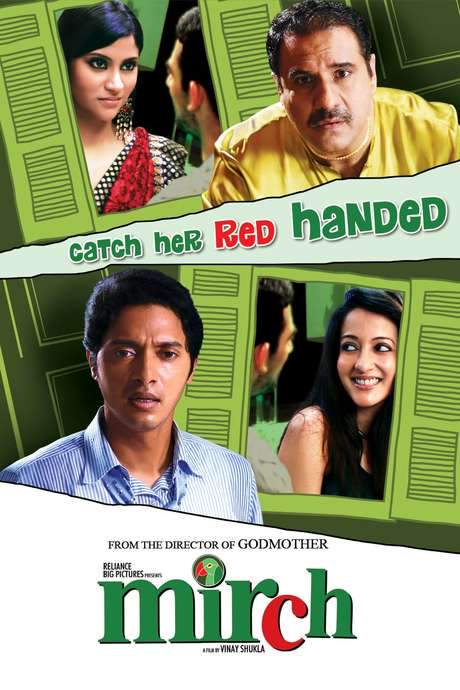
Mirch (2010) movie poster

Timeline

Mirch (2010) Timeline Explained – Every Event in Order

Release, runtime and language
2010 · 117 mins · Hindi
Loading streaming availability…
Directed by
Vinay Shukla
Starring
Shahana Goswami, Sushant Singh, Pitobash, Boman Irani, Saurabh Shukla, Rajpal Yadav

Pure ’adult’erated Fun A story-writer attempts to convince a producer to accept four erotic stories from the Panchtantra.

On this page (5)
  1. 1 Where to watch
  2. 2 Events in order (12)
  3. 3 Timeline questions answered
  4. 4 Movie threads
  5. 5 Every angle
Loading streaming availability…

12 events in order · contains spoilers

Mirch Timeline: Events in Chronological Order

Every key event of Mirch (2010) in order, scene by scene, with when and where it takes place. Use it to untangle flashbacks, time jumps and parallel storylines, to refresh your memory before the sequel or to find the exact scene you are thinking of.

  1. Maanav pitches a bold, frame-based premise to Nitin

    Maanav, a driven filmmaker, presents his bold frame to Nitin while Ruchi coordinates the meeting. He won’t budge on the core idea, and Nitin remains cautious about its box-office appeal. The session sets the project on a path toward a larger, multi-story structure.

    When
    Early development phase
    Where
    Nitin's office
  2. Nitin asks for a longer, more developed version

    Nitin requests a longer, more developed version of the concept to demonstrate its market potential. Maanav accepts the challenge and crafts four interconnected tales that expand the same premise. Ruchi helps shape the pitch as they move toward a formal development phase.

    When
    Pre-production
    Where
    Nitin's office
  3. First tale: Kashi invited to the king's palace

    Set in ancient India, Kashi is invited to work in the king’s palace. His wife Maya loves him fiercely, but he doubts her devotion after a friend’s jokes about her beauty. Maya spins a tale about an astrologer warning of misfortune if she resists, and a prince arrives to play along with the ruse, while Kashi hides to watch from under the bed.

    When
    Ancient era
    Where
    Ancient India: Kashi's home and the king's palace
  4. First tale climax: Maya's ruse unfolds

    Maya’s ruse unfolds around the prince’s claim that a Kshatriya must protect and fulfill his duties. Kashi sits under the bed, torn between stopping the encounter and risking greater misfortune. The scene explores loyalty, fate, and moral ambiguity as the lovers navigate danger.

    When
    Ancient era
    Where
    Ancient India: palace vicinity
  5. Second tale: Lavni's Rajput-era court intrigue

    Second tale shifts to Rajput-era royalty where Lavni, the king’s young wife, schemes to entice a trusted subject, Chandresh. She and her maid Kesara push through a series of near-impossible dares designed to test her resolve. Eventually Chandresh proposes that whatever happens must occur in front of the king, setting the stage for a climactic secret witnessed in the garden.

    When
    Rajput era
    Where
    Rajput-era court and garden
  6. Second tale climax: the king and the cursed illusion

    In the garden, the king secretly witnesses what looks like a forbidden act. Humiliation and fear spread as whispers of possession swirl, and the tree around which the vision centers becomes a symbol of a royal superstition that refuses to die. The king orders a final drastic action, convinced the scene is a cursed illusion.

    When
    Rajput era
    Where
    Royal garden, Rajput palace
  7. Third tale: Manjul's modern Mumbai games begin

    Modern Mumbai tale follows Manjul, who loves testing those around him by disguising as different people. At a party, he pretends to be his own boss and watches his wife Manjula flirt with a visiting executive. He then imitates another man—'Mark'—to probe her loyalty, and the prank fractures their marriage.

    When
    Modern era
    Where
    Party and home in modern Mumbai
  8. Third tale twist: a painter awakens forbidden bond

    One year later, Manjula encounters a painter who admires her, drawing her into a tender, forbidden connection that echoes the earlier tales’ temptations. Manjul discovers her secret, and the past disguises seem to come back to haunt them, reshaping their relationship. The modern thread mirrors the core premise across time.

    When
    One year later
    Where
    Mumbai art scene
  9. Fourth tale: Asu Hotmal and Anita's crisis

    Asu Hotmal and Anita’s crisis unfolds in the fourth tale. On a work trip, Asu seeks cheap thrills and is confronted when Anita arrives disguised as a hooker. Anita uses the deception to expose his missteps and demands jewelry instead of forgiveness, culminating in a tense public reconciliation where money and sentiment collide.

    When
    Modern era
    Where
    Trip and hotel/office settings
  10. Back home: Nitin faces Seema and reconsiders

    Back home, producer Nitin faces his own parallel echo when Seema, his wife, is present. Seema speaks with quiet honesty, helping him realize that some wounds are better left unexamined. The moment ties the personal stakes to the professional narrative.

    When
    Modern era
    Where
    Nitin's office and Seema's environment
  11. Verdict: Ruchi approves the overarching frame

    Ruchi delivers the final verdict: Nitin has approved Maanav’s overarching frame. The group celebrates a project that threads desire, trust, and consequence across time. The four tales are confirmed to be interconnected and to illuminate the central idea.

    When
    Final development stage
    Where
    Meeting room
  12. The four vignettes weave into a single narrative

    As the stories converge, the film’s structure reveals how temptation shifts across eras yet continues to test loyalty and storytelling itself. The framing device ties the four vignettes back to a single core premise, enriching every twist with a shared theme.

    When
    Final stage

Last updated: October 09, 2025 at 16:57

Was this helpful?

Timeline questions answered

Mirch Timeline Explained: Your Questions Answered

When does it happen, and why in that order? The questions people ask about the chronology of Mirch (2010): time jumps, flashbacks, cause and effect between scenes and the correct order of events, each answered with spoilers.

Q1

Why did Maya create the astrologer story in the first tale?

Maya invented the astrologer warning to prevent Kashi from leaving for the palace. When Kashi expressed worry about leaving his beautiful wife behind, Maya used the fictional prophecy as a manipulation tactic, claiming she must be with another man to ward off misfortune. This gave her plausible cover to bring the prince to their home, though her true intentions remain ambiguous: she may have genuinely wanted to be with another man or was simply testing Kashi's trust in her.

  • maya
  • kashi
  • astrologer
  • ancient india tale
  • infidelity test
Q2

What did the king see in the garden during the second tale?

King Nirgun Singh secretly witnessed what appeared to be a forbidden act between his wife Lavni and his trusted courtier Chandresh in the royal garden. The precise details are deliberately obscured, the scene was staged by Chandresh to satisfy Lavni's dares, but whether actual infidelity occurred remains unclear. The king believed he witnessed a cursed illusion or demonic possession rather than reality, and this perceived betrayal drove his extreme response.

Foreshadowing: Earlier, Chandresh set increasingly impossible tasks for Lavni, culminating in the demand that whatever happens must occur in front of the king himself.

  • lavni
  • chandresh
  • king nirgun singh
  • garden scene
  • rajput tale
  • cursed illusion
Q3

Why did Manjul keep disguising himself to test Manjula?

Manjul enjoys testing the truth and loyalty of people around him as a kind of game. At a party, he first impersonated his own boss to observe Manjula's reaction to a flirting executive, then escalated to posing as "Mark," a charming stranger, to probe her fidelity further. His compulsion to test and verify reflects the film's central theme of testing fidelity, though his methods ultimately backfired and created deep rifts in his marriage.

  • manjul
  • manjula
  • disguise
  • mark
  • modern mumbai tale
  • fidelity test
Q4

What was the painter's significance in the third tale?

One year after Manjul's testing games damaged their marriage, Manjula encountered a painter (also played by Arunoday Singh) at an art exhibition who admired her deeply. This created a tender, forbidden connection that mirrored the earlier tales' themes of temptation. When Manjul discovered this secret relationship, it paralleled his own previous disguises, Manjula cryptically暗示ed that his past disguise had "returned to haunt them," suggesting a poetic justice or cyclical nature to the testing of fidelity.

  • manjula
  • painter
  • art
  • forbidden love
  • mirror story
Q5

Why did Anita pretend to be a hooker in the fourth tale?

Anita discovered that Asu Hotmal was seeking extramarital encounters during his work trip. To expose his hypocrisy and test his character, she arrived at the hotel disguised as a hooker. When Asu fell into the trap, Anita used the situation to expose his missteps publicly. Rather than seeking forgiveness, she demanded compensation in jewelry, turning the power dynamic upside down and exposing the underlying hurt beneath her strategic maneuver.

  • anita
  • asu hotmal
  • hooker disguise
  • jewelry compensation
  • modern tale
Q6

How are the four stories connected in Mirch?

All four tales are modern adaptations inspired by Panchatantra stories, sharing the same core premise: a spouse testing their partner's fidelity through elaborate ruses. Each tale is set in a different era (ancient India, Rajput court, two modern settings) but all explore how temptation and deception affect relationships. The framing device shows these stories being pitched by filmmaker Maanav to producer Nitin, with the four vignettes ultimately weaving back into this single narrative frame.

  • four stories
  • panchtantra
  • frame narrative
  • thematic connection
  • interconnected tales
Q7

Why did Nitin approve Maanav's script at the end?

After hearing all four interconnected tales that explored desire, trust, and consequences across different eras, Nitin was impressed by the cohesive premise and its market potential. Ruchi delivered the verdict that Nitin had approved the overarching frame. The stories' unified theme of testing fidelity, presented through the Panchantantra-inspired structure, convinced him the concept had sufficient depth and commercial appeal.

  • nitin
  • maanav
  • ruchi
  • script approval
  • producer
  • final verdict
Q8

What did Seema mean about wounds being better left unexamined?

Seema, Nitin's wife, spoke with quiet honesty about the parallel between the stories Nitin was producing and his own life choices. Her statement suggests that some marital issues, once probed too deeply, cannot be undone and cause more damage than good. This connects to the film's themes of testing fidelity, sometimes the act of investigation itself destroys more than the original transgression would have.

  • seema
  • nitin
  • marriage
  • wounds
  • truth
  • acceptance
Q9

Why did Chandresh set impossible tasks for Lavni?

Chandresh, the king's trusted courtier, designed a series of nearly impossible dares to test Lavni's determination and potentially deter her from pursuing a forbidden connection with him. Each challenge was meant to push her away, yet Lavni's relentless determination pushed through every task. Eventually, Chandresh made one final demand: that whatever unfolds must happen in front of the king himself, setting up the climactic garden scene.

  • chandresh
  • lavni
  • tasks
  • challenges
  • rajput queen
  • test of resolve
Q10

What triggered Kashi's suspicion about Maya?

Kashi's suspicion stemmed from his friend's jokes about his wife's beauty and his own insecurity about leaving her behind while working at the king's palace. Rather than communicating his fears, Kashi secretly hid under the bed to watch what Maya would do when a handsome prince arrived, choosing deception over direct conversation, which set the tragic chain of events in motion.

  • kashi
  • maya
  • suspicion
  • jealousy
  • ancient tale
  • hidden watching
Q11

What was the tree's significance in the Rajput tale?

The tree in the royal garden became the symbolic center of the cursed vision the king witnessed. Surrounding the tree, the ambiguous garden scene played out, and afterward, whispers of possession and supernatural influence circulated. The tree's fate, resulting in a final drastic action ordered by the king, became a symbol of royal superstition that "refused to die," representing how false beliefs can destroy lives.

Foreshadowing: The garden encounter centered around this specific tree location.

  • tree
  • cursed illusion
  • royal garden
  • superstition
  • rajput tale
  • symbolism

Movie threads

More Movies Like Mirch, by Mood & Story

Curated lists built around what makes Mirch tick: the same mood, the same kind of story or the same emotional payoff. Each list explains why these movies belong together.

Anthology films with layered storytelling like Mirch

Films that weave multiple tales together through a central framing device. Explore movies like Mirch that use a story-within-a-story format. If you enjoyed the clever narrative framing of Mirch, you'll appreciate these films, which share a similar complex structure where multiple tales are connected by a central theme or plot device.

  • witty
  • playful
  • complex
  • intellectual
  • self-referential
  • anxious
  • Tone: tense, witty, playful
  • Pacing: variable, shifting
Why these movies?

The story pattern: The narrative pattern involves a primary story that introduces and contextualizes a series of secondary stories. These vignettes are thematically linked, often exploring variations on a central conflict or idea. The journey connects the intellectual puzzle of how the pieces fit together with the emotional arcs within each tale.

Why they belong together: Movies are grouped here based on their shared multi-layered narrative structure. They create a unique viewing experience that is intellectually engaging, as the viewer pieces together the connections between the frame narrative and the embedded stories.

Erotic dramas about trust and temptation like Mirch

Stories where seduction and role-playing test the boundaries of relationships. Find movies similar to Mirch that delve into themes of marital infidelity, temptation, and deception. If you liked the sensual tension and morally ambiguous power games in Mirch, this collection features other dramas with a focus on erotic charge and the complexities of trust.

  • sensual
  • tense
  • erotic
  • morally ambiguous
  • anxious
  • playful
  • Tone: tense, sensual, morally ambiguous
  • Pacing: steady, character driven
Why these movies?

The story pattern: The narrative revolves around characters who willingly or unwillingly enter games of temptation, often to test their own or their partner's boundaries. This leads to a journey filled with tension, suspense, and morally ambiguous choices, where the line between play and reality becomes dangerously blurred.

Why they belong together: These movies share a core focus on the dynamics of trust and deception within intimate relationships, portrayed with a strong sensual or erotic component. The similarity lies in the specific mood of tense anticipation and the exploration of power through seduction.

Every angle

Mirch (2010) Explained: Plot, Timeline & Characters

Everything about Mirch in one place: what happens in the plot summary, the timeline in chronological order, the characters and meaning and a spoiler-free summary. What's After the Movie adds the cast, box office and post-credit scenes.

Coming soon on iOS and Android

The Plot Explained Movie Summary App

Plot summaries, endings explained and timelines on your phone. Catch up on any movie in minutes, save your favorites and never miss a twist again.

Be the first to know when we launch. Your email stays private, always.

Learn more about the app