








Plot Explained Spoilers guaranteed!
Plot Explained

Browse by genre

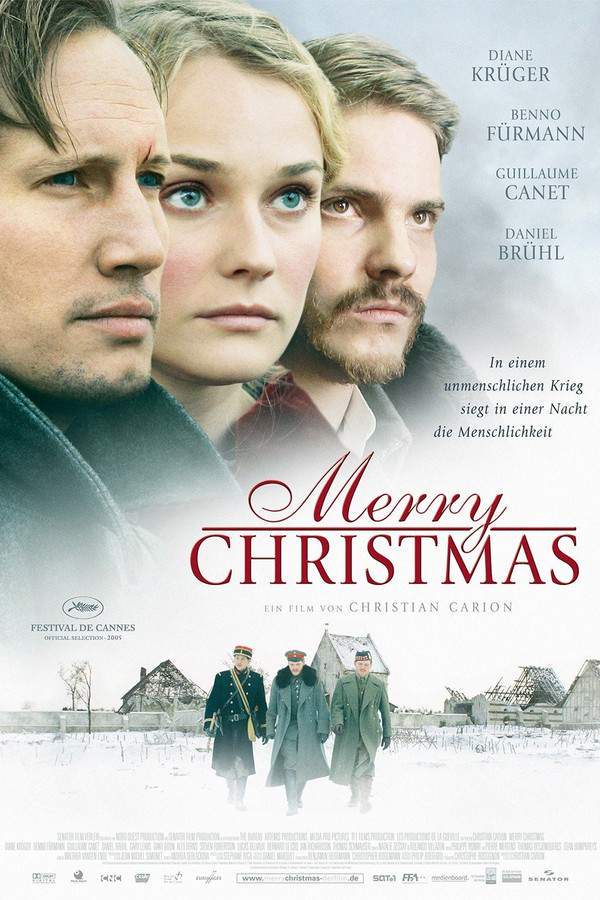
Merry Christmas (2006) movie poster

Timeline

Merry Christmas (2006) Timeline Explained – Every Event in Order

Release, runtime and language
2006 · 116 min · English
Directed by
Christian Carion
Starring
Guillaume Canet, Diane Kruger, Benno Fürmann

During World War I, Christmas Eve brings a temporary and fragile truce between French, Scottish, and German soldiers entrenched in battle. The night becomes a poignant intersection for four individuals: a steadfast priest, a brave lieutenant, a gifted tenor, and his cherished soprano. Amidst the devastation of the trenches, they find an unexpected opportunity for connection, laying down their weapons to share music and experience a moment of shared humanity that transcends the boundaries of war.

On this page (6)
  1. 1 Where to watch
  2. 2 Events in order (15)
  3. 3 Timeline questions answered
  4. 4 Movie threads
  5. 5 Movies like Merry Christmas
  6. 6 Every angle

Where to watch

Where to Watch Merry Christmas (2006)

Where can you watch Merry Christmas? Stream, rent or buy it in the US, including on Fawesome, YouTube Free and Amazon Video: current JustWatch availability with up-to-date prices.

Streaming availability powered by JustWatch

15 events in order · contains spoilers

Merry Christmas Timeline: Events in Chronological Order

Every key event of Merry Christmas (2006) in order, scene by scene, with when and where it takes place. Use it to untangle flashbacks, time jumps and parallel storylines, to refresh your memory before the sequel or to find the exact scene you are thinking of.

  1. Patriotic Orations

    The film begins with schoolboys in Scotland eagerly delivering patriotic speeches that glorify their nations while vilifying their enemies. This fervent display of nationalism sets the tone for the impending war, highlighting the innocence and fervor of youth before the harsh realities of battle ensue.

    Where
    Scotland
  2. Brothers Enlist

    In Scotland, brothers Jonathan and William decide to enlist to fight in the war. They are joined by Father Palmer, who symbolizes the moral and spiritual support, representing the religious motivations behind some soldiers' willingness to fight.

    Where
    Scotland
  3. German Call-Up

    In Germany, Nikolaus Sprink, a renowned tenor, is interrupted during a performance by an official announcing a reserve call-up. This moment foreshadows the imminent dissolution of personal dreams and the encroachment of war on civilian life.

    Where
    Germany
  4. Audebert's Dilemma

    French Lieutenant Audebert reflects on his life as he gazes at a photograph of his pregnant wife left behind in occupied France. This moment of introspection prepares him for the brutal realities he is about to face in the trenches.

    Where
    French trench
  5. Christmas Assault

    As Christmas approaches, Scottish and French forces launch a combined attack against the German trenches. The assault results in devastating losses without changing the course of the war, exemplifying the futility of their efforts.

    Where
    France
  6. Tragic Loss

    During the chaotic retreat, Jonathan is forced to leave his mortally wounded brother William behind in no-man's-land. This harrowing decision marks a turning point that deeply impacts Jonathan's psyche throughout the story.

    Where
    No-man's-land
  7. Audebert's Lost Wallet

    In the chaos of battle, Audebert loses his wallet containing a cherished photo of his wife. This loss becomes symbolic of the personal sacrifices the soldiers are forced to endure amid the horrors of war.

    Where
    German trench
  8. Performance for the Crown Prince

    Anna Sørensen secures permission for a performance for Crown Prince Wilhelm, allowing her partner Sprink to join her. Their shared night before the performance highlights their deep connection even amidst the backdrop of war.

    Where
    Germany
  9. The Christmas Truce

    An unexpected truce unfolds as Scottish soldiers begin singing festive songs, resonating across the lines. As Sprink performs 'Silent Night' and the troops exchange greetings, this moment of humanity cuts through the violence of war.

    Where
    No-man's-land
  10. Sharing Gifts

    During the truce, soldiers from opposing sides exchange gifts such as chocolate and champagne, fostering a connection rarely seen in wartime. This sharing emphasizes the shared humanity even amid fierce conflict.

    Where
    No-man's-land
  11. Father Palmer's Mass

    Father Palmer holds a Latin mass for the soldiers during the truce, instilling a sense of peace and togetherness. The mass leaves an emotional impact on the men, reminding them of their values amid the war's brutality.

    Where
    No-man's-land
  12. Football Match

    On Christmas Day, a spirited football match breaks out among the soldiers, showcasing the camaraderie forged during the truce. This event serves as a joyous reminder of normalcy amidst the absurdity of war.

    Where
    No-man's-land
  13. Return to Trenches

    After the celebratory truce, the soldiers reluctantly return to their respective trenches, facing the grim reality that their brief camaraderie is over. The separation signals the rekindled hostilities dictated by their superiors.

    Where
    Trenches
  14. The Tragic Shooting

    Fueled by vengeance, Jonathan shoots a disguised German soldier, uncovering personal ties that complicate the act of violence. This tragedy underscores the blurring of lines between friend and foe in the chaos of war.

    Where
    No-man's-land
  15. Audebert’s Punishment

    Audebert faces a punitive transfer for his involvement in the truce, clashing with his father, who represents the harsh realities of military life. Their confrontation reveals the chasm between the lived experiences of soldiers and the ideals of those in command.

    Where
    Verdun

Last updated: November 07, 2024 at 23:15

Was this helpful?

Timeline questions answered

Merry Christmas Timeline Explained: Your Questions Answered

When does it happen, and why in that order? The questions people ask about the chronology of Merry Christmas (2006): time jumps, flashbacks, cause and effect between scenes and the correct order of events, each answered with spoilers.

Q1

Why did Jonathan shoot the German soldier during the truce?

Jonathan shot the soldier out of vengeance for his brother William, who was left mortally wounded in no-man's-land during the earlier assault. Believing the figure approaching in the dark was German, Jonathan fired, but the soldier was actually Ponchel, Audebert's French aide disguised in German uniform. This tragic mistake deeply affected Audebert, who learned that Ponchel had visited his mother and that Audebert now had a newborn son named Henri.

Foreshadowing: Jonathan's trauma from being forced to leave his brother behind earlier sets the stage for his violent action.

  • jonathan
  • ponchel
  • shooting
  • vengeance
  • brother
  • william
Q2

Why did Father Palmer remove his cross at the end?

Father Palmer removed his Christian cross after hearing the bishop deliver an anti-German sermon to recruits, labeling Germans as evil and commanding soldiers to kill them. This contradicted the message of peace and shared humanity he had witnessed and participated in during the Christmas truce. Disillusioned by the church's warmongering rhetoric, he walked away from his vocation.

Foreshadowing: Palmer's earlier Latin mass for soldiers of all nations demonstrated his belief in universal brotherhood, making the bishop's sermon antithetical to his experience.

  • father palmer
  • cross
  • church
  • disillusion
  • bishop
  • sermon
Q3

Why did Sprink and Anna ask Audebert to take them prisoner?

After the truce ended and they were caught between the opposing armies with no safe way to return to German lines, Sprink and Anna requested to be taken prisoner by Audebert so they could remain together. Their love transcended national boundaries, and captivity offered them the only possibility of staying united amid the chaos of war.

Foreshadowing: Their earlier decision for Sprink to return to sing for his comrades, despite Anna's initial wariness, established their commitment to each other.

  • sprink
  • anna
  • captivity
  • prisoner
  • love
  • together
Q4

How did the Christmas truce start between the armies?

The truce began when Scottish soldiers started singing festive carols and folk songs from their homeland, with bagpipes accompanying them. The melody carried across no-man's-land and inspired German tenor Nikolaus Sprink to respond by singing "Silent Night." This shared musical moment broke the ice, leading to officers meeting in no-man's-land to formally agree on a temporary ceasefire.

Foreshadowing: Sprink's earlier resentment toward generals living lavishly while soldiers suffered foreshadows his willingness to connect with enemy soldiers through music.

  • christmas
  • truce
  • singing
  • carols
  • silent night
  • sprink
Q5

Why was Lieutenant Audebert punished after the truce?

Audebert was punished with a punitive transfer to Verdun for his participation in the Christmas truce and showing camaraderie with enemy soldiers. His father, a general, attempted to reason with him, but Audebert showed no remorse, expressing contempt for civilians and superiors who speak of sacrifice without experiencing the trench warfare's horrors. He declared he would survive for his newborn son Henri.

Foreshadowing: Audebert's earlier loss of his wallet containing his wife's photo in the German trench, which was returned by Horstmayer, symbolized the human connections that transcended enemy lines.

  • audebert
  • punishment
  • verdun
  • general
  • father
  • transfer
Q6

Why was Horstmayer's unit sent to the Eastern Front?

Horstmayer's German unit received orders from the Crown Prince to deploy to the Eastern Front, denying them the chance to see their families before leaving. This cruel decision came after they had experienced the Christmas truce with enemy soldiers. The Crown Prince also destroyed Horstmayer's harmonica, suggesting he was unworthy of his Iron Cross, despite his service.

Foreshadowing: Horstmayer's earlier act of returning Audebert's lost wallet demonstrated his humanity, making the subsequent harsh treatment by the Crown Prince particularly bitter.

  • horstmayer
  • eastern front
  • crown prince
  • orders
  • harmonica
Q7

What happened to William after Jonathan left him in no-man's-land?

William was left mortally wounded in no-man's-land during the chaotic retreat after the failed Christmas Eve assault. Jonathan was forced to abandon his brother to save himself, which caused Jonathan profound psychological trauma throughout the film. William's death drove Jonathan's emotional detachment during the truce and ultimately led to his act of vengeance against the soldier he mistakenly believed was German.

Foreshadowing: The brothers' enlistment together in Scotland, accompanied by Father Palmer, emphasizes the tragic contrast between their hopeful departure and William's fate.

  • william
  • jonathan
  • brother
  • wounded
  • no-man's-land
  • death
Q8

Why did Audebert lose his wallet in the German trench?

Audebert lost his wallet, containing a photograph of his pregnant wife, during the chaotic combined assault by Scottish and French forces on the German trenches. The battle resulted in heavy casualties on both sides and forced a retreat, during which Audebert's wallet fell from his pocket in the confusion of close-quarters combat.

Foreshadowing: This loss occurs during the same futile assault that leads to William's death, highlighting the personal casualties of war.

  • audebert
  • wallet
  • photo
  • wife
  • trench
  • lost
Q9

Why was Father Palmer sent back to his parish after the truce?

Father Palmer was sent back to his parish in disgrace because his regiment was disbanded as punishment for their involvement in the Christmas truce. Despite the positive impact of his Latin mass on the soldiers, the military authorities viewed the fraternization with enemy forces as insubordination, making an example of the unit.

Foreshadowing: The disbandment reflects the military's rejection of the truce's message of peace, contrasting with the spiritual impact Palmer's mass had on the soldiers.

  • father palmer
  • parish
  • disbanded
  • disgrace
  • truce
Q10

What was the significance of Horstmayer returning Audebert's wallet?

When Horstmayer returned Audebert's lost wallet, it rekindled memories of their pre-war lives and demonstrated that humanity persisted even among enemies. This act of kindness across enemy lines helped forge the connection that led to the broader truce, as soldiers realized their shared humanity beneath the uniforms.

Foreshadowing: Horstmayer, a Jewish German soldier serving the Kaiser, and Audebert, a French lieutenant whose father is a general, represent the arbitrary divisions of war that the wallet return transcended.

  • horstmayer
  • wallet
  • return
  • humanity
  • connection
  • truce
Q11

Why did Sprink decide to return to the front lines after performing for the Crown Prince?

Sprink grew resentful of the German generals who lived lavishly far from the front lines while their soldiers suffered in trenches. After performing for Crown Prince Wilhelm, he resolved to return to sing for his fellow soldiers rather than remain in the comfort of civilian life, demonstrating his solidarity with his comrades.

Foreshadowing: This decision directly leads to Sprink's participation in the Christmas truce, where his singing initiates the ceasefire.

  • sprink
  • generals
  • crown prince
  • resentment
  • front
  • singing
Q12

Why did Jonathan remain detached during the Christmas truce?

Jonathan remained emotionally detached throughout the truce because he was consumed with grief over having to leave his mortally wounded brother William behind in no-man's-land. While other soldiers bonded through music, gifts, and football, Jonathan could not overcome his trauma and sense of loss, which ultimately contributed to his tragic decision to shoot Ponchel.

Foreshadowing: Jonathan's initial patriotic enthusiasm when enlisting with his brother contrasts sharply with his emotional state during the truce.

  • jonathan
  • detached
  • grief
  • brother
  • william
  • truce

Movie threads

More Movies Like Merry Christmas, by Mood & Story

Curated lists built around what makes Merry Christmas tick: the same mood, the same kind of story or the same emotional payoff. Each list explains why these movies belong together.

Movies about wartime humanity and truces like Merry Christmas

Stories where brief truces and shared moments defy the divisions of conflict. Explore films like Merry Christmas that capture the poignant moments of connection and temporary peace amid war. If you were moved by the Christmas truce, these movies explore similar themes of shared humanity, unlikely camaraderie, and the brief respites that defy the logic of conflict.

  • somber
  • hopeful
  • tragic
  • reflective
  • melancholic
  • uplifting
  • Tone: bittersweet, poignant, reflective
  • Pacing: steady, deliberate
Why these movies?

The story pattern: Stories in this thread typically unfold within a high-stakes wartime setting, building towards a pivotal event—a truce, a shared meal, a moment of aid—where animosity is suspended. This event serves as the emotional core, creating a powerful contrast with the inevitable return to violence, resulting in a deeply reflective and bittersweet journey.

Why they belong together: These films are grouped together because they all center on the powerful, emotionally resonant theme of finding humanity in inhumane circumstances. They share a heavy emotional weight, a steady or deliberate pacing that allows the moment of connection to land with impact, and a tone that is fundamentally bittersweet, balancing hope against tragedy.


Bittersweet historical dramas with heavy emotion like Merry Christmas

Emotionally weighty period stories where hope and sorrow are inextricably linked. Discover movies like Merry Christmas that are set against a historical backdrop and deliver a powerful, bittersweet emotional experience. If you appreciated the blend of somber reality and uplifting humanity in this film, you'll find similar stories here that explore grief, loss, and fleeting hope with a steady, impactful pace.

  • poignant
  • somber
  • melancholic
  • reflective
  • tragic
  • hopeful
  • Tone: bittersweet, melancholic, somber
  • Pacing: steady, character-driven
Why these movies?

The story pattern: These narratives are often character-driven, set against a significant historical event. The plot follows individuals grappling with immense external pressures, leading to a climax that offers a moment of profound emotional release or moral clarity. However, this moment exists within the larger, often tragic, context of history, resulting in an ending that acknowledges both loss and the enduring power of human spirit.

Why they belong together: Movies in this thread share a specific emotional recipe: a heavy emotional weight derived from historical authenticity, a steady pacing that allows for deep immersion, and a dominant bittersweet tone that authentically reflects the complexities of the human experience within difficult times. They provide a thoughtful, emotionally resonant viewing experience.

If you liked this

Movies Like Merry Christmas

Similar movies to Merry Christmas: the same genre, themes or kind of story. Each one comes with its own plot summary, timeline and ending explained.

Browse all movie summaries

Every angle

Merry Christmas (2006) Explained: Plot, Timeline & Characters

Everything about Merry Christmas in one place: what happens in the plot summary, the timeline in chronological order, the characters and meaning and a spoiler-free summary. What's After the Movie adds the cast, box office and post-credit scenes.

Coming soon on iOS and Android

The Plot Explained Movie Summary App

Plot summaries, endings explained and timelines on your phone. Catch up on any movie in minutes, save your favorites and never miss a twist again.

Be the first to know when we launch. Your email stays private, always.

Learn more about the app