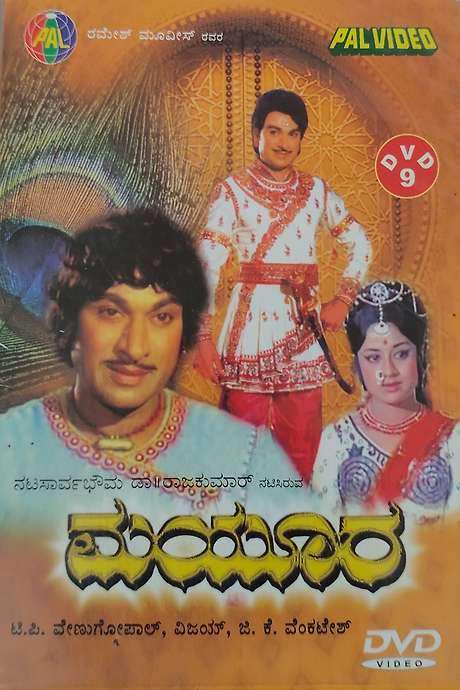
The film opens in Kanchi with Mayura, Dr. Rajkumar a Brahmin youth who dares to challenge an arrogant wrestler and defeats him, despite having learned martial arts only by watching others. Though his path is rooted in the Vedas, his heart beats for combat, and his raw talent soon draws the attention of Ranga Jetti, M. P. Shankar, the city’s premier wrestler, who takes him under his wing and begins a demanding, transformative training regime. Under this rigorous mentorship, Mayura quickly becomes proficient in a wide array of martial arts, blending technique, speed, and strategy in a way that astonishes those who had underestimated him.
During a moment of quiet observation of the Pallava princes, Mayura’s skill surfaces in a clash with Vishnugopa, Vajramuni the Pallava prince, whom he thrashes. This fight sours their relationship and earns Mayura a dangerous enmity from the Pallava camp. To escape retaliation, he flees Kanchi on the counsel of Ranga Jetti, setting off on a journey that will redefine his destiny. Along the way, he learns a startling truth about his lineage: he is the son of Raja Chandravarma, the Kadamba king who was killed through deceit by Sivaskandhavarma, the Pallava sovereign. This revelation—the fusion of noble blood and depleted memory—fuels Mayura’s resolve to throw off foreign dominion and restore his homeland’s honor.
With renewed purpose, Mayura returns to Banavasi, adopting the guise of a merchant named Nilakanthagupta. There, he quickly builds a following and an army, using diplomacy and daring to win hearts and minds. Through calculated campaigns, he expands his reach, conquering Banavasi and the Telugu-speaking regions around Srishaila, thereby laying the groundwork for a broad, powerful kingdom of his own.
As the tale unfolds, the rivalry between Vishnugopa and Mayura intensifies, even as a surprising friendship grows between Mayura and the Pallava crown prince Srinath. At the same time, a tender romance blooms between Mayura and the Pallava princess, Premavati — a bond that adds personal stakes to the political chessboard. The story notably treats these relationships with warmth and nuance, showing how admiration, affection, and respect can coexist with conflict and ambition.
In a final turn of events, Vishnugopa’s anger gradually softens, paving the way for an unexpected union. Mayura and Premavati marry, a union blessed by Sivaskandhavarma, the very king who once stood as a formidable foe. The film closes on a mood of reconciliation and the forging of a lasting alliance, with Mayura’s hard-earned freedom and a kingdom built on a blend of strength, strategy, and shared destinies.