Plot Explained Spoilers guaranteed!
Plot Explained

Browse by genre

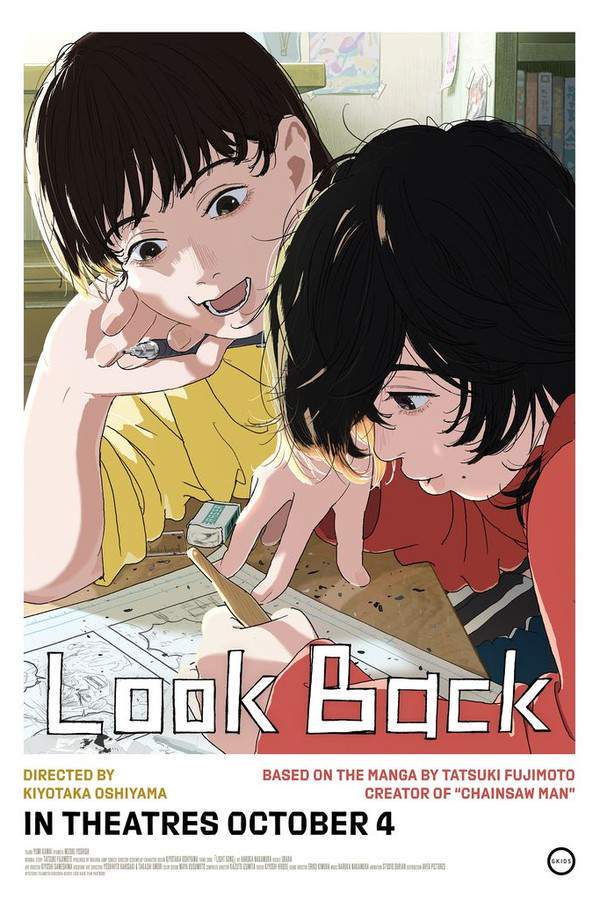
Look Back (2024) movie poster

Plot Summary

Look Back (2024) Plot Summary & Ending Explained

Release, runtime and language
2024 · 58 m · Japanese
Echo score 87
Loading streaming availability…
Directed by
Kiyotaka Oshiyama
Starring
Yumi Kawai, Mizuki Yoshida

A popular artist known for her humorous comics finds herself challenged when her teacher assigns her to work with Kyomoto, a gifted but reserved classmate. Initially rivals, they develop a deeper connection as they explore the unifying power of their shared artistic passion.

On this page (7)
  1. 1 Where to watch
  2. 2 What happens: full plot
  3. 3 Plot questions answered
  4. 4 How it ends
  5. 5 The book behind the movie
  6. 6 Movie threads
  7. 7 Every angle
Loading streaming availability…

Full plot summary · contains spoilers

What Happens in Look Back: Full Plot Summary

The whole story of Look Back (2024) explained, from the opening scene to the final frame: every key event, every twist and what it all adds up to. Read it as a quick recap before the sequel, to check a scene you missed, or to finally understand what really happened.

Ayumu Fujino, portrayed by Yumi Kawai, is a spirited elementary school student who possesses a natural talent for drawing manga. She spends her days publishing yonkoma (four-panel comics) in her school's newspaper, where she deeply enjoys the praise and admiration she receives from both her classmates and her teachers. However, her confidence is shaken when her teacher requests that she share one of her comic strips with Kyomoto, played by Mizuki Yoshida. Kyomoto is a shut-in struggling with severe social anxiety who harbors a secret longing to draw manga herself.

While Fujino initially agrees to the request with some reluctance, she is soon hit with a shocking discovery: Kyomoto is an exceptionally skilled background illustrator. Kyomoto's ability to create intricate, professional-grade scenic artwork far surpasses Fujino's own technical skills. Consumed by an intense feeling of envy and a desperate need to be the best, Fujino becomes obsessed with surpassing Kyomoto. This drive leads her to isolate herself, alienating her family and friends as she pours every waking moment into improving her art. Despite a full year of rigorous effort and visible improvement, Fujino finds that she still cannot meet Kyomoto's high standards. Ultimately, feeling defeated, she gives up on drawing entirely and attempts to rekindle her social life.

Years later, as her class prepares to graduate from middle school, Fujino is given the task of delivering Kyomoto's diploma to her home. Upon entering the house, Fujino discovers stacks of sketchbooks. In a moment of impulsivity, she draws a mocking yonkoma aimed at Kyomoto, but the paper accidentally slips under the door of Kyomoto's room. Though Fujino tries to flee in remorse, Kyomoto emerges from her room. Instead of anger, Kyomoto reveals that she is actually a massive fan of Fujino, having closely followed her work in the school paper all along. Flattered by this sudden idolization, Fujino lies and claims she stopped drawing only because she intends to enter professional contests. This interaction reignites Fujino's creative spark, and she decides to pick up her pen once again.

Throughout high school, the two form a bond, and Fujino invites Kyomoto to collaborate with her. Their joint effort results in a winning contest entry. The two become close friends, and Fujino uses a portion of their prize money to take Kyomoto on a trip around town. They continue creating manga under the collective pen name "Kyo Fujino", earning high praise for their one-shots. Kyomoto expresses deep gratitude to Fujino for providing the motivation she needed to finally step out of her shell. Following graduation, they are offered a serialization deal with Weekly Shōnen Jump, but Kyomoto chooses to decline the offer to pursue a formal art education at the Tohoku University of Art and Design.

Fujino is deeply upset by this decision but continues her career alone, publishing a manga titled Shark Kick under the name Kyo Fujino. While the series becomes a massive success—spanning eleven volumes and receiving an anime adaptation—the adult Fujino feels a void in her life. She feels unfulfilled without Kyomoto's presence, leading her to struggle with a rotating door of assistants.

Tragedy strikes on January 10, 2016, when a man claiming that Tohoku University plagiarized his work carries out a mass murder with a pickaxe. Kyomoto is among the victims. Devastated by the loss, Fujino places Shark Kick on hiatus and returns to her hometown for the funeral. While alone in Kyomoto's house, Fujino is consumed by guilt, convincing herself that she indirectly caused Kyomoto's death by encouraging her to pursue art. In a fit of despair, she tears up the mocking comic she drew years prior. A small scrap of that paper slips under Kyomoto's door and seemingly travels through time to the day the two first met.

In this altered reality, the scrap of paper alarms Kyomoto, preventing her from leaving her room to meet Fujino. Despite this, Kyomoto still pursues her passion for art and attends Tohoku. However, when the killer arrives, this version of Fujino—who pursued athletics instead of art—physically fights and incapacitates the attacker before he can harm Kyomoto. As Fujino is taken away in an ambulance, the two meet for the first time in a manner similar to their original encounter. Back in the original timeline, a gust of wind blows a drawing—titled "Look Back"—from the alternate reality into Fujino's view. The drawing depicts Fujino saving Kyomoto, drawn in Fujino's childhood style.

Shocked, Fujino enters Kyomoto's room and finds a collection of Shark Kick volumes and merchandise, discovering that Kyomoto had spent her life supporting her and voting for her in reader surveys. Overwhelmed by grief and questioning her life choices, Fujino laments that she hates drawing. It is then that she hears Kyomoto's voice asking:

> "Then, why do you draw, Fujino?"

This question triggers a flood of memories of all the joy her art brought to Kyomoto. Finally coming to terms with the tragedy, Fujino decides to return to her work and continue drawing manga, taping Kyomoto's yonkoma above her workstation as a permanent source of inspiration.
Last updated: October 03, 2026 at 14:47

Was this helpful?

Plot questions answered

Look Back Plot Explained: Your Questions Answered

The questions people ask most about Look Back (2024): what happens in the confusing scenes, why the characters do what they do, the twists, hidden details and what the ending means. Each answer contains spoilers.

Q1

Why did Fujino give up drawing after trying to surpass Kyomoto?

In Look Back, Fujino quits drawing because a full year of obsessive practice still isn't enough to match Kyomoto's technical skill as a background illustrator. Consumed by envy after discovering how gifted Kyomoto was, she isolated herself from friends and family to improve, but the gap between them never closed. Defeated by the realization that natural talent and dedication had outpaced her, she chose to step away from manga entirely and rebuild her social life.

Foreshadowing: Fujino's confidence early in the film is built entirely on the praise she receives, leaving her fragile the moment a more skilled peer appears.

  • fujino give up drawing
  • kyomoto rivalry
  • look back manga quit
  • jealousy art
Q2

Why did Kyomoto refuse the Weekly Shōnen Jump serialization deal?

Kyomoto turned down the serialization because she wanted a formal art education at Tohoku University of Art and Design rather than commit to a weekly commercial manga schedule. Her passion had always leaned toward scenic illustration and fine art, and she saw university as the right path to grow those skills. The decision reflects her quiet, deliberate personality, even though it ended the Kyo Fujino partnership.

Foreshadowing: Kyomoto's appreciation for intricate backgrounds over character-driven comedy hints early on that her artistic identity differs from Fujino's.

  • kyomoto decline serialization
  • kyo fujino split
  • tohoku university art
Q3

What does the torn paper slipping under Kyomoto's door mean in Look Back?

When Fujino tears up the mocking yonkoma she had drawn years earlier, a small scrap slides under Kyomoto's door and triggers a time slip that rewinds events to the day the two first met. The scrap acts as a narrative device that opens an alternate timeline where their meeting never happens. It is not explained as a literal mechanism but rather as a story-driven way to explore whether Kyomoto could be saved.

Foreshadowing: The same yonkoma was the object that originally forced Kyomoto to leave her room, making it a natural trigger for the time loop.

  • look back time travel
  • torn paper
  • yonkoma under door
  • alternate timeline
Q4

How does the alternate timeline save Kyomoto from the attack?

In the rewritten timeline, the scrap of paper frightens Kyomoto so much that she never leaves her room to meet Fujino as a child, so the two never become friends. Because Fujino never reconnects with art, she grows up pursuing athletics instead. When the 2016 Tohoku attacker arrives, this athletic version of Fujino is present and physically overpowers him before he can harm Kyomoto. The meeting between them still happens, just under entirely different circumstances.

Foreshadowing: Fujino's childhood energy and stubbornness, traits that earlier drove her art, resurface in the alternate version as physical bravery.

  • alternate timeline look back
  • fujino saves kyomoto
  • tohoku attack 2016
Q5

Why does Fujino blame herself for Kyomoto's death?

Fujino convinces herself that she is the indirect cause of the tragedy because she was the one who encouraged Kyomoto to step out of her shell and pursue art. If Kyomoto had stayed a shut-in or followed a different path, she argues, she would never have enrolled at Tohoku University and would not have been on campus that day. This survivor's guilt spirals into a conviction that her own art and influence are worthless, which is what paralyzes her creatively.

Foreshadowing: Fujino's earlier tendency to take sole credit and blame for their creative output resurfaces here as an exaggerated sense of personal responsibility.

  • fujino guilt
  • survivor guilt look back
  • kyomoto death tohoku
Q6

What does Fujino discover inside Kyomoto's room after her death?

When Fujino finally enters Kyomoto's room, she finds shelves full of Shark Kick tankōbon volumes, merchandise, and evidence that Kyomoto had been voting for her in reader polls for years. The discovery reveals that Kyomoto never stopped admiring her and had quietly supported her career the entire time they were apart. It reframes their relationship from one of separation and drift into one of constant, unseen loyalty.

Foreshadowing: Kyomoto's gratitude at the end of high school, expressed privately, hints that her devotion to Fujino would not fade with distance.

  • shark kick merchandise
  • kyomoto room
  • fujino discovers
  • fan support
Q7

Why does Fujino feel unfulfilled even though Shark Kick is a huge success?

Although Shark Kick runs for eleven volumes and gets an anime adaptation, Fujino feels empty because the work was always meant to be a collaboration with Kyomoto. The pen name Kyo Fujino, the creative rhythm, and the emotional core of the series all originated from their partnership. Without Kyomoto by her side, Fujino cycles through assistants and cannot find a creative companion who understands her the same way, leaving her professionally successful but personally hollow.

Foreshadowing: Even during their high school collaborations, Fujino's motivation was tied less to fame and more to shared joy with Kyomoto.

  • shark kick success
  • fujino loneliness
  • kyo fujino pen name
Q8

What does the title 'Look Back' actually mean?

The title refers both to the yonkoma Kyomoto draws in the alternate timeline and to the emotional act of reflecting on the past. The strip, titled Look Back, shows Fujino saving her and is rendered in Fujino's childhood art style, symbolizing that their connection transcends timelines. On a deeper level, the title captures Fujino's final movement through grief as she stops running from her memories and finally looks back at what she and Kyomoto shared.

Foreshadowing: Fujino's habit of looking back at old sketchbooks and strips throughout the film prepares the audience for the title's meaning.

  • look back meaning
  • title explained
  • kyomoto yonkoma look back
Q9

How did Fujino and Kyomoto first become friends?

The two were never close until middle school graduation, when Fujino was sent to deliver Kyomoto's diploma because Kyomoto, a shut-in, did not attend the ceremony. Inside the house, Fujino impulsively drew a mocking yonkoma that slipped under Kyomoto's door. Instead of being offended, Kyomoto came out and revealed she was a devoted fan of Fujino's school paper comics. That surprise encounter, layered with guilt on Fujino's side and admiration on Kyomoto's, became the foundation of their friendship.

Foreshadowing: The teacher's earlier decision to share Fujino's strip with Kyomoto already established a quiet connection between them before they ever spoke.

  • fujino kyomoto first meeting
  • diploma delivery
  • mocking yonkoma
Q10

Why does Fujino say she hates drawing at the end of the film?

Fujino's declaration that she hates drawing is not literal but an expression of her grief and self-punishment. She has convinced herself that her art led Kyomoto to art school and ultimately to her death, so she wants to reject the very thing that connects her to Kyomoto. The line is a cry of despair rather than a real change of heart, and it sets up Kyomoto's question that finally breaks through her guilt.

Foreshadowing: Fujino's earlier abandonment of drawing at age twelve shows she is capable of turning her back on art when it becomes emotionally painful.

  • fujino hates drawing
  • why do you draw
  • grief denial
Q11

What is the meaning of 'Then, why do you draw, Fujino?'

The line, voiced by Kyomoto as if from memory, is the emotional turning point of Look Back. It cuts through Fujino's self-punishment by reminding her that her art exists independently of the tragedy. The question forces Fujino to remember every moment her comics made Kyomoto smile, restoring the joy that guilt had buried and allowing her to return to drawing with Kyomoto's work as inspiration.

Foreshadowing: Fujino's earliest motivation for drawing was the simple happiness of being praised, a feeling the question reconnects her to.

  • then why do you draw
  • fujino
  • look back ending
  • kyomoto voice
Q12

Why did Fujino lie to Kyomoto about entering professional contests?

Fujino lied on the spot because she was flattered and embarrassed that the girl she had mocked turned out to idolize her. Claiming she had quit drawing to prepare for contests let her preserve her pride and look impressive in front of someone who clearly looked up to her. Ironically, the lie pushed her to actually start drawing again, because pretending she still had ambitions reignited the creative drive she thought she had lost.

Foreshadowing: Fujino's pattern of acting on impulse and improvising her emotions, established in childhood, is what makes the lie feel in character.

  • fujino lie contests
  • kyomoto fan
  • drawing motivation

Ending explained

What Happens at the End of Look Back?

How Look Back (2024) ends, in short: the final scene, the last twist and what it means for the characters. The full ending explained, with every spoiler, lives on its own page.

Read the full ending explained

Look Back concludes with Fujino gradually coming to terms with Kyomoto’s death and learning how to move forward in life. After losing her close friend to a tragic act of violence, Fujino is overwhelmed by grief and despair. In a moment of deep sadness, she visits Kyomoto’s home and finds a comic strip she had drawn when they first became friends. Filled with guilt and sorrow, she tears it up, blaming herself for what happened. As she does, a single panel slips under Kyomoto’s door and somehow travels back in time to when Kyomoto was about to go out and meet Fujino. In the altered timeline, Kyomoto still goes to art school and faces the same dangers, but this time, Fujino arrives just in time to save her from a crazed attacker. Despite her rescue, the two friends are faced with the harsh reality that Kyomoto’s life is still fragile and threatened by the same dangers. However, in this new version of events, Fujino promises to support Kyomoto and even hopes to work with her in the future. Later, Kyomoto draws a comic about Fujino saving her, and this scene is reflected in the original timeline—showing how Fujino’s hope and efforts to change the past helped shape her feelings and memories. In her grief-stricken state, Fujino finds herself in Kyomoto’s room again, realizing that her imagined rescue was a manifestation of her pain. Amidst the chaos, she is reminded of what their friendship truly meant to her—her reason for continuing to create manga. Recognizing that Kyomoto wouldn’t want her to be consumed by sorrow, Fujino decides to return to her work, embracing the hope that she can carry on her friend's legacy. The story ends on a poignant note, with Fujino back at her drawing table, symbolizing her coming to accept the loss and find the strength to move forward. The ending emphasizes that while grief is a powerful force, it shouldn’t define or destroy a life. Instead, through acceptance and remembering loved ones, one can find the courage to go on, even after profound tragedy. This blend of realism and hope gives the story a bittersweet but ultimately uplifting conclusion.

Look Back ending explained in full

Movie threads

More Movies Like Look Back, by Mood & Story

Curated lists built around what makes Look Back tick: the same mood, the same kind of story or the same emotional payoff. Each list explains why these movies belong together.

Movies like Look Back where art becomes a way to grieve

Stories where creating becomes a way to keep the people we have lost alive. These are films for viewers who loved how Look Back treats manga making as an act of mourning. Stories where a creator pours grief into their work and keeps a lost loved one alive through every page, with creativity and sorrow braided together. Great for fans searching for movies like Look Back that blend artistic passion with devastating loss.

  • grief
  • creative passion
  • bittersweet
  • intimate
  • melancholic
  • haunting
  • Tone: bittersweet, melancholic
  • Pacing: variable, character driven
Why these movies?

The story pattern: Films in this thread follow a creator who has lost someone precious to them, often a friend, partner, or mentor whose presence shaped their art. The narrative traces how that absence warps the creative process, sometimes paralyzing the artist, sometimes driving them to pour everything into a single defining work. The journey moves from shared creative joy through grief that stops the art in its tracks, and finally toward a fragile return to making things, with the lost person still echoing through every choice. By the end, the art and the mourner have become inseparable.

Why they belong together: These films share a tone of bittersweet reverence, where creative passion is intertwined with permanent loss. They tend to be quietly devastating, with long stretches of tender intimacy interrupted by sudden tragedy, and where the art form on screen is treated with serious craft. Pacing is variable, emotional weight is heavy, and the ending usually offers a kind of healing that does not erase what was lost.

Movies like Look Back with fractured timelines and survivor's guilt

Stories where grief bends time itself, and the past keeps pulling the present back. If you loved how Look Back uses a time slip to crack open the protagonist's grief and survivor's guilt, these films are for you. They pair heavy emotional weight with complex storytelling, where past and present collide and the narrative mirrors how trauma reshapes memory. Great for fans searching for movies like Look Back with non-linear time.

  • survivor's guilt
  • time slip
  • non-linear
  • haunting
  • grief
  • parallel timelines
  • Tone: melancholic, bittersweet
  • Pacing: variable, non-linear
Why these movies?

The story pattern: Films in this thread follow someone who survived a tragedy that claimed a person they loved, and whose mind keeps reaching back through time, often in literal ways. The narrative braids parallel timelines or slips between past and present, dramatizing the question of whether things could have been different. The protagonist's guilt manifests as obsession, paralysis, or a desperate attempt to rewrite what happened, and the resolution usually arrives not by changing the past, but by finally carrying it forward with clear eyes.

Why they belong together: These films share a heavy emotional register, complex non-linear structures, and a focus on guilt rather than simple grief. The pacing is variable, with quiet stretches interrupted by sudden jumps in time, and the tone is bittersweet or melancholic with weight. They reward patient viewers who appreciate when form and content work together to express trauma, and they tend to offer resolutions that heal without erasing the loss.

Every angle

Look Back (2024) Explained: Plot, Ending, Timeline & Characters

Everything about Look Back in one place: what happens in the plot summary, the timeline in chronological order, the characters and meaning, the ending explained and a spoiler-free summary. What's After the Movie adds the cast, box office and post-credit scenes.

Coming soon on iOS and Android

The Plot Explained Movie Summary App

Plot summaries, endings explained and timelines on your phone. Catch up on any movie in minutes, save your favorites and never miss a twist again.

Be the first to know when we launch. Your email stays private, always.

Learn more about the app