


















Plot Explained Spoilers guaranteed!
Plot Explained

Browse by genre

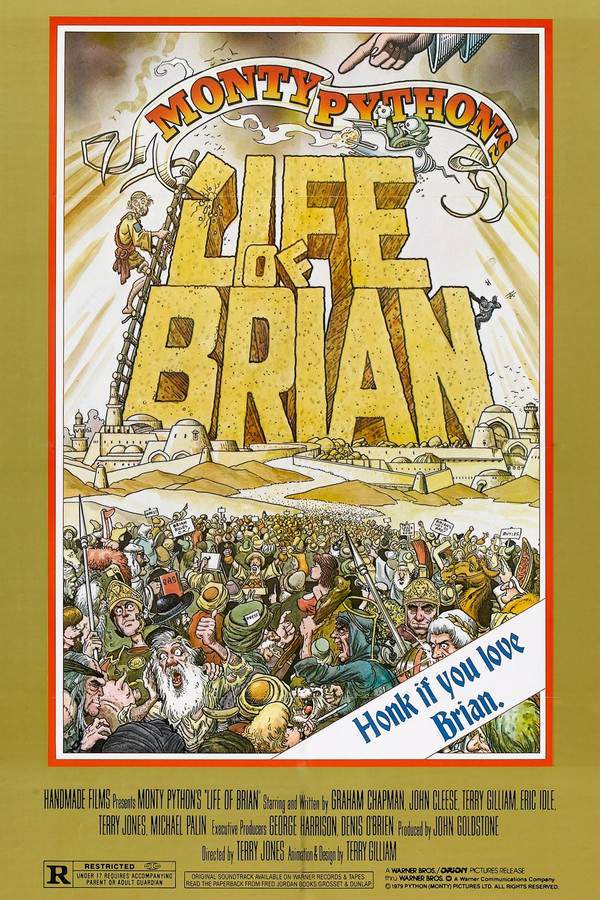
Monty Python's Life of Brian (1979) movie poster

Timeline

Monty Python's Life of Brian (1979) Timeline Explained – Every Event in Order

Release, runtime and language
1979 · 94 min · English
JustWatch #3,217 16
Starring
Eric Idle, Graham Chapman, John Cleese, Michael Palin, Terry Gilliam, Terry Jones

In 33 A.D. Judea, Roman rule clashes with the emergence of numerous messianic figures, creating widespread chaos. Brian Cohen, born in a Bethlehem stable, finds himself caught in a chaotic series of events. Mistaken for the legendary savior, he's pursued by zealous followers, leading to a riotous and satirical examination of religious fervor and mistaken identity. The Monty Python troupe delivers a hilarious and irreverent comedy poking fun at biblical themes and societal beliefs.

On this page (6)
  1. 1 Where to watch
  2. 2 Events in order (15)
  3. 3 Timeline questions answered
  4. 4 Movie threads
  5. 5 Movies like Monty Python's Life of Brian
  6. 6 Every angle

Where to watch

Where to Watch Monty Python's Life of Brian (1979)

Where can you watch Monty Python's Life of Brian? Stream, rent or buy it in the US, including on Amazon Prime Video, fuboTV and Peacock Premium: current JustWatch availability with up-to-date prices.

Streaming availability powered by JustWatch

15 events in order · contains spoilers

Monty Python's Life of Brian Timeline: Events in Chronological Order

Every key event of Monty Python's Life of Brian (1979) in order, scene by scene, with when and where it takes place. Use it to untangle flashbacks, time jumps and parallel storylines, to refresh your memory before the sequel or to find the exact scene you are thinking of.

  1. Birth of Brian Cohen

    Brian Cohen is born in a stable adjacent to the birthplace of Jesus. This leads to a comedic mix-up for the three wise men who mistakenly visit him instead of Jesus.

    When
    4 BC
    Where
    Stable in Judea
  2. Mandy's Upbringing

    Brian's mother, Mandy, raises him with a strong sense of injustice against the Roman occupation. This upbringing shapes Brian into a passionate young man, fueling his desire for rebellion.

    When
    33 AD
    Where
    Judea
  3. Brian's Infatuation

    Brian becomes infatuated with Judith, a rebel, which intensifies his resentment towards the Romans. His feelings are complicated by the revelation that he is half-Roman, stemming from his mother's past.

    When
    33 AD
    Where
    Judea
  4. The Chaotic Stoning

    Brian and Mandy attend a chaotic stoning of a man executed for uttering 'Jehovah.' A priest humorously gets hit by stones for inadvertently uttering the same name during the event.

    When
    33 AD
    Where
    Judea
  5. Joining the People's Front of Judea

    Brian joins the disjointed revolutionaries of the People's Front of Judea, where he meets various eccentric characters. His fervor for rebellion leads him into absurd situations as he tries to rally support.

    When
    33 AD
    Where
    Judea
  6. Misguided Mission

    Brian is tasked with spreading the phrase 'Romans go home' in Latin. His mission backfires when he is caught by a centurion, leading to a humiliating lesson in Latin.

    When
    33 AD
    Where
    Judea
  7. Failed Kidnapping Attempt

    During a failed attempt to kidnap the governor's wife, Brian gets caught in a messy conflict between rebel factions. The chaos highlights the disorganization of the rebel efforts against the Romans.

    When
    33 AD
    Where
    Judea
  8. Unintentional Messianic Role

    Brian's misadventures lead him to become mistaken for a messiah. This culminates in a comedic series of confrontations with the Romans and absurd situations where he gains an unintended following.

    When
    33 AD
    Where
    Bustling plaza in Judea
  9. Crowd's Misguided Worship

    As a crowd starts following Brian, they believe he possesses the secrets to eternal life. Despite his protests, they interpret his messages as doctrine, leading to several humorous scenarios.

    When
    33 AD
    Where
    Outside Brian's mother's house
  10. The People's Front Demands Miracles

    The People's Front of Judea takes advantage of Brian's fame, pushing him to provide miracle cures for their followers. This unexpected turn of events places Brian in a precarious position.

    When
    33 AD
    Where
    Judea
  11. Brian's Crucifixion

    Brian is captured by Roman soldiers and sentenced to crucifixion during Passover. In a comical twist, the crowd’s mocking of Pilate’s speech impediment adds to the absurdity of the situation.

    When
    33 AD
    Where
    Judea
  12. Judith's Plea

    Amidst the chaos, Judith's voice rises above the crowd as she calls for Brian. This leads to the infamous cry of 'Welease Bwian,' showcasing the absurdity of the moment.

    When
    33 AD
    Where
    Judea
  13. Crucifixion Mix-Up

    In a chaotic climax, various crucified individuals mistakenly claim to be Brian, parodying 'Spartacus.' This leads to comedic misidentification, with the wrong person being released.

    When
    33 AD
    Where
    Judea
  14. Hope Amidst Despair

    Just when hope seems lost, a comically dysfunctional suicide squad unexpectedly intervenes, providing Brian with a fleeting moment of hope before facing his fate. The irony of the situation adds to the comedy.

    When
    33 AD
    Where
    Judea
  15. The Final Chorus

    As Brian faces crucifixion, he finds solace among the other condemned men. They join together in singing 'Always Look on the Bright Side of Life,' encapsulating the film's comedic yet poignant spirit.

    When
    33 AD
    Where
    Crosses on a hill

Last updated: November 16, 2024 at 11:24

Was this helpful?

Timeline questions answered

Monty Python's Life of Brian Timeline Explained: Your Questions Answered

When does it happen, and why in that order? The questions people ask about the chronology of Monty Python's Life of Brian (1979): time jumps, flashbacks, cause and effect between scenes and the correct order of events, each answered with spoilers.

Q1

Why was Brian mistaken for the messiah?

Brian becomes mistaken for a messiah through a chain of absurd coincidences. After escaping Roman authorities in the plaza, he accidentally delivers a confused speech while hiding in a crowd, inadvertently sounding prophetic. The desperate, gullible crowd simply latches onto the first person who appears to offer any guidance, blindly interpreting his mundane comments as divine wisdom.

Foreshadowing: Earlier scenes establish thePeople's Front of Judea as incompetent revolutionaries, and the crowd's eagerness to follow any leader foreshadows their blind devotion to Brian.

  • messiah
  • mistaken identity
  • crowd following
  • brian
  • prophet
Q2

Why did the crowd blindly follow Brian?

The crowd follows Brian because they are desperate for spiritual guidance and easily swayed by apparent authority. Despite Brian repeatedly telling them to think for themselves and not to follow him, they twist his words into doctrine and treat his mother as a virgin saint. This satirizes how people project meaning onto vague or random messages when seeking direction.

Foreshadowing: The earlier stoning scene shows crowds enthusiastically participating in mob mentality, establishing this pattern of uncritical following.

  • crowd
  • blind faith
  • following
  • groupthink
  • religion satire
Q3

What is the 'Welease Bwian' scene about?

The 'Welease Bwian' scene occurs during the crucifixion attempt when Judith shouts Brian's name to demand his release. The crowd, mocking Pontius Pilate's speech impediment by mispronouncing 'release' as 'welease' and 'Brian' as 'Bwian,' creates a raucous chant that demands a prisoner release. This forces Pilate to agree to release someone, though not necessarily Brian.

Foreshadowing: The film establishes Pilate's lisp earlier during the 'Death of Brian' scene where the crowd shouts their own names over his, building to this payoff.

  • welease bwian
  • prisoner release
  • pilate
  • judith
  • crowd scene
Q4

Why was Brian sentenced to crucifixion?

Brian is sentenced to crucifixion because the Romans view him as a dangerous insurgent leader who has gathered a large following against Roman rule. The People's Front of Judea, seeing his 'fame' as useful, demands he perform miracles for them. When Brian refuses and tries to escape, the Romans capture him and condemn him as a rebel during Passover, a politically charged time.

Foreshadowing: Brian's earlier activities with the PFJ, including the failed kidnapping and his accidental messiah status, directly lead Roman authorities to target him.

  • crucifixion
  • roman sentence
  • brian
  • captured
  • passover
Q5

Why do other crucified people claim to be Brian?

In the chaotic climax, when the Romans ask which prisoner should be released, multiple crucified individuals each claim to be Brian. This is a direct parody of the scene in 'Spartacus' where the rebel slaves all claim to be Spartacus to protect him. The joke subverts that heroic moment, here, people claim to be Brian not out of solidarity, but because being 'Brian' has become fashionable and attention-worthy, and the crowd cheers them on for it.

Foreshadowing: The film establishes throughout that people are eager to associate with Brian's fame without understanding why, making this absurd group claim consistent with the satire.

  • spartacus
  • claim to be brian
  • mix-up
  • crucified
  • comedy
Q6

What is the People's Front of Judea?

The People's Front of Judea (PFJ) is a disorganized rebel group fighting against Roman occupation. Unlike the other rebel factions (the Judean People's Front, the Judean Popular People's Front), the PFJ is portrayed as ineffective and petty, spending more time arguing amongst themselves about revolutionary semantics than actually fighting the Romans. Brian joins them hoping to make a difference.

Foreshadowing: The various rebel factions are introduced early, with Reg notably complaining about the other groups' names, establishing the PFJ's obsessive focus on branding over action.

  • people's front of Judea
  • rebel group
  • reg
  • revolutionaries
  • satire
Q7

Why is Brian half-Roman?

Brian discovers he is half-Roman after his mother Mandy reveals that she was once assaulted by a Roman centurion. This traumatic past explains why Brian resents Roman occupation despite his Jewish heritage. The revelation complicates his identity and his place in the rebellion against the very people who victimized his mother.

Foreshadowing: Mandy's strong sense of injustice and her particularly vocal hatred of Romans hints at personal trauma underlying her worldview.

  • brian
  • half-roman
  • mandy
  • centurion
  • origin
Q8

What is the Latin grammar lesson scene about?

Brian is tasked by Reg to write 'Romans go home' in Latin on a wall. He writes 'Romans go home' as three separate words instead of the proper Latin phrase 'Romani ite domum.' When a centurion catches him, Brian's nonsensical Latin results in the centurion forcing him to stand there all night memorizing the correct grammar. It satirizes incompetent rebels who half-understand their causes and the strict attention to trivial details by authorities.

Foreshadowing: This scene establishes Brian's ineffectiveness as a revolutionary and his tendency to fail at even simple tasks.

  • latin
  • grammar
  • centurion
  • mission failed
  • romani ite domum
Q9

What is the meaning of 'Always Look on the Bright Side of Life' ending?

The film ends with Brian and the other condemned prisoners singing 'Always Look on the Bright Side of Life' while crucified. This darkly comic moment encapsulates the film's tone, finding humor and optimism even in dire circumstances. Despite facing execution, the characters choose collective joy over despair, making the ending both bittersweet and defiantly cheerful.

Foreshadowing: The film's consistently absurdist tone and the characters' ability to find humor in grim situations prepare viewers for this defiant musical finale.

  • always look on the bright side of life
  • ending
  • song
  • crucifixion
  • finale
Q10

Why does the ex-leper resent Jesus?

The ex-leper, cured by Jesus, resents him because losing his leprosy meant losing his livelihood as a beggar. With his disease gone, he can no longer rely on public sympathy for income. This absurd grievance exemplifies the film's satirical approach, finding comedy in unlikely sources of resentment and poking fun at religious narratives.

Foreshadowing: This brief scene establishes the film's willingness to mock various figures and motivations, from religious leaders to ordinary people.

  • ex-leper
  • jesus
  • cured
  • beggar
  • resentment

Movie threads

More Movies Like Monty Python's Life of Brian, by Mood & Story

Curated lists built around what makes Monty Python's Life of Brian tick: the same mood, the same kind of story or the same emotional payoff. Each list explains why these movies belong together.

Irreverent historical satire like Monty Python's Life of Brian

Absurd comedies that gleefully mock authority and sacred institutions. If you enjoyed Life of Brian's hilarious takedown of religious fervor, you'll love these movies. This collection features similar comedies that satirize history, challenge authority, and poke fun at sacred cows with sharp wit and absurd situations.

  • satirical
  • irreverent
  • absurd
  • witty
  • defiant
  • farci-cal
  • Tone: whimsical, irreverent, satirical
  • Pacing: fast, chaotic
Why these movies?

The story pattern: These narratives often follow an ordinary person who becomes accidentally entangled in a system of belief or power, exposing its hypocrisies through a series of chaotic and comedic misunderstandings. The plots are driven by mistaken identities, ideological clashes, and the sheer folly of human institutions.

Why they belong together: Movies in this thread share a defiantly irreverent tone, using fast-paced, farcical humor to satirize serious subjects. They balance sharp social commentary with a light emotional touch, resulting in comedies that are thought-provoking without being heavy.

Bittersweet absurdist comedies like Monty Python's Life of Brian

Stories where hilarious chaos meets a touch of poignant reality. Fans of Life of Brian's unique blend of riotous farce and its famously uplifting yet bittersweet ending will find more to love here. These movies deliver big laughs while embracing a poignant, thoughtful, or surprisingly hopeful resolution.

  • bittersweet
  • absurd
  • witty
  • uplifting
  • farci-cal
  • thoughtful
  • Tone: whimsical, bittersweet, uplifting
  • Pacing: fast, energetic
Why these movies?

The story pattern: The journey is typically fast-paced and chaotic, filled with absurd situations and witty dialogue. However, the narrative arc leads to an ending that acknowledges the sadness or difficulty of the situation, often undercutting it with a defiantly optimistic or ironic twist that provides emotional resonance.

Why they belong together: These films are grouped by their unique tonal balance: they are fundamentally hilarious and lighthearted, yet they possess an emotional intelligence that allows for a bittersweet or thoughtful conclusion without diminishing the comedic experience.

If you liked this

Movies Like Monty Python's Life of Brian

Similar movies to Monty Python's Life of Brian: the same genre, themes or kind of story. Each one comes with its own plot summary, timeline and ending explained.

Browse all movie summaries

Every angle

Monty Python's Life of Brian (1979) Explained: Plot, Timeline & Characters

Everything about Monty Python's Life of Brian in one place: what happens in the plot summary, the timeline in chronological order, the characters and meaning and a spoiler-free summary. What's After the Movie adds the cast, box office and post-credit scenes.

Coming soon on iOS and Android

The Plot Explained Movie Summary App

Plot summaries, endings explained and timelines on your phone. Catch up on any movie in minutes, save your favorites and never miss a twist again.

Be the first to know when we launch. Your email stays private, always.

Learn more about the app