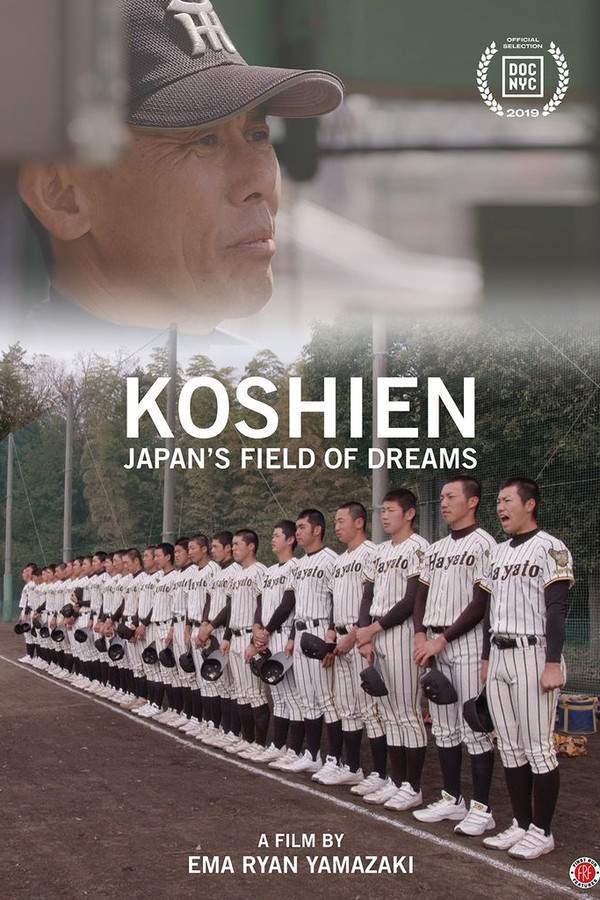
Koshien: Japan's Field of Dreams is a documentary that dives into the deep cultural weight of Japan's National High School Baseball Championship, known simply as Koshien. The film opens with Tetsuya Mizutani, the steadfast manager of Yokohama Hayato High School in Kanagawa, stepping onto the field to announce his roster for the upcoming prefectural tournament and delivering a stern lecture to his players about the twin duties of performance and behavior. The opening montage then unfurls a sense of Koshien’s grandeur, weaving in clips of later-famous players who once wore high school uniforms, including Shohei Ohtani and Yusei Kikuchi, to remind viewers that today’s legends often begin as ambitious teenagers chasing a shared dream.
As the cameras follow Mizutani at work, the film paints a portrait of a coach whose philosophy is rooted in tradition. Baseball, for him, is a discipline built on relentless hard work, meticulous training, and a clear hierarchy where direction comes from the top down. He lectures his players with a steady, uncompromising tone, and punitive measures are depicted as a routine part of striving for excellence. Though he concedes that his approach is old-fashioned, he has no intention of softening his methods. Under his watch, the Hayato crew absorbs the same rigid rules—weight requirements, exhaustive practice, and a culture of self-policing—shaping not only their on-field performances but also their sense of team identity, to the point that players sometimes train each other to mirror their manager’s standards.
Away from the diamond, Mizutani’s devotion bleeds into his home life. His wife explains that he is rarely present in the evenings or on weekends because coaching duties swallow him whole, even as he serves as vice-principal of the school during the day. The strain of this life extends to his family, including his son Kosho Mizutani, who is about to begin high school. Rather than following in his father’s exact footsteps, Kosho sets his sights on Higashi Hanamaki High School in Iwate Prefecture, suggesting a tension between tradition and personal aspiration that threads through the documentary. The film gently raises questions about how a single-minded pursuit of success might shape generations of young athletes and the people who love them.
Across town, the Hanamaki High School program finds its own counterpoint in the figure of manager Hiroshi Sasaki. Sasaki previously coached Hayato and is connected to the same legendary year that produced players who later reached the professional ranks, including Yusei Kikuchi and Shohei Ohtani. Sasaki’s philosophy is presented through a different lens than Mizutani’s: he views his job as a gardener tending young plants—offering support and setting boundaries, while allowing each player to grow into his own strengths. He is shown embracing modern tools, even smartphones, to help his students refine their batting form, balancing the heritage of the sport with the advantages of contemporary coaching techniques. He openly admits that he cannot claim sole credit for Ohtani’s development and expresses concern about how past decisions may have stifled other talents before them. The juxtaposition of Sasaki’s quieter confidence with Mizutani’s more punitive rigidity underscores two distinct paths toward success in the same sport.
Interwoven throughout the film are vivid sequences that capture the texture of Japanese life—speeding trains, gloves and shoes neatly lined up, crowds queuing for a ride or a game, and a culture of respectful bowing and restraint. Some footage is modern, others archival, creating a tapestry that reminds viewers that Koshien sits at the crossroads of enduring tradition and evolving society. Against this backdrop, Mizutani speaks at length about his own childhood, offering glimpses of a life shaped by Tokushima, the prefecture that inspired his early dreams of victory in the national tournament. The narrative also follows a crucial moment when Hayato suffers a tough loss, a blowout marred by errors, and Mizutani confronts his captain about the team’s failures—emphasizing the traits of effort, confidence, and leadership that he believes were lacking in that game.
Meanwhile, Hanamaki’s players pulse with a different energy. Under Sasaki’s watch, their training atmosphere is electric; they envision triumph at the prefectural level and practice their post-win celebrations with a joy that contrasts Mizutani’s stern, almost ritualistic approach. When the time comes for their own prefectural game, the film watches as they secure a hard-fought victory and celebrate in a way that signals a shift toward a new generation of discipline and self-expression. The moment is tender and ceremonial: the team hoists their manager triumphantly, a ritual echoing the tradition of Japanese baseball, and Mizutani, on a separate line, phones Sasaki to offer congratulations. He watches Hanamaki from afar, a mix of pride and envy coloring his gaze as he contemplates what might have been under different circumstances for his own squad. The documentary alternates between the cheering crowds and the solemn finality of extra innings, culminating in a broader sweep of Koshien tournaments still unfolding across the country.
As the film nears its close, both men—Mizutani and Sasaki—are shown at the threshold of renewal. Mizutani reflects on the need to temper his severity and to reach closer to his players, recognizing that even a hard-won discipline can coexist with empathy. He rides a bicycle, listening to something on his headphones, and softens in his expressions, suggesting a readiness to adapt without abandoning core principles. Sasaki, too, appears more open to flexibility—announcing a loosening of strict rules, like crew-cut requirements—while reaffirming a steadfast commitment to disciplined play and to preserving the valuable parts of baseball tradition. The film thus closes on a note of hopeful transition: two managers at the start of a new season, guiding a fresh crop of students toward future opportunities, each searching for a balance between heritage and growth, and between personal and collective dreams.
In the end, Koshien: Japan's Field of Dreams invites audiences to witness more than a sport. It presents a meditation on mentorship, sacrifice, and the ways communities rally around a shared dream. It is a portrait of how coaching philosophies shape young athletes, how personal lives press against professional demands, and how the ritual of competition—whether in a tournament's 100th year or in a quiet, ordinary practice—continues to redefine what it means to strive, to fail, and to persevere.