Plot Explained Spoilers guaranteed!
Plot Explained

Browse by genre

Joy (2015) movie poster

Ending Explained

Joy (2015) Ending Explained – Final Scene & Meaning

Release, runtime and language
2015 · 124 min · English
Loading streaming availability…
Directed by
David O. Russell
Starring
Robert De Niro, Bradley Cooper, Jennifer Lawrence, Virginia Madsen, Édgar Ramírez, Dascha Polanco
Budget
$60M

A driven and resourceful businesswoman recounts her tumultuous journey to build a thriving home shopping service. The story explores her complex relationship with her family, revealing past betrayals and the struggles she faced while forging alliances and navigating cutthroat business deals. Through love, loss, and unwavering determination, she rises to become a formidable force and ultimately defines her own success.

On this page (7)
  1. 1 Where to watch
  2. 2 What happens at the end
  3. 3 Final events in order
  4. 4 Ending questions answered
  5. 5 Movie threads
  6. 6 Movies like Joy
  7. 7 Every angle
Loading streaming availability…

Ending explained · contains spoilers

What Happens at the End of Joy?

How Joy (2015) ends, what the final scene means, which earlier moments set it up and how to read the ending if the film leaves it open. The full ending explained, with every spoiler.

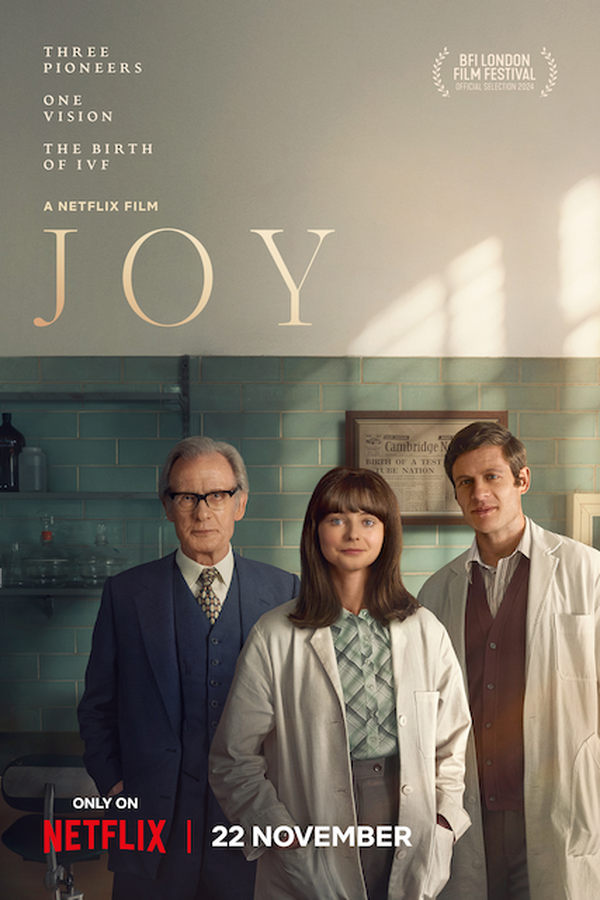
In the end, "Joy" reveals that despite the many setbacks, the groundbreaking IVF experiments led to the birth of Louise Brown in 1978, marking a historic milestone in reproductive science. The film concludes with the triumphant moment when the first baby born via IVF is finally delivered, a healthy girl named Louise. Her birth symbolizes hope and perseverance, made possible by the dedicated efforts of Jean Purdy, Bob Edwards, and Patrick Steptoe, who faced societal opposition and personal struggles along the way. Sadly, Jean, a key figure in this achievement, passed away from cancer in 1985 before receiving the recognition she deserved, including the Nobel Prize, which is not awarded posthumously. Nevertheless, her contributions were ultimately acknowledged, and today, these pioneers are celebrated for fundamentally changing countless lives. The film underscores the importance of perseverance, scientific innovation, and the quiet, often unrecognized heroism of those who push boundaries to bring hope to millions. The final moments leave viewers inspired by the realization that what once seemed impossible has become a normal part of modern life, and Jean’s legacy lives on in every child born through IVF.

Last updated: June 25, 2025 at 08:44

Was this helpful?

The last 4 events

How Joy Ends: The Final Events in Order

The last events of Joy (2015) in chronological order, the run-up to the ending explained above. The complete timeline has all 15 events, scene by scene.

Open the full timeline
  1. Confronting Manufacturing Issues

    Joy's dedication leads her to California to address discrepancies with the manufacturer. Here, she uncovers fraud that threatens her business, pushing her to take decisive action to regain control over her empire.

    Where
    California
  2. Reclaiming Control

    With her persistence, Joy navigates through legal and financial issues to reclaim her molds and secure necessary funds. This victory is pivotal, allowing her to move forward with her business ambitions.

  3. Becoming a Successful Inventor

    Joy’s perseverance culminates in her becoming a prolific inventor, holding over 100 patents. Despite ongoing family tensions, she rises to take charge of her life, inspiring others with her story of resilience.

  4. Inspiring the Next Generation

    Even as Joy continues to face familial disputes, she commits to mentoring other aspiring inventors. Her journey from struggle to success serves as an inspiration to those around her, forging a legacy of innovation and determination.

Ending questions answered

Joy Ending: Your Questions Answered

The questions people ask most about the ending of Joy (2015): what the final scene means, how the twist works, what happens to each character and how to read the ending. Each answer contains spoilers.

Q1

Why was Louise Brown's birth considered a historic milestone?

Louise Brown's birth in 1978 marked the first time a baby was successfully conceived and born through in vitro fertilization (IVF), a groundbreaking reproductive technology that had never before resulted in a living child. Her birth proved that IVF could work, opening doors for millions of couples worldwide who struggled with infertility. The film portrays this moment as the culmination of years of scientific experimentation, personal sacrifice, and determination against overwhelming odds.

  • louise brown
  • first ivf baby
  • 1978
  • historic birth
  • reproductive science
Q2

What happened to Jean Purdy after the IVF breakthrough?

Jean Purdy, who was instrumental in developing the IVF technique and helping create Louise Brown, passed away from cancer in 1985. She never received the Nobel Prize, which is not awarded posthumously, despite her crucial contributions to the breakthrough. The film highlights this as a tragic oversight, noting that her work was eventually acknowledged and today she is celebrated alongside Bob Edwards and Patrick Steptoe as pioneers who changed countless lives.

  • jean purdy death
  • 1985
  • cancer
  • ivf pioneer
  • recognition
Q3

Why didn't Jean Purdy receive the Nobel Prize?

Jean Purdy did not receive the Nobel Prize because the prize is not awarded posthumously, and she died in 1985. Additionally, the Nobel Prize in Physiology or Medicine was awarded in 2010 to Robert Edwards and Patrick Steptoe for their work on IVF, but not to Jean Purdy, who had already passed away. The film portrays this as an example of how scientific contributions often go unrecognized, especially for women in science during that era.

  • nobel prize
  • not awarded posthumously
  • jean purdy
  • ivf recognition
Q4

What is the message of the ending regarding perseverance?

The ending conveys that perseverance in the face of extreme adversity can lead to world-changing achievements. Despite financial pressure, family betrayals, professional setbacks, and societal opposition, the team continued their work. Their determination resulted in a breakthrough that has since helped millions of families. The film suggests that quiet, often unrecognized heroism, like Jean Purdy's, is essential to scientific progress.

  • perseverance
  • scientific innovation
  • determination
  • legacy
  • heroism
Q5

How did the first IVF baby's birth impact future reproductive medicine?

Louise Brown's birth demonstrated that IVF was a viable fertility treatment, paving the way for decades of advancement in reproductive medicine. Since 1978, millions of children have been born through IVF and related technologies. The ending shows how what was once considered impossible has become a normal part of modern life, with the film emphasizing that this transformation began with a small team working against tremendous odds.

  • ivf technology
  • reproductive medicine
  • millions of births
  • medical breakthrough
Q6

Why is the ending considered a triumphant moment in the film?

The ending is triumphant because it shows the successful birth of Louise Brown after years of failed experiments, personal struggles, and opposition from the scientific community and society. The film portrays the moment of her delivery as the payoff for all the sacrifices made by Jean Purdy, Bob Edwards, and Patrick Steptoe. Their perseverance ultimately led to a breakthrough that has given hope to millions of infertile couples worldwide.

  • triumph
  • birth scene
  • delivery
  • success
  • breakthrough
Q7

What is Jean Purdy's legacy according to the film?

Jean Purdy's legacy, as portrayed in the film, is that of a pioneering scientist whose work fundamentally changed reproductive medicine but who died before receiving full recognition. The ending emphasizes that her contributions live on in every child born through IVF. She is now celebrated as one of the three founding mothers of IVF, alongside Edwards and Steptoe, though she achieved this recognition posthumously.

  • legacy
  • jean purdy
  • pioneer
  • ivf children
  • contributions
Q8

How does the ending inspire viewers?

The ending inspires viewers by showing that seemingly impossible challenges can be overcome through persistence and innovation. The film leaves viewers with a sense of hope by demonstrating that one person's determination can create lasting change that benefits millions. The final message emphasizes that what once seemed like science fiction is now everyday reality, encouraging viewers to pursue their own seemingly impossible goals.

  • inspiration
  • hope
  • impossible dreams
  • perseverance
  • change lives

Movie threads

More Movies Like Joy, by Mood & Story

Curated lists built around what makes Joy tick: the same mood, the same kind of story or the same emotional payoff. Each list explains why these movies belong together.

Inspiring business biopics like Joy

True stories of determined underdogs building empires from scratch. If you were inspired by Joy's journey, you'll enjoy these other movies about real-life entrepreneurs. Discover similar stories of female founders and self-made businesspeople who faced financial hardship and industry resistance to achieve their dreams.

  • inspiring
  • determined
  • frustrating
  • triumphant
  • dramatic
  • tense
  • Tone: hopeful, determined
  • Pacing: steady, methodical
Why these movies?

The story pattern: The narrative follows a predictable but satisfying arc: an innovative idea is met with skepticism, followed by a grueling period of trial and error, fraught with financial insecurity and complex personal relationships. The climax is a hard-fought breakthrough that validates the protagonist's vision and resilience.

Why they belong together: These films are grouped by their shared focus on the biographical entrepreneurial journey. They blend medium emotional weight with a hopeful tone, creating an experience that is both frustrating in its depiction of obstacles and ultimately triumphant.

Movies about complex family dynamics like Joy

Protagonists whose greatest challenge and strength is their own family. Fans of Joy's portrayal of a complicated family will appreciate these other dramas. Explore stories where family relationships are a source of both conflict and strength, driving the protagonist's journey through love, betrayal, and perseverance.

  • dramatic
  • frustrating
  • tense
  • heartfelt
  • complex relationships
  • betrayal
  • Tone: dramatic, hopeful
  • Pacing: steady, character-driven
Why these movies?

The story pattern: The central conflict is not just external but internal, playing out within the home. The protagonist's ambition is constantly tested by familial obligations, past grievances, and betrayals from those closest to them. Success is achieved not in spite of the family, but by redefining their place within it.

Why they belong together: This thread connects movies where family is a primary source of both drama and motivation. They share a moderate complexity from intertwining personal and professional plots, a steady pacing that balances domestic scenes with external ambition, and a medium emotional weight from relational tensions.

If you liked this

Movies Like Joy

Similar movies to Joy: the same genre, themes or kind of story. Each one comes with its own plot summary, timeline and ending explained.

Browse all movie summaries

Every angle

Joy (2015) Explained: Plot, Ending, Timeline & Characters

Everything about Joy in one place: what happens in the plot summary, the timeline in chronological order, the characters and meaning, the ending explained and a spoiler-free summary. What's After the Movie adds the cast, box office and post-credit scenes.

Coming soon on iOS and Android

The Plot Explained Movie Summary App

Plot summaries, endings explained and timelines on your phone. Catch up on any movie in minutes, save your favorites and never miss a twist again.

Be the first to know when we launch. Your email stays private, always.

Learn more about the app