Plot Explained Spoilers guaranteed!
Plot Explained

Browse by genre

Joy (2015) movie poster

Plot Summary

Joy (2015) Plot Summary & Ending Explained

Release, runtime and language
2015 · 124 min · English
JustWatch #18,623 11
Directed by
David O. Russell
Starring
Robert De Niro, Bradley Cooper, Jennifer Lawrence, Virginia Madsen, Édgar Ramírez, Dascha Polanco
Budget
$60M

A driven and resourceful businesswoman recounts her tumultuous journey to build a thriving home shopping service. The story explores her complex relationship with her family, revealing past betrayals and the struggles she faced while forging alliances and navigating cutthroat business deals. Through love, loss, and unwavering determination, she rises to become a formidable force and ultimately defines her own success.

On this page (7)
  1. 1 Where to watch
  2. 2 What happens: full plot
  3. 3 Plot questions answered
  4. 4 How it ends
  5. 5 Movie threads
  6. 6 Movies like Joy
  7. 7 Every angle

Where to watch

Where to Watch Joy (2015)

Where can you watch Joy? Stream, rent or buy it in the US, including on Amazon Video, Apple TV Store and Fandango At Home: current JustWatch availability with up-to-date prices.

Streaming availability powered by JustWatch

Full plot summary · contains spoilers

What Happens in Joy: Full Plot Summary

The whole story of Joy (2015) explained, from the opening scene to the final frame: every key event, every twist and what it all adds up to. Read it as a quick recap before the sequel, to check a scene you missed, or to finally understand what really happened.

In 1989, Joy Mangano (Jennifer Lawrence), a divorced mother of two, struggles to make ends meet while working as a booking clerk at Eastern Airlines. She shares a cramped house in Quogue, New York, with her two young children, her mother Terri (Virginia Madsen), her grandmother Mimi (Diane Ladd), and her ex-husband Tony (Édgar Ramírez). The dynamic is tense, as Joy's father Rudy (Robert De Niro) and mother are divorced and can’t seem to be in the same room without erupting into conflict. Adding to her woes, Joy faces constant societal pressures from her overachieving half-sister Peggy (Elisabeth Rohm), who embarrasses Joy in front of her kids.

While Terri spends her days indulging in soap operas, leaving Joy to juggle household chores, only Mimi and Joy’s best friend Jackie (Dascha Polanco) truly encourage Joy's ambitions as an inventor. Despite having shown creative potential from a young age, Joy feels trapped in her chaotic family life and longs for independence. As a child, she had even designed a dog collar and a flea collar, but lacked the guidance to pursue patents.

The household is overly dependent on Joy’s meager contributions, with Rudy managing a garage that Joy assists with financially, while Peggy lends a hand in the business too. The situation grows more complicated as Tony, a former singer, shares the basement with Rudy. Initially drawn to Tony's dreamer persona, Joy soon finds herself overwhelmed as they welcome two children into a life where Tony proves to be often absent and intoxicated, leading to their eventual divorce.

As if the situation couldn’t worsen, after divorcing his third wife, Joy's father begins dating Trudy (Isabella Rossellini), a wealthy widow with business acumen. During a trip on Trudy's boat, a mishap with a glass of red wine results in Joy injuring her hands—a pivotal moment that sparks the inspiration for a self-wringing mop. With the help of staff at her father's garage, she advances her prototype and persuades Trudy to invest in this product, setting the stage for her entrepreneurial journey.

However, Peggy, ever the skeptical sister, questions Joy’s business acumen, arguing that her own decade of experience in the garage makes her more competent. Yet, Trudy connects Joy with a patent attorney who uncovers a potential legal quagmire involving a similar mop design owned by a company in Hong Kong. To thwart a possible lawsuit, Joy pays a hefty sum in royalties, but the ensuing chaos only intensifies when manufacturing flaws lead to increased bills.

Joy struggles to gain traction for her product as retailers resist carrying it, preferring to offer less reliable mops that necessitate repeat purchases. After a humiliating attempt to showcase her invention outside K-Mart, she is motivated to seek a new advertising avenue.

Through Tony's connections, she meets Neil Walker (Bradley Cooper), an executive at QVC. Impressed by her vision, Neil convinces her to manufacture 50,000 mops. To finance this production, Joy takes out a second mortgage on her home, despite the prior failures of infomercials. When the first TV spot flops, Joy pleads with Neil for another chance, emphasizing her precarious financial position. Fortunately, Joy’s television debut turns her product into a sensational success, aided by Jackie’s timely call during her broadcast that helps her regain her composure.

As Joy’s fortunes begin to shift, her grandmother’s sudden death and ensuing complications with family dynamics threaten to derail her progress. Peggy escalates the financial drama by paying unauthorized charges to the manufacturer, putting Joy's business at risk. Frustrated, Joy travels to California to confront the manufacturing contractor about the discrepancies and discovers fraudulent activities that have plagued her dealings from the start.

With tenacity, Joy navigates through the tangled web of contracts, ultimately reclaiming her molds and securing funds that validate her rights. The culmination of her struggles leads her to ample success as she becomes a prolific inventor with a portfolio of over 100 patents. In the end, even if family tensions remain—particularly as Rudy and Peggy contest her ownership of the company—Joy rises to champion her own narrative, helping to inspire future generations of inventors, including a young mother she mentors.

Last updated: November 04, 2024 at 00:20

Was this helpful?

Plot questions answered

Joy Plot Explained: Your Questions Answered

The questions people ask most about Joy (2015): what happens in the confusing scenes, why the characters do what they do, the twists, hidden details and what the ending means. Each answer contains spoilers.

Q1

How did Joy get the idea for her self-wringing mop?

Joy got the idea for the self-wringing mop during a trip on her father Rudy's girlfriend Trudy's boat in 1989. When a glass of red wine spilled, Joy injured her hands while trying to wring out a rag. This mishap inspired her to design a mop that could be wrung out without using her hands, making household cleaning easier.

  • self-wringing mop invention
  • Joy Mangano
  • origin story
  • household invention
Q2

Why did Trudy decide to invest in Joy's invention?

Trudy, a wealthy widow with business acumen, decided to invest in Joy's mop after being impressed by her determination and prototype. Despite skepticism from Joy's sister Peggy, Trudy saw potential in Joy's invention and became her first investor, helping her advance from concept to product.

  • Trudy investment
  • Joy Mangano funding
  • first investor
  • entrepreneurial start
Q3

Why was Joy's sister Peggy so opposed to her business venture?

Peggy opposed Joy's business venture because she believed her own decade of experience working in the family garage made her more competent to run a business. Peggy's skepticism stemmed from jealousy and a desire to protect the family from what she saw as financial recklessness, though her actions often undermine Joy rather than genuinely help.

  • Peggy Joy sister
  • family conflict
  • business opposition
  • jealousy
Q4

What legal challenges did Joy face with her mop invention?

Joy faced a legal challenge when a patent attorney discovered a similar mop design owned by a company in Hong Kong. To avoid a potential lawsuit, Joy was forced to pay a hefty sum in royalties, creating significant financial strain on her already precarious business.

  • patent lawsuit
  • Hong Kong
  • royalties
  • legal battle
  • invention protection
Q5

How did Joy get her product onto QVC?

Joy got her product onto QVC through her ex-husband Tony's connections, who introduced her to Neil Walker, an executive at QVC. After a humiliating attempt to showcase her invention outside K-Mart, Neil agreed to give Joy a chance after being impressed by her vision and persistence, convincing her to manufacture 50,000 mops.

  • QVC
  • Neil Walker
  • TV shopping
  • infomercial
  • Bradley Cooper character
Q6

What went wrong with Joy's first TV infomercial?

Joy's first TV infomercial for the mop was a flop, failing to generate sales. Despite taking a huge financial risk by taking out a second mortgage on her home to finance production, the initial advertising approach did not resonate with viewers, putting her in a precarious financial position.

  • infomercial failure
  • TV ad
  • financial risk
  • first attempt
  • marketing struggle
Q7

What fraud did Joy uncover at the manufacturing plant in California?

When Joy traveled to California to confront the manufacturer about discrepancies, she discovered fraudulent activities that had been plaguing her business dealings from the start. This discovery revealed why her costs were higher than expected and threatened her entire operation.

  • California manufacturer
  • fraud
  • counterfeit
  • production issues
  • quality control
Q8

How did Joy reclaim control of her company?

Joy reclaimed control of her company by persistently navigating through tangled contracts and legal issues. She traveled to California, confronted the fraudulent manufacturer, and successfully reclaimed her molds while securing funds that validated her rights as the true owner of her invention and business.

  • reclaim molds
  • legal victory
  • ownership
  • business control
  • perseverance
Q9

What was the turning point that made Joy's mop a success?

The turning point came during Joy's live QVC television debut. After a rocky start, her best friend Jackie called during the broadcast, helping Joy regain her composure and confidence. This authentic, passionate presentation resonated with viewers and transformed her product into a sensational success.

  • QVC success
  • TV debut
  • Jackie call
  • breakthrough
  • live broadcast
Q10

How did Joy's grandmother Mimi's death affect her journey?

Joy's grandmother Mimi, who had been one of her biggest supporters believing in her inventiveness since childhood, suddenly died while Joy's career was beginning to flourish. This loss deeply impacted Joy emotionally and intensified family tensions, particularly her ongoing conflict with Peggy, complicating her path to success.

  • Mimi death
  • family loss
  • emotional impact
  • grandmother support
  • tragedy
Q11

How did Joy become a successful inventor despite all obstacles?

Joy became a successful inventor through relentless determination despite constant financial pressure, family betrayals, and professional setbacks. She overcame legal challenges, manufacturing fraud, and retail resistance to eventually hold over 100 patents, building a thriving home shopping empire and defining her own success on her own terms.

  • 100 patents
  • success
  • perseverance
  • inventor
  • entrepreneurship
  • legacy

Ending explained

What Happens at the End of Joy?

How Joy (2015) ends, in short: the final scene, the last twist and what it means for the characters. The full ending explained, with every spoiler, lives on its own page.

Read the full ending explained

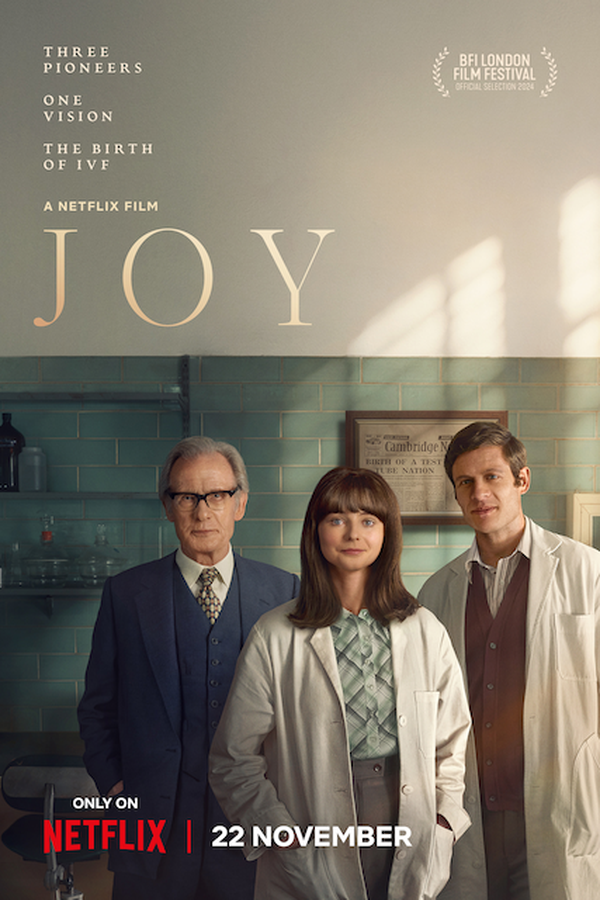
In the end, "Joy" reveals that despite the many setbacks, the groundbreaking IVF experiments led to the birth of Louise Brown in 1978, marking a historic milestone in reproductive science. The film concludes with the triumphant moment when the first baby born via IVF is finally delivered, a healthy girl named Louise. Her birth symbolizes hope and perseverance, made possible by the dedicated efforts of Jean Purdy, Bob Edwards, and Patrick Steptoe, who faced societal opposition and personal struggles along the way. Sadly, Jean, a key figure in this achievement, passed away from cancer in 1985 before receiving the recognition she deserved, including the Nobel Prize, which is not awarded posthumously. Nevertheless, her contributions were ultimately acknowledged, and today, these pioneers are celebrated for fundamentally changing countless lives. The film underscores the importance of perseverance, scientific innovation, and the quiet, often unrecognized heroism of those who push boundaries to bring hope to millions. The final moments leave viewers inspired by the realization that what once seemed impossible has become a normal part of modern life, and Jean’s legacy lives on in every child born through IVF.

Joy ending explained in full

Movie threads

More Movies Like Joy, by Mood & Story

Curated lists built around what makes Joy tick: the same mood, the same kind of story or the same emotional payoff. Each list explains why these movies belong together.

Inspiring business biopics like Joy

True stories of determined underdogs building empires from scratch. If you were inspired by Joy's journey, you'll enjoy these other movies about real-life entrepreneurs. Discover similar stories of female founders and self-made businesspeople who faced financial hardship and industry resistance to achieve their dreams.

  • inspiring
  • determined
  • frustrating
  • triumphant
  • dramatic
  • tense
  • Tone: hopeful, determined
  • Pacing: steady, methodical
Why these movies?

The story pattern: The narrative follows a predictable but satisfying arc: an innovative idea is met with skepticism, followed by a grueling period of trial and error, fraught with financial insecurity and complex personal relationships. The climax is a hard-fought breakthrough that validates the protagonist's vision and resilience.

Why they belong together: These films are grouped by their shared focus on the biographical entrepreneurial journey. They blend medium emotional weight with a hopeful tone, creating an experience that is both frustrating in its depiction of obstacles and ultimately triumphant.

Movies about complex family dynamics like Joy

Protagonists whose greatest challenge and strength is their own family. Fans of Joy's portrayal of a complicated family will appreciate these other dramas. Explore stories where family relationships are a source of both conflict and strength, driving the protagonist's journey through love, betrayal, and perseverance.

  • dramatic
  • frustrating
  • tense
  • heartfelt
  • complex relationships
  • betrayal
  • Tone: dramatic, hopeful
  • Pacing: steady, character-driven
Why these movies?

The story pattern: The central conflict is not just external but internal, playing out within the home. The protagonist's ambition is constantly tested by familial obligations, past grievances, and betrayals from those closest to them. Success is achieved not in spite of the family, but by redefining their place within it.

Why they belong together: This thread connects movies where family is a primary source of both drama and motivation. They share a moderate complexity from intertwining personal and professional plots, a steady pacing that balances domestic scenes with external ambition, and a medium emotional weight from relational tensions.

If you liked this

Movies Like Joy

Similar movies to Joy: the same genre, themes or kind of story. Each one comes with its own plot summary, timeline and ending explained.

Browse all movie summaries

Every angle

Joy (2015) Explained: Plot, Ending, Timeline & Characters

Everything about Joy in one place: what happens in the plot summary, the timeline in chronological order, the characters and meaning, the ending explained and a spoiler-free summary. What's After the Movie adds the cast, box office and post-credit scenes.

Coming soon on iOS and Android

The Plot Explained Movie Summary App

Plot summaries, endings explained and timelines on your phone. Catch up on any movie in minutes, save your favorites and never miss a twist again.

Be the first to know when we launch. Your email stays private, always.

Learn more about the app