






Plot Explained Spoilers guaranteed!
Plot Explained

Browse by genre

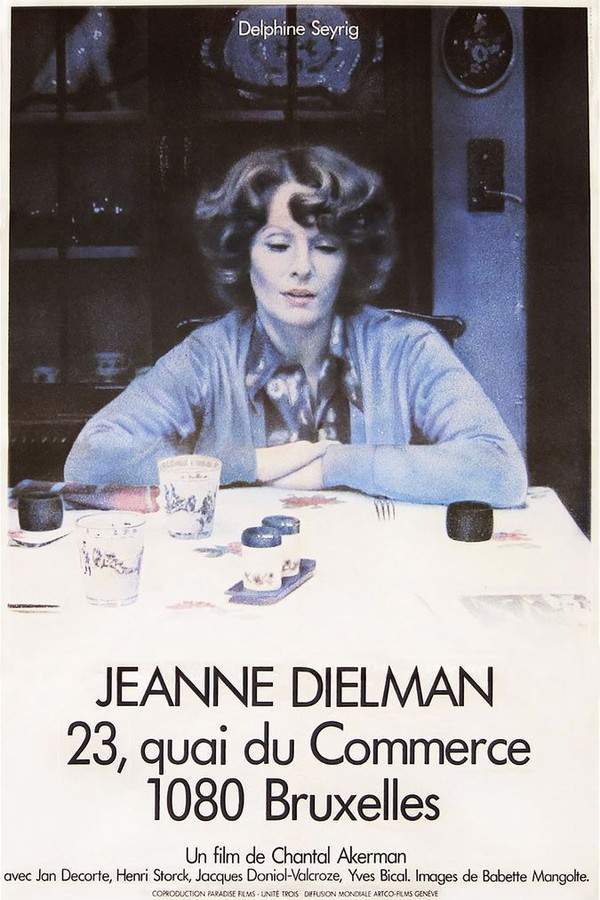
Jeanne Dielman, 23, quai du commerce, 1080 Bruxelles (1978) movie poster

Timeline

Jeanne Dielman, 23, quai du commerce, 1080 Bruxelles (1978) Timeline Explained – Every Event in Order

Release, runtime and language
1978 · 202 min · French
JustWatch #1,788 26
Starring
Chantal Akerman, Delphine Seyrig, Henri Storck, Jacques Doniol-Valcroze, Jan Decorte, Yves Bical

In 1970s Brussels, the widowed Jeanne Dielman meticulously maintains a strict routine of housework and occasional prostitution to survive. Her days are a precise sequence of domestic tasks, but this fragile balance is threatened when unexpected events disrupt her carefully planned life. As the rhythms of her existence are challenged, Jeanne's composure begins to unravel, leading to a profound and unsettling confrontation with her circumstances.

On this page (6)
  1. 1 Where to watch
  2. 2 Events in order (12)
  3. 3 Timeline questions answered
  4. 4 Movie threads
  5. 5 Categories
  6. 6 Every angle

Where to watch

Where to Watch Jeanne Dielman, 23, quai du commerce, 1080 Bruxelles (1978)

Where can you watch Jeanne Dielman, 23, quai du commerce, 1080 Bruxelles? Stream, rent or buy it in the US, including on HBO Max, Amazon Video and Apple TV Store: current JustWatch availability with up-to-date prices.

Streaming availability powered by JustWatch

12 events in order · contains spoilers

Jeanne Dielman, 23, quai du commerce, 1080 Bruxelles Timeline: Events in Chronological Order

Every key event of Jeanne Dielman, 23, quai du commerce, 1080 Bruxelles (1978) in order, scene by scene, with when and where it takes place. Use it to untangle flashbacks, time jumps and parallel storylines, to refresh your memory before the sequel or to find the exact scene you are thinking of.

  1. Introduction to Jeanne's Life

    The film opens by introducing Jeanne Dielman, a widowed mother whose life is steeped in routine. Her days consist of repetitive tasks such as cooking, cleaning, and caring for her son, encapsulating the struggle of a single parent juggling responsibilities.

  2. Daily Errands and Routine

    For three consecutive days, Jeanne meticulously carries out her daily errands, ensuring that her home is organized and her son is well cared for. This structure represents her attempt to maintain control in her life amidst the chaos of widowhood.

  3. Engaging in Prostitution

    To supplement her income, Jeanne engages in sexual encounters with a different client each afternoon. She accomplishes this just before her son returns from school, blending her work into the seams of her otherwise monotonous day.

  4. The First Day Encounter

    The first day progresses without incident, maintaining the facade of Jeanne's routine. However, this normalcy is punctuated by the underlying tension of her secret life, which she shields from her son.

  5. Signs of Disarray Begin to Emerge

    On the second day, after an encounter with a client, surprising changes occur in Jeanne's behavior. She starts to exhibit signs of forgetfulness, such as overcooking dinner and failing to complete basic tasks, hinting at her internal turmoil.

  6. Increased Forgetfulness

    As the day progresses, Jeanne's forgetfulness escalates in alarming ways. She forgets to put lids on jars, leaves lights on, and even neglects her appearance, showing a slip from her previously pristine self.

  7. Climactic Third Day

    The third day marks a pivotal point for Jeanne, as she prepares for her client with an anxious energy. The routine she clings to begins to unravel dramatically, reflecting her growing instability.

  8. Conflict of Emotions During Encounter

    During the encounter with her final client, Jeanne grapples with conflicting emotions of pleasure and disgust. This internal struggle culminates in a moment of violent realization as she confronts her feelings towards her life choices.

  9. The Act of Violence

    In an unexpected turn of events, Jeanne brandishes scissors and violently stabs her client. This shocking act not only signifies a breaking point for her but also serves as a stark commentary on the depths of her despair.

  10. Silent Reflection

    After committing the murder, Jeanne retreats to her dining room table in silence. Her stillness prompts a haunting reflection on her decisions, leaving both her and the audience in a state of contemplation about the nature of her existence.

  11. Life After the Incident

    In the aftermath of the violent encounter, Jeanne’s life is irrevocably changed. The stark contrast between her previous routine and her new reality showcases the complexity of her character and her circumstances.

  12. Questioning Choices

    The film concludes with an open-ended question about Jeanne's choices and the life she had constructed. It challenges the audience to reflect on the implications of her actions and the societal structures surrounding her.

Last updated: November 16, 2024 at 18:46

Was this helpful?

Timeline questions answered

Jeanne Dielman, 23, quai du commerce, 1080 Bruxelles Timeline Explained: Your Questions Answered

When does it happen, and why in that order? The questions people ask about the chronology of Jeanne Dielman, 23, quai du commerce, 1080 Bruxelles (1978): time jumps, flashbacks, cause and effect between scenes and the correct order of events, each answered with spoilers.

Q1

Why does Jeanne turn to prostitution to earn money?

Jeanne is a widowed mother struggling to survive and support her son on her own. Her income from running the household is insufficient, so she supplements it by seeing clients each afternoon. For Jeanne, this is purely a financial transaction woven into her daily routine, a pragmatic, mechanical way to make ends meet rather than something driven by desire.

Foreshadowing: The film hints at her financial strain early on through her meticulous tracking of earnings in an urn.

  • prostitution
  • survival
  • widow
  • finances
  • income
Q2

Why does Jeanne's routine start falling apart?

After her encounter with a client on the second day, Jeanne experiences something that disrupts her emotional equilibrium, possibly an unfamiliar physical response or a moment of self-recognition. This internal disturbance manifests externally through small mistakes: overcooked potatoes, forgotten lids, leaving lights on. These lapses represent her carefully controlled facade beginning to crack under the weight of suppressed feelings.

Foreshadowing: The first day passes without incident, establishing the pattern that will be disrupted.

  • routine
  • breakdown
  • forgetfulness
  • psychology
  • disruption
Q3

Why does Jeanne kill her client?

During her final encounter, Jeanne experiences a confusing mix of sensations, possibly an orgasm or a profound wave of disgust at her own existence. This moment of reckoning with her life triggers an extreme reaction. She stabs the client with scissors, but the murder seems less about him specifically and more about her violent rejection of the life she has been living. It is the breaking point of years of suppression and emotional numbness.

Foreshadowing: Her escalating mistakes throughout the second and third days signal her growing internal turmoil.

  • murder
  • scissors
  • violence
  • breakdown
  • climax
Q4

What does Jeanne feel during her final sexual encounter?

The film deliberately leaves this ambiguous. Jeanne appears to experience either an orgasm or a wave of intense disgust, possibly both simultaneously. This confusion is central: she cannot distinguish between pleasure and self-loathing, or perhaps she feels them at once. This moment of physical sensation breaks through her emotional numbness, leading to the violent act that follows.

Foreshadowing: Her earlier encounters are shown as mechanical and emotionless, making this response stand out as unprecedented.

  • orgasm
  • disgust
  • feelings
  • sensation
  • confusion
Q5

What do Jeanne's small mistakes like overcooking potatoes represent?

Jeanne's domestic tasks are the foundation of her identity and control. When she overcooks the potatoes, forgets to put lids on containers, and leaves lights on, these are not mere oversights, they symbolize her psychological disintegration. Her routine is the structure that holds her world together; as it crumbles, so does her grip on normalcy.

Foreshadowing: These mistakes begin only after her second-day encounter, connecting them to her internal disturbance.

  • symbolism
  • routine
  • domestic
  • breakdown
  • control
Q6

What happens at the end of the film?

After stabbing her client to death, Jeanne calmly sits at her dining room table in silence. She remains motionless for a long time, neither expressing guilt nor relief. The ending leaves her fate uncertain, will she call the police, will she be discovered? The final image is of her sitting in eerie stillness, implying that her act has freed her from her routine but also trapped her in an unknowable new reality.

Foreshadowing: The murder represents the culmination of her three-day psychological unraveling.

  • ending
  • silence
  • murder
  • aftermath
  • stillness
Q7

Why is the film so slow and repetitive?

The deliberate pacing mirrors Jeanne's daily routine and the suffocating nature of her existence. By showing every mundane task in real time, the audience experiences the crushing weight of repetition she lives with. The slowness builds psychological tension, viewers begin to feel the pressure she feels, making the eventual rupture more impactful.

Foreshadowing: The repetitive structure establishes the normalcy that will be disrupted.

  • pacing
  • repetition
  • cinematography
  • slow
  • routine
Q8

Why does the title include Jeanne's full address?

The title 'Jeanne Dielman, 23, quai du Commerce, 1080 Bruxelles' functions like an address label or bureaucratic record, reducing a woman's life to an address and postal code. This reflects how society views women like Jeanne, as anonymous figures defined by their domestic location rather than as complex individuals. It emphasizes her isolation and the transactional nature of her existence.

  • title
  • address
  • symbolism
  • identity
  • bureaucracy
Q9

Why does Jeanne hide her prostitution from her son?

Jeanne maintains a strict separation between her maternal role and her work, seeing them as incompatible. She performs her afternoon encounters quickly and mechanically, just before her son returns from school, ensuring he never discovers her secret. This duality represents the facade she maintains, that she is simply a devoted mother, while her survival depends on hidden labor.

Foreshadowing: The timing of her clients (just before her son returns) is carefully calculated.

  • son
  • secret
  • hiding
  • motherhood
  • duality
Q10

What are the main themes of the film?

The film explores themes of alienation, monotony, and the psychological cost of survival. Jeanne lives in quiet desperation, trapped by routine and economic necessity. Her violence is not random but the explosive result of suppressed identity, bodily autonomy, and the dehumanizing nature of her work. The film critiques societal structures that leave women with impossible choices.

  • themes
  • alienation
  • survival
  • women
  • routine
Q11

Why does Jeanne sit in silence after the murder?

Jeanne's silence after killing her client represents a complete psychological shutdown. She has acted on an impulse that breaks her routine entirely, and now faces an unknowable future. The stillness also suggests a kind of freedom, the pressure valve has released, but at what cost? The open-ended silence invites viewers to interpret whether she feels regret, relief, or simply emptiness.

Foreshadowing: The murder itself is sudden and reactive, not planned.

  • silence
  • aftermath
  • psychology
  • interpretation
  • stillness

Movie threads

More Movies Like Jeanne Dielman, 23, quai du commerce, 1080 Bruxelles, by Mood & Story

Curated lists built around what makes Jeanne Dielman, 23, quai du commerce, 1080 Bruxelles tick: the same mood, the same kind of story or the same emotional payoff. Each list explains why these movies belong together.

Movies about rigid routines and psychological collapse like Jeanne Dielman, 23, quai du commerce, 1080 Bruxelles

Stories where a rigid routine cracks under pressure, revealing chaos within. If you appreciated the meticulous breakdown of routine in Jeanne Dielman, this thread features other films where characters' carefully constructed worlds disintegrate. These movies share a focus on domestic or personal order, psychological tension, and a slow burn narrative leading to a bleak or violent conclusion.

  • methodical
  • unsettling
  • tense
  • oppressive
  • psychological
  • claustrophobic
  • Tone: dark, unsettling
  • Pacing: slow, deliberate
Why these movies?

The story pattern: The narrative pattern follows a character defined by extreme control over their environment, often as a coping mechanism. An external event or internal flaw disrupts their system, causing small, accumulating errors that escalate into a full-blown psychological breakdown. The journey is less about external conflict and more about the internal collapse of a carefully maintained facade.

Why they belong together: Movies are grouped here based on their shared focus on the psychology of routine, the build-up of oppressive tension through repetition, and the theme of control versus chaos. They are united by a slow, observational pace that allows the viewer to feel the crushing weight of the character's existence before its downfall.


Slow burn dramas of female isolation and domestic life like Jeanne Dielman, 23, quai du commerce, 1080 Bruxelles

Gritty, intimate portraits of isolation and quiet desperation within the home. For viewers who were captivated by the intimate and oppressive portrayal of a woman's life in Jeanne Dielman, this section finds similar movies. These films feature strong female leads, a focus on the minutiae of domestic routine, and a slow build of tension within a confined setting, often culminating in a powerful emotional release.

  • lonely
  • quiet
  • oppressive
  • realist
  • female-centric
  • melancholic
  • Tone: bleak, heavy
  • Pacing: slow, observational
Why these movies?

The story pattern: Stories in this thread are often linear and straightforward, prioritizing atmosphere and character study over complex plotting. They unfold in real-time or over a short period, emphasizing the cyclical nature of domestic labor and the invisible struggles of their protagonists. The conflict arises from the tension between societal expectations, personal desires, and the isolating nature of the home itself.

Why they belong together: These films are connected by their shared aesthetic of realism, their focus on the female experience within domestic spheres, and their use of slow pacing to convey emotional depth. They create a powerful sense of place and mood, making the viewer feel the character's isolation and the weight of their circumstances.

Categories

Movie Lists Featuring Jeanne Dielman, 23, quai du commerce, 1080 Bruxelles

Jeanne Dielman, 23, quai du commerce, 1080 Bruxelles appears in these hand-built movie categories. Each one groups movies by a specific mood, theme or story type, with their plot summaries and endings explained.

View all movie categories

Every angle

Jeanne Dielman, 23, quai du commerce, 1080 Bruxelles (1978) Explained: Plot, Timeline & Characters

Everything about Jeanne Dielman, 23, quai du commerce, 1080 Bruxelles in one place: what happens in the plot summary, the timeline in chronological order, the characters and meaning and a spoiler-free summary. What's After the Movie adds the cast, box office and post-credit scenes.

Coming soon on iOS and Android

The Plot Explained Movie Summary App

Plot summaries, endings explained and timelines on your phone. Catch up on any movie in minutes, save your favorites and never miss a twist again.

Be the first to know when we launch. Your email stays private, always.

Learn more about the app