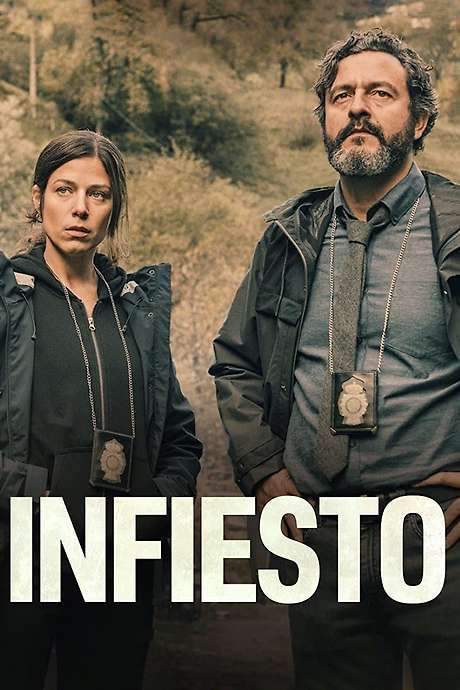
A young woman named Saioa is found walking along a rural road in Spain, dirtied and battered, before collapsing in a parking lot. She is identified as a missing person who disappeared three months earlier, and the country is just beginning to slide into a COVID-19 lockdown. In this tense climate, the case falls to two Federal police officers, the capable and wary Inspector Samuel Garcia and the steadfast Subinspectora Castro, who must navigate the investigation with remarkably little external support as the pandemic strains every resource.
Saioa’s mother, Julie, rushes to the hospital where her daughter lies unconscious. The family’s anxiety is intensified by the shadow of a troubled past—Saioa’s stepfather, who had left Julie the day before Saioa vanished, becomes a suspect in the early phase of inquiries, but he is soon ruled out after thorough questioning. As Saioa awakens briefly, her therapist Paz tries to shield her from further questioning to protect her fragile recovery—an approach that complicates the detectives’ attempts to extract usable information.
The only solid lead emerges from a driver who recalls seeing a young woman at a lonely rural intersection. The two investigators comb the area and uncover an old, abandoned building near that intersection. Inside, they encounter a tense scene: a young woman and a man who bolts from the doorway. Inspector Samuel Garcia is able to subdue the man, but the encounter proves to be a false alarm—the duo turns out to be pot-growing hippies, and these oddball inhabitants are dismissed as irrelevant to Saioa’s case.
The investigation takes a darker turn when another woman reports an attempted kidnapping by a notorious felon known as “The Dog Killer,” a local figure who lives just off the road near the intersection. The detectives follow the trail to the Dog Killer’s property, where they discover a makeshift bed in a barn. The intruder returns, but the Dog Killer is not alone—and the bed is explained away by a claim that it is used by his cousin whom he hunts with. The detectives depart, only to learn that Saioa’s abduction appears linked to something more sinister when traces of sand, a byproduct of wine production, are found on Saioa and match barrels they find in the barn.
A return to the Dog Killer’s home yields a shock: he has fled, and in the barn they discover a hidden chamber that contains evidence of captivity. A roadblock nets the Dog Killer, but he takes his own life, uttering the chilling line, “It’s only the beginning.” The investigation pivots toward the Dog Killer’s cousin, the hunting partner they described, who reveals that the real danger lies with a conspiratorial friend known as “The Demon,” a figure with deep psychological issues. At the Demon's trailer, Subinspectora Castro and Inspector Samuel Garcia narrowly escape a deadly booby-trap explosion and uncover photographs of young people in white robes, hinting at a chilling pattern of abductions every three months.
The trail leads back to Saioa’s life in a shocking way: the Demon’s brother turns out to be Saioa’s stepfather. The two detectives pressure him, uncovering an abandoned building that the Demon uses as a hideout. A violent shootout at the site results in the Demon's capture. In a chilling twist, the captive demon pronounces the same ominous phrase, “it’s only the beginning,” and divulges membership in a cult led by a figure known as “the Prophet,” which worships the Celtic god Taranis and sacrifices humans every three months. Saioa confirms that a third party is involved in the cult’s operations, deepening the circle of danger.
Bedraggled but relentless, the investigation continues as Garcia, suspended for roughing up the Demon, notices an old photograph of a camp director wearing a Celtic straw doll and suspects him to be “the Prophet.” He seeks help from a local detective, Ramos, to identify the Prophet. Ramos offers to guide him to the Prophet’s old house, while Castro uncovers a troubling connection between Saioa’s branding and a patient at a mental hospital. A former cult member, Lidia Vega, tells Castro that Ramos himself is the Prophet.
The tension escalates when Garcia, now wary of Ramos, is shot by the latter before Ramos slips away. The team converges on a nearby abandoned mine, and Castro, trusting a hunch, descends into the dark, confronting Ramos in a brutal confrontation that ends with Ramos dead in a brief firefight. Before his death, the Prophet echoes the apocalyptic warning: the beginning of the end of the world.
In the final act, Castro recovers in a hospital alongside her fiancé as the news broadcasts mounting COVID-19 cases, a somber backdrop that echoes the Prophet’s warnings and the cult’s ominous plans. The film closes on this tense juxtaposition: a present haunted by a past and a future overshadowed by the ritualized cruelty of a cult that believes the world is nearing its end.
> "It's only the beginning"
> "it's only the beginning"