Plot Explained Spoilers guaranteed!
Plot Explained

Browse by genre

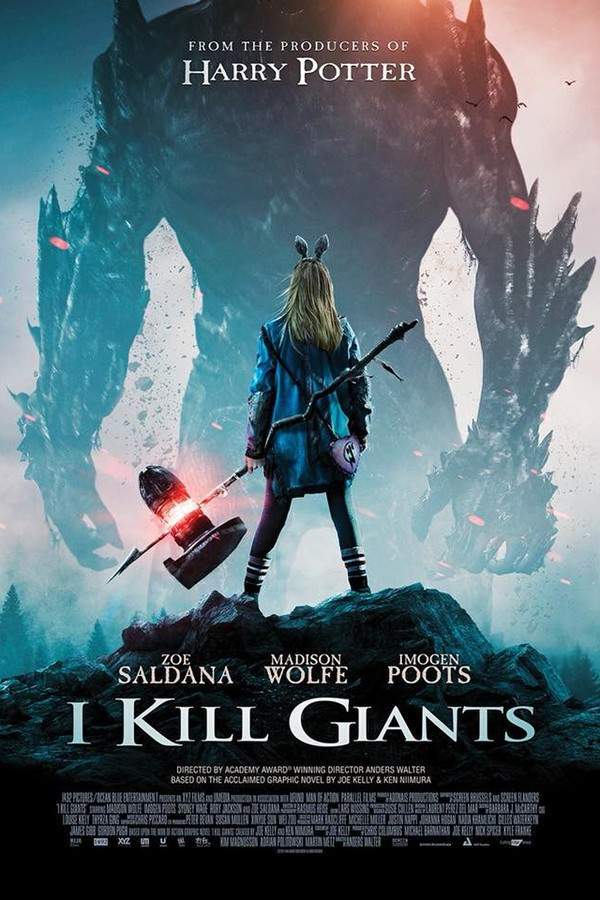
I Kill Giants (2018) movie poster

Plot Summary

I Kill Giants (2018) Plot Summary Explained

Release, runtime and language
2018 · 106 min · English
Echo score 68
Loading streaming availability…
Directed by
Anders Walter
Starring
Zoe Saldana, Imogen Poots, Jennifer Ehle, Aideen Wylde, Allanah O'Connor, Amanda Stuart
Budget
$15.1M

A young teenager escapes from her personal problems by immersing herself in a world of heroic fantasy and battling mythical giants. As she fiercely defends her town from these imagined creatures, she must also confront the very real challenges and emotional turmoil in her own life, blurring the lines between her elaborate fantasy and the world around her.

On this page (6)
  1. 1 Where to watch
  2. 2 What happens: full plot
  3. 3 Plot questions answered
  4. 4 Movie threads
  5. 5 Movies like I Kill Giants
  6. 6 Every angle
Loading streaming availability…

Full plot summary · contains spoilers

What Happens in I Kill Giants: Full Plot Summary

The whole story of I Kill Giants (2018) explained, from the opening scene to the final frame: every key event, every twist and what it all adds up to. Read it as a quick recap before the sequel, to check a scene you missed, or to finally understand what really happened.

Barbara Thorson, portrayed by Madison Wolfe, is an imaginative and fierce young teenager who resides with her supportive older sister, Karen Poots, and her brother. Inspired by her passion for Dungeons & Dragons and the history of former Phillies pitcher Harry Coveleski, Barbara has developed a rich fantasy world of her own. She is convinced that giants from other realms are plotting to attack her hometown, prompting her to spend her days meticulously crafting weapons and traps to safeguard against these threats.

When she encounters Sophia, a newcomer from Leeds, England, Barbara initially seems aloof despite Sophia's attempts to befriend her. A confrontation with a group of bullies led by Taylor interrupts their budding connection, and soon after, Barbara is summoned by the school psychologist, Mrs. Mollé. Annoyed by this interruption, she exits the meeting abruptly, insisting it would only detract from her vital preparations to combat a giant.

As their friendship begins to develop, Barbara shares the mythology of the giants with Sophia, showing her the various traps and baits she has painstakingly created. Convinced that the magical war-hammer Coveleski, which she keeps in her bag, is crucial in her fight against the giants, Barbara also speaks of the eerie Harbingers—ghostly figures that warn her of impending threats.

After a run-in with the principal, Mr. Mollé, resulting in detention for verbally challenging a teacher, Barbara drags Sophia along on her quest for a giant, causing Sophia's confidence in Barbara's claims to waver. When Mrs. Mollé inquires about Barbara's passion for baseball, it triggers painful memories, making Barbara dash home in a daze. Uneasy and confused, she accidentally strikes Sophia, leading to an embarrassing situation that drives Sophia away.

As tensions grow, Sophia finds herself in the clutches of peer pressure from Taylor, who promises her a secret about Barbara if she joins him and his friends in exploring Barbara’s "freaky" activities. This curiosity leads to a harsh confrontation, where Barbara discovers her traps have been dismantled, and she is beaten by Taylor’s gang after revealing Coveleski is merely a small jawbone on a stick.

Recovering in Sophia's home, Barbara becomes distressed at the sight of her surroundings, warning Sophia to retreat before "it" takes notice. This encounter drives a wedge between them, especially after Sophia uncovers a recording that reveals Barbara’s tumultuous past with her mother. The ensuing argument intensifies when Barbara lashes out, convinced her giants are real.

On a quest to confront a looming giant in an abandoned train yard, Barbara uses creative tactics to combat the threat, electrifying it using a makeshift setup before retreating. Following this, her emotions erupt in a prank that humiliates Taylor, prompting concern from Mrs. Mollé and Karen, who search for her.

As a storm brews, Mrs. Mollé implores Barbara to reconnect with her mother, yet Barbara remains oblivious to the impending tragedy. As destruction unfolds around her, the arrival of the giant forces Barbara into battle once more. With Coveleski restored and transformed into a radiant war hammer, she channels her fury and sorrow into an epic clash, uncovering profound truths along the way.

In the aftermath, the titan's haunting words resonate deeply: "To run from death is to reject life." As Barbara returns to the shore, she comes full circle, reuniting with Sophia.

The next day presents an emotional reckoning as Barbara musters the courage to visit her dying mother for a heartfelt farewell. Following the summer, as life carries on in the wake of loss, Barbara rebuilds her connections with Mrs. Mollé and Sophia. On the first night of school, she is visited by the titan once more, a silent guardian watching from the waves, leaving her with a quiet sense of gratitude.
Last updated: November 04, 2024 at 06:31

Was this helpful?

Plot questions answered

I Kill Giants Plot Explained: Your Questions Answered

The questions people ask most about I Kill Giants (2018): what happens in the confusing scenes, why the characters do what they do, the twists, hidden details and what the ending means. Each answer contains spoilers.

Q1

Why does Barbara think giants are coming to attack her town?

Barbara uses her fantasy world of giants as a coping mechanism to process her real-life trauma. The giants represent the overwhelming emotional threats she faces, particularly her mother's terminal illness and her feelings of powerlessness. By creating an elaborate mythology where she is a heroic warrior defending her town, Barbara transforms her grief and anxiety into something she believes she can fight and control.

Foreshadowing: Early scenes show Barbara obsessively building traps and weapons, reflecting her need to prepare for threats she cannot otherwise manage.

  • Barbara
  • giants
  • coping mechanism
  • fantasy
  • trauma
  • grief
Q2

What is the Coveleski hammer and why does Barbara need it?

Coveleski is Barbara's enchanted war-hammer, named after former Phillies pitcher Harry Coveleski. In reality, it's a small jawbone on a stick that Barbara carries in her bag, but she believes it holds magical powers essential for defeating giants. The hammer represents her source of strength and agency in her fantasy world, allowing her to imagine herself as capable of fighting the overwhelming forces threatening her life.

Foreshadowing: Barbara speaks of Coveleski with reverence and keeps it constantly by her side throughout the film.

  • Coveleski
  • hammer
  • magic weapon
  • Barbara
  • fantasy
Q3

Why does Barbara accidentally hit Sophia and run away?

When Mrs. Mollé asks Barbara about her passion for baseball, it triggers painful memories connected to her father, causing Barbara to panic and flee. In her emotionally overwhelmed state, she accidentally strikes Sophia while trying to retreat. This incident stems from Barbara's inability to process questions about her family history, which she keeps buried beneath her fantasy persona.

Foreshadowing: The baseball question activates Barbara's traumatic memories, revealing the fragility beneath her confident exterior.

  • Barbara
  • Sophia
  • accident
  • baseball
  • trauma
  • family
Q4

What does the recording about Barbara's past reveal?

Sophia discovers a recording that exposes Barbara's tumultuous past with her mother, likely involving her mother's illness and the family's struggles. This revelation explains why Barbara has constructed such an elaborate fantasy world, the recording likely contains evidence of Barbara witnessing her mother's decline, which she cannot confront directly in reality.

Foreshadowing: Earlier scenes hint at Barbara's avoidance of anything related to her home life or family history.

  • recording
  • Barbara
  • past
  • mother
  • Sophia
  • trauma
Q5

Why is Barbara's dying mother the real reason for her giants fantasy?

Barbara's mother is terminally ill, which is the central tragedy driving Barbara's imaginative escape. The giants she battles symbolically represent death itself, the inevitable force she feels powerless against. Her fantasy allows her to channel her fear and helplessness into a fight she believes she can win, rather than facing the crushing reality of losing her mother.

Foreshadowing: Mrs. Mollé's repeated attempts to get Barbara to visit her mother, and Barbara's resistance, hint at the underlying familial crisis.

  • mother
  • dying
  • death
  • Barbara
  • grief
  • illness
Q6

What does the titan mean when it says 'To run from death is to reject life'?

The titan's words serve as the film's central thematic message. Barbara has been using her giant-fighting fantasy to run from the reality of her mother's impending death. The titan tells her that avoiding death means rejecting the opportunity to truly live and connect with others. This realization helps Barbara understand that confronting her mother's mortality is necessary for healing and moving forward.

Foreshadowing: The titan's message comes during the climactic battle, representing Barbara's final confrontation with her fears.

  • titan
  • death
  • life
  • message
  • Barbara
  • meaning
Q7

Why does Barbara finally visit her mother at the end?

After her battle with the titan and processing its message about not running from death, Barbara gains the courage to visit her dying mother. This visit represents her acceptance of reality and her willingness to face the painful truth. It marks her transition from escapism to confronting her grief head-on, allowing her to say goodbye and begin true healing.

Foreshadowing: Mrs. Mollé had been encouraging Barbara throughout the film to reconnect with her mother.

  • Barbara
  • mother
  • visit
  • goodbye
  • acceptance
  • healing
Q8

Are the giants real or just in Barbara's imagination?

The giants are primarily manifestations of Barbara's psychological state rather than literal creatures. They represent her inner emotional battles, her fear of loss, her feelings of isolation, and her struggle against overwhelming circumstances. The film intentionally blurs the line between fantasy and reality, suggesting that the emotional truths Barbara processes through her imagination are very real, even if the giants themselves are not physically present.

Foreshadowing: The film shows Barbara constructing traps and encountering giants in ways that suggest psychological rather than literal events.

  • giants
  • real
  • imaginary
  • fantasy
  • reality
  • Barbara
Q9

Why does Sophia distance herself from Barbara after learning the truth?

Sophia becomes confused and frightened after discovering Barbara's recording and witnessing her erratic behavior. The revelation about Barbara's troubled past, combined with Barbara's insistence that the giants are real, creates a rift between them. Sophia's withdrawal reflects her struggle to understand Barbara's mental state and her own discomfort with the intensity of Barbara's fantasy world.

Foreshadowing: The confrontation where Barbara's traps are dismantled and she reveals Coveleski's true nature marks the turning point.

  • Sophia
  • Barbara
  • friendship
  • distance
  • recording
  • betrayal
Q10

Why does Barbara prank Taylor after the giant confrontation?

Barbara's prank on Taylor is an emotional outburst stemming from her overwhelming stress and grief. After the intense experience at the train yard where she fought the giant, combined with the mounting pressure from her mother's declining health and her fractured friendship with Sophia, Barbara acts out. The prank represents her inability to properly process these emotions, leading to destructive behavior that concerns those around her.

Foreshadowing: The prank follows immediately after Barbara's emotionally draining giant battle at the train yard.

  • Barbara
  • Taylor
  • prank
  • emotion
  • outburst
  • bullying
Q11

Why does Mrs. Mollé keep pushing Barbara about her mother?

Mrs. Mollé, the school psychologist, recognizes that Barbara is using her fantasy world to avoid confronting her mother's terminal illness. Throughout the film, she persistently encourages Barbara to face reality and reconnect with her mother before it's too late. Mrs. Mollé represents the adult guidance Barbara needs but resists, understanding that Barbara's avoidance will lead to greater emotional damage.

Foreshadowing: Mrs. Mollé's repeated questions about Barbara's home life and her insistence on family connections hint at her awareness of the underlying situation.

  • Mrs. Mollé
  • Barbara
  • mother
  • psychologist
  • guidance
  • intervention
Q12

What does the titan watching Barbara from the waves at the end mean?

At the end, the titan appears as a silent guardian in the waves on the first night of school. This suggests that the titan has become a protective symbol rather than an enemy. Having accepted her mother's death and processed her grief, Barbara no longer fears death as a destructive force. The titan now represents a benevolent presence watching over her, symbolizing her newfound peace and the idea that death is not an enemy but part of life's cycle.

Foreshadowing: The final battle ends with Barbara embracing the titan's message about life and death.

  • titan
  • guardian
  • waves
  • ending
  • Barbara
  • symbolism

Movie threads

More Movies Like I Kill Giants, by Mood & Story

Curated lists built around what makes I Kill Giants tick: the same mood, the same kind of story or the same emotional payoff. Each list explains why these movies belong together.

Movies that use fantasy as an emotional shield like I Kill Giants

Characters use elaborate imaginary worlds to cope with unbearable real-world pain. Discover movies like I Kill Giants, where characters retreat into fantasy worlds to escape painful realities. These films blend heartfelt drama with imaginative elements, exploring themes of grief, trauma, and resilience through the lens of escapism. If you were moved by Barbara's journey, you'll find similar poignant and introspective stories here.

  • imaginative
  • melancholic
  • introspective
  • dreamlike
  • resilient
  • somber
  • Tone: bittersweet, melancholic
  • Pacing: steady, reflective
Why these movies?

The story pattern: These narratives often follow a protagonist, frequently a child or young adult, who creates an alternate reality to process a traumatic event they cannot yet face head-on. The story unfolds by gradually revealing the real-world pain, forcing a confrontation between the comforting fantasy and the painful truth, leading to a cathartic but bittersweet resolution.

Why they belong together: They are grouped by their shared core mechanism: using imagination not as simple fantasy, but as a profound psychological response to emotional distress. They share a bittersweet tone, heavy emotional weight, and a central theme of navigating the delicate boundary between coping and confronting reality.

Bittersweet movies about processing grief like I Kill Giants

Stories about confronting profound loss that end with a mix of sorrow and acceptance. If you appreciated the emotional depth of I Kill Giants, explore these films about coming to terms with loss. They capture the heavy, bittersweet journey of grief, blending sorrow with moments of resilience and connection. Find movies with similar heartfelt drama and poignant endings that honor the complexity of healing.

  • somber
  • melancholic
  • introspective
  • resilient
  • heartfelt
  • cathartic
  • Tone: bittersweet, somber
  • Pacing: steady, character-driven
Why these movies?

The story pattern: The narrative pattern follows a character's struggle with a significant loss, depicting the stages of denial, anger, bargaining, and depression not as a checklist but as a messy, internal experience. The climax involves a painful confrontation with the truth, leading to an ending that is neither fully happy nor utterly bleak, but one of hard-won acceptance and continued life.

Why they belong together: These films are united by their unflinching focus on the grieving process, their heavy emotional weight, and their commitment to a bittersweet resolution that feels authentic to the experience of loss. They share a somber, introspective mood and a pacing that allows for deep emotional reflection.

If you liked this

Movies Like I Kill Giants

Similar movies to I Kill Giants: the same genre, themes or kind of story. Each one comes with its own plot summary, timeline and ending explained.

Browse all movie summaries

Every angle

I Kill Giants (2018) Explained: Plot, Timeline & Characters

Everything about I Kill Giants in one place: what happens in the plot summary, the timeline in chronological order, the characters and meaning and a spoiler-free summary. What's After the Movie adds the cast, box office and post-credit scenes.

Coming soon on iOS and Android

The Plot Explained Movie Summary App

Plot summaries, endings explained and timelines on your phone. Catch up on any movie in minutes, save your favorites and never miss a twist again.

Be the first to know when we launch. Your email stays private, always.

Learn more about the app