






Plot Explained Spoilers guaranteed!
Plot Explained

Browse by genre

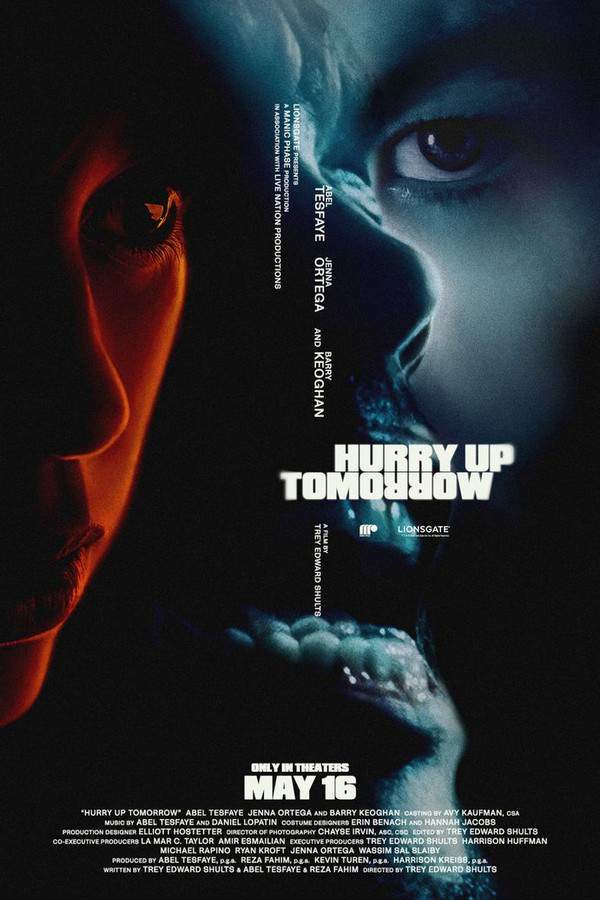
Hurry Up Tomorrow (2025) movie poster

Ending Explained

Hurry Up Tomorrow (2025) Ending Explained – Final Scene & Meaning

Release, runtime and language
2025 · 1 h 45 m · English
Echo score 46
Directed by
Trey Edward Shults
Starring
Barry Keoghan, Jenna Ortega, The Weeknd, Riley Keough, Roman Mitichyan, Ash T
Budget
$15M

A musician struggling with insomnia finds his grasp on reality loosening. As his mental state deteriorates, he encounters the enigmatic Anima. His world becomes increasingly surreal, forcing him to question everything he thought he knew about himself.

On this page (7)
  1. 1 Where to watch
  2. 2 What happens at the end
  3. 3 Final events in order
  4. 4 Ending questions answered
  5. 5 Movie threads
  6. 6 Movies like Hurry Up Tomorrow
  7. 7 Every angle

Where to watch

Where to Watch Hurry Up Tomorrow (2025)

Where can you watch Hurry Up Tomorrow? Stream, rent or buy it in the US, including on Amazon Video, Apple TV Store and Fandango At Home: current JustWatch availability with up-to-date prices.

Streaming availability powered by JustWatch

Ending explained · contains spoilers

What Happens at the End of Hurry Up Tomorrow?

How Hurry Up Tomorrow (2025) ends, what the final scene means, which earlier moments set it up and how to read the ending if the film leaves it open. The full ending explained, with every spoiler.

In the climax of Hurry Up Tomorrow, Abel, played by Tesfaye, finds himself on a windswept rooftop, symbolizing a threshold between his old self and something new. There, he encounters Anima, a haunting figure played by Jenna Ortega, who has been guiding him through his psychological nightmare. As their interaction reaches its peak, Anima douses Abel in gasoline and sets him on fire. Striking the match, she essentially ignites a moment of catharsis. Abel is engulfed in flames but doesn’t perish; instead, he stands there, unburned, his face blank but illuminated by the blaze. This powerful image signifies a symbolic death and rebirth—shedding his former identity as The Weeknd and emerging anew. The flames are a metaphor for transformation, pain, and renewal, suggesting that Abel has confronted his inner demons and is ready to move forward without his past persona. The film ends with him walking alone into the morning light, silent and unmarked, embodying a sense of quiet rebirth and an uncertain, yet hopeful, future. The ending leaves viewers with the impression that he has ultimately embraced his true self beyond the fame and facade, closing the chapter on his persona and beginning a new personal journey.

Last updated: June 25, 2025 at 08:44

Was this helpful?

The last 4 events

How Hurry Up Tomorrow Ends: The Final Events in Order

The last events of Hurry Up Tomorrow (2025) in chronological order, the run-up to the ending explained above. The complete timeline has all 14 events, scene by scene.

Open the full timeline
  1. Violence and Chaos

    Lee, Abel's manager, arrives drunk and a violent struggle ensues with Anima. In a moment of desperation, she stabs Lee in the neck, leaving him bleeding as she runs back to Abel, escalating the situation further.

    Where
    Hotel Room
  2. Desperate Measures

    After the violent confrontation, Anima attempts to drown Abel in gasoline, feeling betrayed by his silence. However, Abel's heartfelt rendition of 'Wake Me Up' resonates with her, leading her to spare him at the last moment.

    Where
    Hotel Room
  3. Fire and Freedom

    Anima allows Abel to leave but then sets the hotel room on fire as she lets go of her frustrations. Abel walks out traumatized but now free from his captivity, heading back towards his music career.

    Where
    Hotel Room
  4. Return to Performance

    Abel strides back towards the stage for his next performance, haunted yet determined. He emotionally stares at his reflection, confronting the tumultuous events he has just endured.

Ending questions answered

Hurry Up Tomorrow Ending: Your Questions Answered

The questions people ask most about the ending of Hurry Up Tomorrow (2025): what the final scene means, how the twist works, what happens to each character and how to read the ending. Each answer contains spoilers.

Q1

Why does Anima set Abel on fire?

Anima sets Abel on fire as an act of catharsis and transformation. Rather than a malicious act, it represents a symbolic burning away of his old identity and trauma. The fire is meant to destroy his former self so he can be reborn anew, free from the pain and persona that have been consuming him throughout the film.

Foreshadowing: Earlier in the film, Abel's world becomes increasingly surreal as his mental state deteriorates, with Anima guiding him through this psychological nightmare.

  • anima
  • abel
  • fire
  • transformation
  • catharsis
Q2

Does Abel die in the ending?

Abel does not die literally. While the fire appears to kill his old self, he emerges unburned and walks away alive. The death is symbolic, he sheds his former identity as The Weeknd and is reborn into a new version of himself. The ambiguous ending leaves his physical survival clear but his psychological state uncertain.

Foreshadowing: The rooftop setting symbolizes a threshold between his old self and something new, hinting at this liminal state between death and rebirth.

  • abel
  • death
  • survival
  • rebirth
  • ending
Q3

What does Abel walking into the morning light mean?

Abel walking into the morning light symbolizes his emergence from the darkness of his psychological nightmare into a new beginning. The light represents hope, renewal, and the uncertainty of what lies ahead. He walks alone, unmarked but forever altered, suggesting he has confronted his inner demons but must now face an unknown future.

Foreshadowing: The entire film builds toward Abel's confrontation with his inner demons, with the light representing the opposite of the surreal darkness that has consumed him.

  • morning light
  • rebirth
  • hope
  • new beginning
  • resolution
Q4

Who is Anima in the movie?

Anima is an enigmatic figure played by Jenna Ortega who appears throughout Abel's psychological descent. She serves as both a guide and a catalyst in his nightmare, though her exact nature remains ambiguous. Whether she represents a real person, a manifestation of his subconscious, or a literal embodiment of his psychological state is deliberately left unclear.

Foreshadowing: Anima has been guiding Abel through his psychological nightmare throughout the film, suggesting she is connected to his deteriorating mental state.

  • anima
  • jenna ortega
  • character
  • identity
  • guide
Q5

Is Anima real or part of Abel's mind?

The film deliberately leaves Anima's reality ambiguous. She could be a literal person involved in Abel's life, a hallucination born from his insomnia and mental deterioration, or a symbolic representation of his subconscious pushing him toward transformation. The surreal nature of the narrative supports multiple interpretations.

Foreshadowing: As Abel's mental state deteriorates, his world becomes increasingly surreal, making it difficult to distinguish between reality and his psychological nightmare.

  • anima
  • reality
  • hallucination
  • psychology
  • ambiguity
Q6

What happens to The Weeknd persona at the end?

The Weeknd persona is effectively destroyed in the fire. The burning represents Abel shedding his stage identity and the fame, facade, and trauma associated with it. By the end, he emerges as a new person without the persona, suggesting a complete break from his previous life as The Weeknd.

Foreshadowing: The film forces Abel to question everything he thought he knew about himself, including the identity he has built around his musical career.

  • the weeknd
  • persona
  • identity
  • fame
  • transformation
Q7

Why doesn't Abel burn when set on fire?

Abel doesn't burn because the fire is metaphorical rather than literal. The flames represent a symbolic purification, he is burning away his old identity and trauma. His physical immunity to the fire signifies that the transformation is happening on a psychological and spiritual level, not a physical one. He stands unburned, blank but illuminated, embodying this symbolic death and rebirth.

Foreshadowing: The rooftop scene is heavily symbolic throughout, representing a threshold between his old self and something new.

  • fire
  • burns
  • symbolic
  • immunity
  • metaphor
Q8

Is the ending of Hurry Up Tomorrow happy or sad?

The ending is bittersweet and ambiguous rather than clearly happy or sad. Abel achieves a form of transformation and renewal, but the meta notes describe him as "forever altered" and grappling with trauma. He walks into an uncertain future with quiet rebirth, suggesting hope mixed with the lasting weight of his experiences. There is no definitive closure or redemptive resolution.

Foreshadowing: The film is characterized by high tension, sadness, and a lack of humor throughout, with emotional weight anchored in grief, professional failure, and trauma.

  • ending
  • interpretation
  • tone
  • rebirth
  • ambiguity
Q9

What does the rooftop scene symbolize?

The rooftop scene symbolizes a threshold or liminal space between Abel's old identity and his new self. Being high above the city, exposed to the elements, represents his vulnerable state and the pivotal moment of transformation. The windswept setting emphasizes the dramatic nature of this choice to let go of who he was and step into something unknown.

Foreshadowing: The entire film has been building toward this moment of confrontation, with the rooftop serving as the literal and figurative high point of his journey.

  • rooftop
  • threshold
  • transformation
  • symbolism
  • climax
Q10

Why does Abel appear unmarked after being set on fire?

Abel appears unmarked because the fire is a symbolic act of psychological transformation, not a physical attack. His unburned appearance reinforces that this is about shedding his identity and inner demons rather than causing physical harm. The blank expression on his face suggests he has been emptied of his former self and is now ready to be filled with something new.

Foreshadowing: The fire is explicitly described as a metaphor for transformation, pain, and renewal in the ending explanation.

  • unchanged
  • fire
  • symbol
  • transformation
  • rebirth

Movie threads

More Movies Like Hurry Up Tomorrow, by Mood & Story

Curated lists built around what makes Hurry Up Tomorrow tick: the same mood, the same kind of story or the same emotional payoff. Each list explains why these movies belong together.

Movies where reality fractures like in Hurry Up Tomorrow

Stories where a character's perception of reality fractures into a disturbing dreamscape. If you enjoyed the surreal psychological descent in Hurry Up Tomorrow, you'll find similar movies here. These films explore characters losing their sanity, often featuring dreamlike sequences, unreliable narrators, and a constant, unsettling tension between what is real and what is imagined.

  • surreal
  • unreliable narrator
  • psychological
  • unsettling
  • anxious
  • claustrophobic
  • Tone: dark, unsettling, melancholic
  • Pacing: variable, shifting between slow introspection and chaotic bursts
Why these movies?

The story pattern: The narrative follows a character, often under extreme pressure or suffering from a mental health crisis, as their stable reality begins to decay. This is depicted through increasingly surreal and symbolic events, forcing them—and the viewer—to question every perception. The journey is typically internal, focusing on the collapse of the mind.

Why they belong together: These films are grouped by their shared focus on a fractured psyche as the primary source of conflict. They create a cohesive experience through a dark tone, high emotional weight, and the use of surrealism to externalize internal trauma, resulting in a deeply unsettling and introspective vibe.

Celebrity breakdown thrillers similar to Hurry Up Tomorrow

Explorations of celebrities cracking under the immense weight of public scrutiny. Fans of Hurry Up Tomorrow's look at a musician's mental health crisis will appreciate these movies. They depict the dark side of fame, exploring themes of identity crisis, performance pressure, and the psychological toll of living in the spotlight, often with bleak or ambiguous endings.

  • obsessive
  • desperate
  • isolating
  • chaotic
  • melancholic
  • celebrity culture
  • Tone: dark, desperate, bleak
  • Pacing: variable, building tension to a climax
Why these movies?

The story pattern: The plot centers on a famous individual whose life is consumed by their public persona. External pressures from fans, media, and career demands exacerbate internal struggles like trauma or addiction, leading to a crisis point. The narrative often involves a violent or self-destructive confrontation that shatters their carefully constructed world.

Why they belong together: Movies in this thread share a specific thematic focus on the corrosive effects of celebrity culture. They are united by a dark tone, heavy emotional weight stemming from isolation and pressure, and a narrative arc that charts a destructive fall from grace, creating a consistent mood of anxious desperation.

If you liked this

Movies Like Hurry Up Tomorrow

Similar movies to Hurry Up Tomorrow: the same genre, themes or kind of story. Each one comes with its own plot summary, timeline and ending explained.

Browse all movie summaries

Every angle

Hurry Up Tomorrow (2025) Explained: Plot, Ending, Timeline & Characters

Everything about Hurry Up Tomorrow in one place: what happens in the plot summary, the timeline in chronological order, the characters and meaning, the ending explained and a spoiler-free summary. What's After the Movie adds the cast, box office and post-credit scenes.

Coming soon on iOS and Android

The Plot Explained Movie Summary App

Plot summaries, endings explained and timelines on your phone. Catch up on any movie in minutes, save your favorites and never miss a twist again.

Be the first to know when we launch. Your email stays private, always.

Learn more about the app