






Plot Explained Spoilers guaranteed!
Plot Explained

Browse by genre

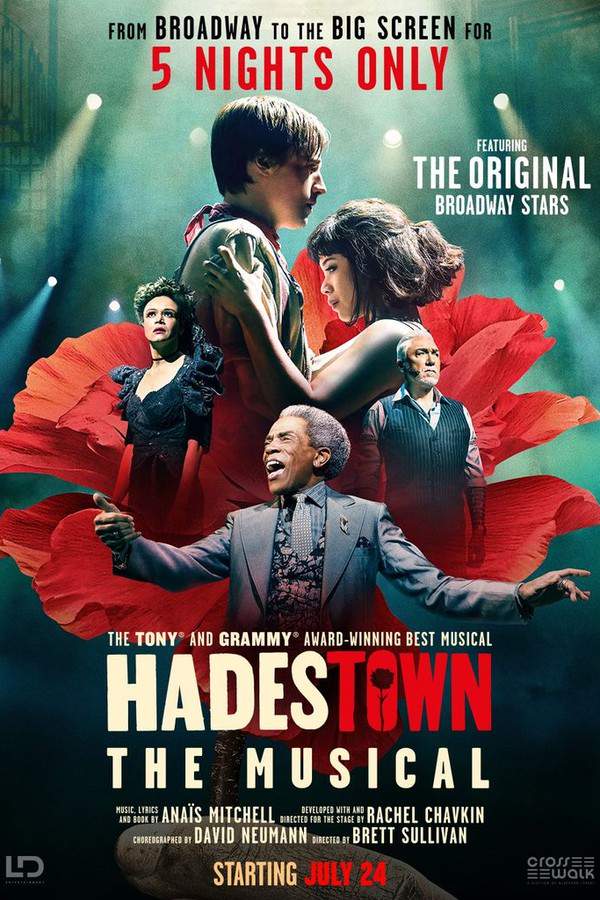
Hadestown: The Musical (2026) movie poster

Characters & Themes

Hadestown: The Musical (2026) Characters, Setting & Themes Explained

Release, runtime and language
2026 · 2 h 21 m · English
Echo score 87
Directed by
Brett Sullivan
Starring
Reeve Carney, Eva Noblezada, André De Shields, Patrick Page, Amber Gray, Allie Daniel
Budget
$5M

This live recording captures the acclaimed Broadway musical Hadestown, which swept the 2019 Tonys with eight wins—including Best Musical—and won the 2020 Grammy for Best Musical Theater Album. It stars the five original Broadway principals and blends modern American folk with New Orleans‑style jazz to reimagine a sweeping, genre‑defying story.

On this page (7)
  1. 1 Where to watch
  2. 2 Characters explained (9)
  3. 3 Where & when it takes place
  4. 4 Themes & meaning (3)
  5. 5 Character & meaning questions
  6. 6 Movie threads
  7. 7 Every angle

Where to watch

Where to Watch Hadestown: The Musical (2026)

Where can you watch Hadestown: The Musical? Stream, rent or buy it in the US, including on Amazon Video, Apple TV Store and Fandango At Home: current JustWatch availability with up-to-date prices.

Streaming availability powered by JustWatch

9 main characters · contains spoilers

Hadestown: The Musical Characters Explained: Who Is Who

The main characters of Hadestown: The Musical (2026), heroes and villains: what drives them, how they change over the course of the story and what each of them reveals about the film's bigger ideas.

  • Orpheus (Reeve Carney)

    A gifted, hopeful musician who believes his lyre can transform the world. He falls in love with Eurydice and promises to bring her home, using song to try to overcome poverty and despair. He must navigate doubt and danger as he follows a treacherous path to rescue Eurydice.

    • 🎵 Musician
    • 💫 Hopeful
    • 🗝️ Determined
  • Eurydice (Eva Noblezada)

    A young woman struggling to survive in poverty who finds herself falling for Orpheus. She longs for a better life but is forced to weigh love against hunger. Her decision to sign with Hades reveals the brutal trade-offs between security and freedom.

    • 🌹 Survivor
    • 💬 Cautious
    • 🎭 Complex
  • Hermes (André De Shields)

    Messenger of the gods and narrator guiding the story, offering sly commentary and bridging mortal and divine perspectives. He introduces the tale and hints at the cyclical nature of Hadestown. His presence keeps the audience aware that the tale is both ancient and ongoing.

    • 🗣️ Narrator
    • 🎩 Trickster
    • 🧭 Guide
  • Hades (Patrick Page)

    Ruler of the underworld, stern and calculating. He maintains Hadestown through power, enforcing obedience with a ruthless sense of order. His contract with Eurydice and the threat he poses underline the limits of resistance against a system built on control.

    • 👁️ Authority
    • ⚖️ Control
    • 💰 Power
  • Persephone (Amber Gray)

    Goddess of spring who alternates between the above world and the underworld. Her return brings light and a fragile sense of renewal, while her secret speakeasy in Hadestown reveals a hidden kind of resistance. Her relationship with Hades shapes the seasonal cycle that drives the plot.

    • 🌼 Seasons
    • 🗝️ Secrets
    • 🎭 Complexity
  • Fate I (Bella Brown)

    One of the three Fates who appear as a chorus of destiny, watching and steering the events of the story. They manipulate outcomes with a knowing tone, blurring the line between fate and human choice. Their presence underscores how individual actions fit into a larger web of inevitability.

    • 🧭 Destiny
    • 🎭 Chorus
    • 🗝️ Fate
  • Fate II (Madeline Charlemagne)

    Another Fate weaving threads of destiny with a calm, observant stance. She helps set the stage for pivotal decisions while reminding the audience that outcomes are influenced by chance as much as by intention. Her reflections deepen the sense that the world is guided by unseen forces.

    • 🧭 Destiny
    • 🎭 Chorus
    • 🗝️ Fate
  • Fate III (Allie Daniel)

    The third Fate who completes the trio of destinies, signaling the omnipresence of fate in every choice. She participates in the commentary on risk, hope, and consequence, and reinforces the idea that the future is shaped by small acts.

    • 🧭 Destiny
    • 🎭 Chorus
    • 🗝️ Fate
  • Worker (Christopher Short)

    A representative of Hadestown's working class, one of many unnamed laborers who endure brutal conditions. The Worker embodies resilience and the collective struggle of those who keep the machine running. He reflects the human cost behind the city’s gleaming surface.

    • 🏭 Worker
    • 🧭 Collective
    • 🎭 Ensemble

Last updated: August 13, 2026 at 19:51

Was this helpful?

Setting

Where and When Does Hadestown: The Musical Take Place?

The setting of Hadestown: The Musical (2026): the year and time period, the places and locations, and how they shape the characters, the mood and the tension of the story.

Time period

The story unfolds in a timeless, mythic present that reimagines the Orpheus and Eurydice tale. It cycles between the underground Hadestown and the brighter above world, tied to Persephone's seasonal movements. The narrative uses a looping structure that suggests the tragedy might unfold differently if someone chooses differently.

Location

Hadestown, Above World

Hadestown is an underworld city ruled by Hades where workers toil in a sunless factory. The above world exists as a bright counterpoint, with Persephone's seasonal return bringing light and life. The setting blends ancient myth with a modern stage aesthetic, highlighting the tension between dream and harsh reality.

  • 🌍 Dual Worlds
  • 🏭 Industrial Hadestown
  • 🎭 Mythic Setting
  • 🎶 Musical Theater Locale

Last updated: August 13, 2026 at 19:51

Was this helpful?

3 major themes

Hadestown: The Musical Meaning: Themes & Message Explained

What is Hadestown: The Musical (2026) really about? The emotional, social and philosophical themes the film keeps returning to, its symbolism and the message beneath the surface.

  • Love

    Orpheus and Eurydice's romance drives the plot and motivates the characters' choices. Their bond offers hope in a brutal world, showing how love can inspire risk and resilience. Yet trust and sacrifice collide with fate and necessity, testing whether love can overcome systemic power and hunger.

  • Oppression

    Hadestown portrays a harsh underworld where workers are exploited to sustain the surface world. The factory setting and songs like 'Why We Build the Wall' illustrate control, inequality, and the costs of obedience. The Fates emphasize how power can shape destinies at the expense of human agency.

  • Music

    Music is the narrative engine, turning songs into both storytelling and resistance. Orpheus's lyre and Persephone's songs awaken hope and challenge oppression. The musical form foregrounds emotional arcs while signaling high-stakes political consequences, making song a weapon against despair.

Last updated: August 13, 2026 at 19:51

Was this helpful?

Character & theme questions

Hadestown: The Musical Characters & Meaning: Your Questions Answered

The questions people ask about Hadestown: The Musical (2026): who the characters really are, their relationships, what the symbols mean, where it takes place and what the movie is really about. Each answer contains spoilers.

Q1

What is Hadestown about thematically?

At its core, Hadestown explores love as a force of hope set against oppressive systems of power. The musical examines how poverty and hunger can drive people to surrender their freedom, while asking whether trust and sacrifice can overcome fate. It ultimately suggests that love and resistance matter, even when the ending is bittersweet.

  • hadestown themes
  • love vs oppression
  • orpheus and eurydice
  • musical meaning
  • bittersweet ending
  • systemic power
Q2

Who is Orpheus in the Hadestown musical?

Orpheus is a gifted, hopeful young musician who believes his song can transform the world. He falls in love with Eurydice and promises to rescue her from the underworld using his gift for music. His journey tests whether art, faith, and love can overcome doubt and an unforgiving system built on control.

  • orpheus character
  • hadestown protagonist
  • gifted musician
  • orpheus motivation
  • lyre
Q3

Who is Hades in the Hadestown musical?

Hades is the stern, calculating ruler of the underworld who built Hadestown as a machine of control and labor. He maintains order through contracts, walls, and the promise of security, representing systemic power over individual freedom. His strained marriage to Persephone and his grip on Eurydice define the musical's central conflict.

  • hades underworld
  • hadestown ruler
  • hades character
  • factory system
  • power and control
Q4

What are the two worlds in Hadestown?

Hadestown contrasts the Above World, a bright, sunlit realm tied to Persephone's seasonal presence, with Hadestown itself, a sunless industrial city ruled by Hades. The Above World represents hope, warmth, and life, while the underworld embodies labor, control, and despair. This dual-world structure frames the central conflict between freedom and oppression.

  • above world
  • underworld
  • persephone seasons
  • dual worlds
  • hadestown setting
Q5

What kind of place is the underworld in Hadestown?

The underworld in Hadestown is depicted as a grim, factory-like city where workers labor endlessly to sustain the surface world. The setting blends ancient Greek myth with Depression-era industrial imagery, reinforcing the story's focus on exploitation and economic inequality. Its walls, machinery, and bleak atmosphere symbolize the cost of obedience to a rigid power structure.

  • underworld factory
  • hadestown setting
  • industrial myth
  • depression-era aesthetic
  • exploitation
Q6

What role does music play in Hadestown?

Music functions as the narrative engine of Hadestown, driving the plot forward while expressing characters' inner worlds. Orpheus's lyre symbolizes hope and creative resistance, while Persephone's songs represent renewal and quiet defiance against Hades' rule. The folk and jazz-infused score turns emotion into a political weapon against despair.

  • music as resistance
  • orpheus lyre
  • persephone songs
  • folk jazz score
  • emotional storytelling
Q7

What is Persephone's role in Hadestown?

Persephone is the goddess of spring whose seasonal return to the Above World brings warmth and renewal to a frozen land. Trapped in a strained marriage to Hades, she runs a secret speakeasy in Hadestown as an act of quiet rebellion. Her movement between the two worlds drives the seasonal cycle that structures the entire narrative.

  • persephone goddess
  • spring season
  • speakeasy hadestown
  • seasonal cycle
  • rebellion
Q8

Is Hadestown based on Greek mythology?

Yes, Hadestown is a modern retelling of the ancient Greek myth of Orpheus and Eurydice, with Hades and Persephone as central figures. The musical reimagines the classical tale through a Depression-era American lens, blending folk and jazz music to explore love, loss, and oppression. While it preserves the mythic structure, it layers industrial and economic themes not present in the original myth.

  • greek mythology
  • orpheus myth
  • hadestown source
  • retelling
  • classical myth
Q9

What does the wall in Hadestown symbolize?

The wall in Hadestown represents the physical and ideological barriers Hades uses to control his workers and isolate the underworld from the surface. It embodies themes of division, propaganda, and enforced obedience, most explicitly in the song "Why We Build the Wall." Its construction illustrates how oppression relies on collective complicity to survive.

  • why we build the wall
  • wall symbolism
  • oppression hadestown
  • propaganda
  • control
Q10

What style of music does Hadestown use?

Hadestown blends modern American folk with New Orleans-style jazz to create its distinctive sound. The score draws on acoustic guitar-driven ballads, brass-heavy jazz ensembles, and bluesy vocal work. This musical fusion mirrors the story's emotional arc, pairing warmth and resilience in the first act with darker, industrial tones as the narrative descends into the underworld.

  • folk music
  • new orleans jazz
  • musical style
  • hadestown score
  • americana
Q11

What time period is Hadestown set in?

Hadestown exists in a timeless, mythic present that reimagines the ancient Orpheus and Eurydice story without anchoring itself to a specific historical era. However, the production layers a Depression-era American aesthetic, including diesel smoke, industrial labor, and folk-jazz sounds, onto the classical tale. The narrative also uses a cyclical structure, suggesting the tragedy replays across seasons and ages.

  • mythic present
  • timeless setting
  • depression era
  • cyclical time
  • era context
Q12

Who is Hermes in the Hadestown musical?

Hermes is the messenger of the gods and the musical's narrator, guiding the audience through the tale with sly, knowing commentary. He bridges the mortal and divine worlds, introducing characters and hinting at the cyclical nature of the tragedy. His presence keeps the audience aware that the story is both ancient and continuously unfolding.

  • hermes narrator
  • messenger god
  • hadestown narrator
  • divine and mortal
  • storytelling
Q13

Who are the three Fates in Hadestown?

The three Fates, Fate I, Fate II, and Fate III, serve as a chorus of destiny who watch and steer the story's events with knowing detachment. They blur the line between fate and human choice, commenting on risk, hope, and consequence throughout the musical. Their presence reinforces the inevitability woven into the Orpheus myth while raising questions about free will.

  • three fates
  • fate chorus
  • destiny hadestown
  • inevitability
  • free will
Q14

What does the Worker character represent in Hadestown?

The Worker stands in for the many unnamed laborers who power Hadestown's industrial machine under brutal conditions. He embodies the collective resilience and quiet suffering of the working class who keep the city's gears turning. His presence highlights the human cost behind the underworld's gleaming surface and amplifies the musical's themes of exploitation and endurance.

  • worker character
  • hadestown laborers
  • working class
  • collective struggle
  • exploitation

Movie threads

More Movies Like Hadestown: The Musical, by Mood & Story

Curated lists built around what makes Hadestown: The Musical tick: the same mood, the same kind of story or the same emotional payoff. Each list explains why these movies belong together.

Modern myth retellings like Hadestown: The Musical

Ancient legends reborn with contemporary fire, fresh music, and urgent meaning. Discover movies like Hadestown: The Musical that reimagine ancient Greek myths, legends, and folklore through modern music, settings, and themes. These mythic retellings blend timeless stories with contemporary fire, perfect for fans of folk and jazz-infused Greek mythology adaptations. If you loved Hadestown's blend of Orpheus and Depression-era industry, these similar films will resonate deeply.

  • mythic
  • ritualistic
  • atmospheric
  • folk-infused
  • cyclical
  • genre-defying
  • Tone: bittersweet, mythic, melancholic
  • Pacing: variable, with sweeping shifts
Why these movies?

The story pattern: Modern mythic retellings typically take a familiar ancient story—Orpheus, Persephone, Odysseus, Tristan—and transplant it into a recognizable modern or stylized world. The narrative often preserves the tragic arc of the source material while layering in contemporary concerns like class struggle, environmental collapse, or political oppression. Characters carry the weight of archetypes but speak and feel like people we know, and the journey usually ends with a sense of cyclical inevitability rather than clean resolution.

Why they belong together: These films share a ritualistic, atmospheric quality and a willingness to use myth as a lens on modern anxieties. They tend to feature folk, jazz, or genre-defying music, stylized production design, and a heavy emotional register. Many blend romance with loss, often with bittersweet or tragic endings, and treat fate or destiny as a tangible force shaping ordinary people.

Doomed love stories like Hadestown: The Musical

Two hearts collide with a system, a fate, or a wall they cannot break. Find movies like Hadestown: The Musical where love is tested against poverty, industry, fate, and impossible odds. These bittersweet, emotionally heavy romances feature lovers fighting systems and cruel destinies, with devastating or open-ended conclusions. If you were moved by Orpheus and Eurydice's tragic separation, these similar doomed romance films and musicals will leave you just as wrecked.

  • romantic
  • tragic
  • doomed
  • bittersweet
  • sweeping
  • fated
  • Tone: bittersweet, romantic, tragic
  • Pacing: variable, sweeping and intimate
Why these movies?

The story pattern: In these stories, two people meet and fall into a love that feels destined, but the world around them refuses to let it breathe. One or both lovers are drawn into a larger system—a factory, a war, a contract, a social order—that demands their separation, labor, or death. The narrative builds toward a moment of hope, a last chance, or a desperate act that almost works, before fate, the machine, or human weakness pulls them apart. The ending is rarely happy, but often cathartic.

Why they belong together: These films and musicals share a heavy emotional weight, bittersweet or tragic endings, and a central romance where external forces—not the lovers themselves—are the true antagonists. They feature sweeping music, strong romantic leads, and a thematic concern with power, control, and the limits of free will. The pacing tends to vary between tender intimacy and sweeping spectacle, and the tone rarely lifts fully into uncomplicated joy.

Every angle

Hadestown: The Musical (2026) Explained: Plot, Timeline & Characters

Everything about Hadestown: The Musical in one place: what happens in the plot summary, the timeline in chronological order, the characters and meaning and a spoiler-free summary. What's After the Movie adds the cast, box office and post-credit scenes.

Coming soon on iOS and Android

The Plot Explained Movie Summary App

Plot summaries, endings explained and timelines on your phone. Catch up on any movie in minutes, save your favorites and never miss a twist again.

Be the first to know when we launch. Your email stays private, always.

Learn more about the app