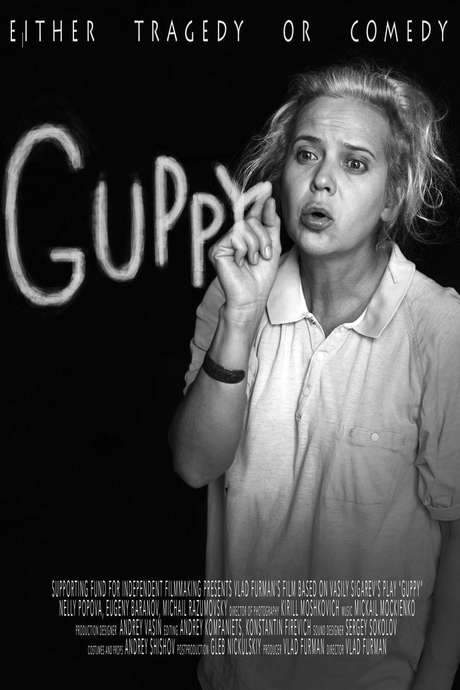
Guppy
Year: 2017
Runtime: 79 mins
Language: Russian
Director: Vlad Furman
Tamara's life takes an unexpected turn when she encounters Pasha while taking out the trash. A chance encounter leads to a visit, and soon Pasha finds himself in her apartment, where she reveals her deep affection for her husband, Lenechka. He rescued her from the countryside, settled her into a domestic life, and playfully nicknamed her "gupeshka," referencing an aquarium fish known for its quiet obedience and unwavering devotion to its keeper.
Warning: spoilers below!
Haven’t seen Guppy yet? This summary contains major spoilers. Bookmark the page, watch the movie, and come back for the full breakdown. If you're ready, scroll on and relive the story!
Timeline – Guppy (2017)
Trace every key event in Guppy (2017) with our detailed, chronological timeline. Perfect for unpacking nonlinear stories, spotting hidden connections, and understanding how each scene builds toward the film’s climax. Whether you're revisiting or decoding for the first time, this timeline gives you the full picture.
Last updated: October 09, 2025 at 15:48
Guppy (2017) Timeline Questions Answered – Chronology FAQ
Find frequently asked questions about the Guppy (2017) timeline, including chronological order, nonlinear jumps, cause-and-effect links, and scene sequence clarifications. This timeline FAQ helps explain when key events happen, how moments connect, and why the story unfolds in that specific order.
Why did Thejus Varkey demolish Guppy's fish tanks and stall?
Thejus ordered the demolition of Guppy's fish tanks and roadside stall as retaliation after Guppy vandalized his jeep. The conflict began when Thejus pressured the village officer to reduce the payment Guppy received for his fish, prompting Guppy to damage the engineer's vehicle. The demolition effectively destroyed Guppy's entire livelihood, which escalated the personal feud between them.
Earlier tension was established when Thejus cut Guppy's compensation for his ornamental fish, sparking the first act of defiance.
Who actually stabbed Thejus Varkey?
Thejus was stabbed by Uppooppa, the elderly railway gate operator, not by the thug Guppy had hired. Uppooppa attacked Thejus because the bridge project would make his job obsolete once the over-bridge was completed. When Guppy learned the truth, he was shaken to realize the attack came from someone with their own desperate motivation, not from the violence he had set in motion.
The film establishes early that the bridge would eliminate jobs, creating tension among village workers like Uppooppa.
Why did Thejus cancel the railway over-bridge project?
Thejus cancelled the project after recovering from his injuries and realizing the devastating impact his presence had on the village. He came to believe the bridge was politically motivated rather than technically necessary, and he witnessed how his actions had destroyed Guppy's livelihood and pushed Uppooppa to desperate violence. His personal reflection led him to reject the project entirely.
The tension between the villagers and the project builds gradually as the consequences of Thejus's decisions unfold.
What happened to Thejus Varkey's family?
Years earlier, during the inauguration of the Omallur Bridge, Thejus lost his parents, wife, and young daughter Malu in a tragic accident. This devastating loss drove him to use riding as a coping mechanism, and he came to see every child he encountered as a replacement for Malu. The railway over-bridge project became his attempt at meaningful work since that tragedy, though it manifested as harsh authority over the village children.
Thejus's protective yet aggressive behavior toward Guppy hints at a deeper, unresolved grief throughout the film.
What happens to Guppy's mother at the end?
Guppy's mother dies shortly after Thejus agrees to cancel the project and rebuild Guppy's fish tanks. Guppy rushes home to tell her the good news, only to discover she has already passed away. The motorized wheelchair he had been working toward remains unfinished and on the way, leaving his dream unfulfilled.
The bittersweet tone is established early through Guppy's precarious living situation and his urgency to provide for his disabled mother.
What does the title "Guppy" mean in the movie?
The title refers to the nickname "gupeshka" given to Tamara (not Guppy the boy) by her husband Lenechka in the description, referencing an aquarium fish known for its quiet obedience and unwavering devotion to its keeper. While this seems to describe Tamara's character in the opening context, the film's protagonist is actually a young boy also called Guppy, likely named for the same qualities of persistence and care he demonstrates toward his mother.
The opening establishes the guppy metaphor as representing devoted care for family.
Why did Thejus forgive Uppooppa after being stabbed?
Thejus forgave Uppooppa because during his recovery he gained perspective on how his project had affected the entire community. He recognized that Uppooppa attacked him out of desperation to preserve his livelihood, just as Guppy had acted desperately to protect his own means of survival. This realization enabled Thejus to show compassion rather than seek revenge.
The stabbing forces Thejus to confront the real consequences of his project on individual lives.
Why did Guppy vandalize Thejus's jeep?
Guppy vandalized Thejus's jeep because Thejus had pressured the village officer to reduce the compensation Guppy received for his ornamental fish. This directly threatened Guppy's ability to support his disabled mother and save for her motorized wheelchair, pushing the boy to retaliate against the engineer.
The tension escalates from the first meeting where Guppy accidentally offends Thejus while serving tea.
Why did Thejus slap Guppy?
Thejus slapped Guppy during an escalation of their conflict, which began when Guppy and his friends threatened the engineer for money after a near accident. The confrontation became increasingly personal as Guppy retaliated by vandalizing the jeep, leading Thejus to physically strike the boy. Guppy then responded by throwing a stone that injured the engineer's hand.
The mutual resentment builds from their very first encounter when Guppy offends Thejus.
What is the relationship between Guppy and Amina?
Amina is a village girl who lives with her grandparents and shares a budding romantic connection with Guppy. Their relationship represents the quiet, innocent affection in Guppy's life beyond his responsibilities as a caretaker and breadwinner. After Thejus reconciles with the village, he pledges to support Amina's education, suggesting her future becomes tied to the resolution of the conflict.
Amina appears early as a lighthearted presence in Guppy's daily life, providing contrast to his struggles.
Who burned the construction team's tent?
The team's tent was mysteriously burned shortly after the confrontation where Guppy threw a stone at Thejus. The film doesn't explicitly identify the arsonist, but the timing suggests it was an act of retaliation from Guppy's circle, further deepening the conflict and forcing Thejus to continue the project work largely alone.
The escalating tension between the villagers and the engineer creates an atmosphere where violence becomes normalized.

Explore Movie Threads
Discover curated groups of movies connected by mood, themes, and story style. Browse collections built around emotion, atmosphere, and narrative focus to easily find films that match what you feel like watching right now.
Bittersweet rural dramas like Guppy
Quiet dramas where personal loss and communal healing intertwine in a small-town setting.If you liked the quiet melancholy and communal healing in Guppy, explore more movies like it. These films feature characters navigating grief and finding bittersweet redemption within the intimate, often challenging, world of rural life.












Narrative Summary
Stories in this thread typically follow characters who are deeply affected by a personal loss or trauma. Their journey is not about escaping their environment, but about reconciling with it and the people within it. The narrative often builds steadily from a place of quiet sorrow towards an ending that acknowledges the pain but offers a glimmer of hope or resolution, without being entirely happy.
Why These Movies?
These movies are grouped together because they share a specific mood: a blend of reflective melancholy and quiet hopefulness, set against a backdrop of rural authenticity. They favor steady pacing, medium emotional weight, and character-driven stories that prioritize emotional truth over dramatic plot twists.
Movies with tense grief like in Guppy
Stories where unresolved pain erupts into tense, life-altering confrontations.For viewers who appreciated the tense confrontations stemming from grief in Guppy, this collection features similar movies. Discover stories where emotional pain leads to climactic, life-changing encounters and a difficult path toward forgiveness or understanding.














Narrative Summary
The narrative pattern involves a character, often an antagonist or a secondary protagonist, whose actions are driven by a hidden tragedy. The film slowly reveals this backstory, recontextualizing their behavior. The plot builds towards a direct, tense confrontation between this grieving character and others, which serves as the emotional climax and catalyst for change, even if the resolution remains bittersweet.
Why These Movies?
These films are united by their exploration of grief as a source of conflict. They masterfully balance quiet, reflective moments with spikes of intense interpersonal tension. The mood is a specific mix of melancholic reflection and confrontational drama, creating a compelling and emotionally resonant experience.
Unlock the Full Story of Guppy
Don't stop at just watching - explore Guppy in full detail. From the complete plot summary and scene-by-scene timeline to character breakdowns, thematic analysis, and a deep dive into the ending - every page helps you truly understand what Guppy is all about. Plus, discover what's next after the movie.
Guppy Summary
Read a complete plot summary of Guppy, including all key story points, character arcs, and turning points. This in-depth recap is ideal for understanding the narrative structure or reviewing what happened in the movie.

Characters, Settings & Themes in Guppy
Discover the characters, locations, and core themes that shape Guppy. Get insights into symbolic elements, setting significance, and deeper narrative meaning - ideal for thematic analysis and movie breakdowns.


