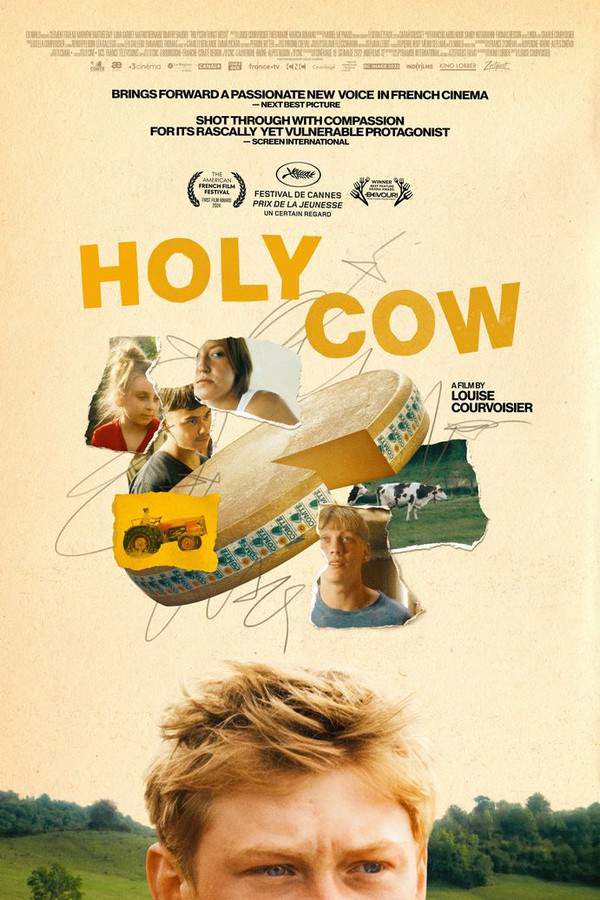
In Jura, Totone, Clément Faveau is an 18-year-old who enjoys carefree days marked by flirting, drinks, and the occasional skirmish with youths from the nearby village. He spends this time with his friends Jean-Yves, Mathis Bernard, and Francis, Dimitri Baudry, as they chase small thrills and shared jokes under the sun. The world changes abruptly when his father dies in a car accident while driving home from a village festival, and Totone suddenly has to take sole responsibility for his younger sister, Claire, Luna Garret. The shock of the tragedy compounds an already tense moment at work: Totone loses his job as a janitor at a cheese dairy after a physical altercation with a coworker, whom Totone had previously tried to steal a girlfriend from, an incident that destabilizes his friendships and his routine.
Marie-Lise, Maïwene Barthelemy, the sister who runs her parents’ dairy farm after becoming an orphan, keeps a reputation for high-quality milk—the same milk that the region used to produce its best cheese last year. Totone sees a high-stakes opportunity: he decides to take over his father’s cheese dairy and aims for the 30,000 EUR prize for the best Comté cheese. To gather the funds needed, his friend Jean-Yves sells his lovingly modified stock car, a move that signals Totone’s shift from reckless youth to a scheme-driven plan. The path to victory, he believes, hinges on securing the milk and turning it into award-winning cheese, a goal that pulls him deeper into Marie-Lise’s world.
The production of cheese becomes the central test of Totone’s resolve. The process is demanding and technical, especially when lifting the hot cheese mass from the vat with a cloth proves to be nearly impossible at first. Each failed attempt requires new milk, driving Totone to visit Marie-Lise more and more often. The dynamics between Totone and Marie-Lise become more intimate as his visits turn into a combination of distraction and collaboration. Yet the tension between his aim and the honesty of his methods grows clear: Totone uses intimate moments to keep Marie-Lise preoccupied while his friends attempt to siphon milk from her dairy, blurring lines between romance and manipulation.
One evening, Marie-Lise is busy tending to a pregnant cow, leaving Totone to step in and watch over the situation. Totone offers to take turns keeping watch with her. When Marie-Lise finally drifts off to sleep, the cow goes into labor, leaving Totone with a fateful choice: should he steal the milk or wake her as promised? He decides to take the risk, stealing the key to the milk chamber and letting his friends into the dairy. He does not abandon Marie-Lise, though; after the moment of temptation, he returns to help her care for the calving cow. This breach does not stay hidden for long—Marie-Lise’s brothers return home and catch the intruders, and a fight erupts between them and Totone’s friends. Totone throws himself between the brawling groups, a move that ruptures his relationship with Jean-Yves and leaves Marie-Lise wary of him.
Despite the turmoil, Totone remains determined and ultimately completes his cheese with help from his little sister, Claire. But the path to recognition is blocked by a rule: only certified businesses may participate in the competition. Totone’s resolve inspires one last act of reconciliation—he breaks into Marie-Lise’s farm one more time and leaves his cheese as a final peace offering. At the stock car race, Totone steps aside to support Jean-Yves as his car regains speed after a rollover, and Jean-Yves wins the competition. Totone sends Claire to celebrate with him, and while he heads home alone, he encounters Marie-Lise at the exit of the grounds. She flashes her breast in a playful, forgiving gesture, signaling a new possibility for their relationship as the film closes.
This story blends small-town rhythms, ambition, and the messy realities of family duty, asking how far someone will go for love, loyalty, and a dream of success in a place where every bottle of milk carries a legacy.