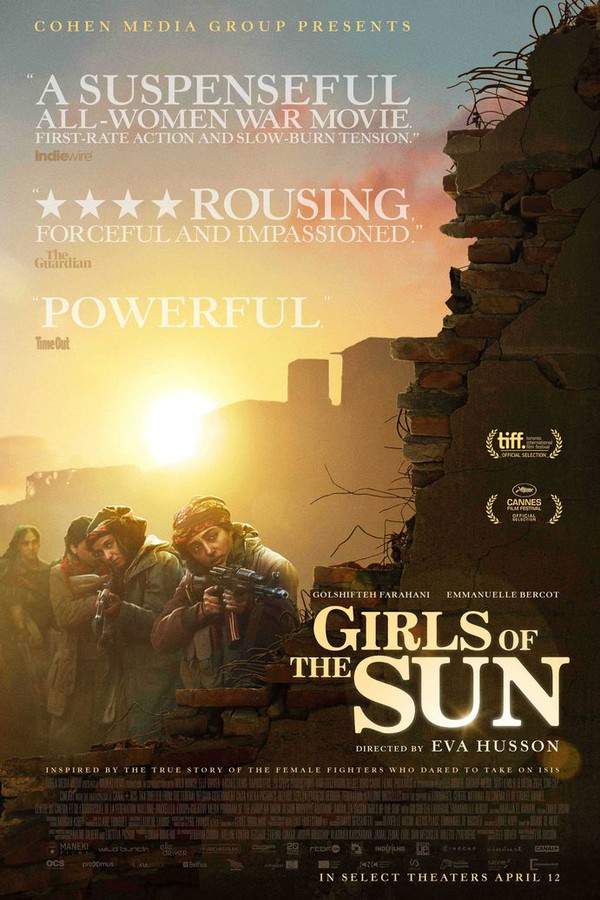
The story unfolds through the eyes of Mathilde, a determined French war reporter who travels to Kurdistan to document the fierce resistance against ISIS. In the rugged landscape of conflict, she comes to meet Bahar Golshifteh Farahani, who leads the Gordyene Unit, a women’s resistance militia built from the ashes of captives who endured ISIS captivity. This unit operates with a quiet resolve, choosing to fight back not with grand speeches but with decisive, relentless action. The narrative blends Mathilde’s contemporary observations with intimate, often painful, flashbacks that reveal Bahar’s life before the war: a lawyer by training, a wife and mother, who enjoyed a simple happiness in a town that would soon be torn apart.
In these memories, we glimpse a life that feels distant but already weathered by the storm to come. Bahar and her husband and son live a routine, hopeful existence until one night ISIS terrorists strike with brutal precision. Men are lined up and executed, while women and children are taken captive. The violence is intimate and destabilizing—children are separated and whisked away, and the women endure rape and trauma. Bahar’s sister’s desperate act of suicide after a brutal rape marks a turning point, a stark reminder of what violence costs and what resistance must shoulder in its wake. Against this backdrop of loss and survival, a glimmer of resilience begins to form: a chance to escape, a plan to endure, and a network of people who refuse to yield.
A pivotal moment comes when Bahar sees a TV interview with a woman activist named Dahlia Saeed, who speaks about rescuing captured women and offers a beacon of hope. Behi Djanati Atai embodies Dahlia in the present day, and her message prompts Bahar to try an audacious escape. With a hidden phone and a whispered, almost ritualized sense of timing, Bahar reaches out to Dahlia’s network during namaz time, when ISIS fighters pause to pray and momentarily lower their guard. The plan is bold but carefully coordinated: three women, guided by a discreet smuggler, slip out of ISIS-controlled territory under the cover of chimes and prayers, and begin a perilous journey toward safety. The sequence is tense and tightly choreographed, underscored by Mathilde’s camera capturing the tension as the escape unfolds.
Back in the present, the Gordyene Unit keeps a perilous watch. They detect approaching ISIS fighters and mount a defensive, determined response. A firefight erupts, and tragedy shadows the group as one of the unit’s young fighters is killed. They manage to capture a single ISIS fighter, a fragile thread of information that hints at how close the danger has crept to their position. Through the captured fighter’s reluctant confession, they learn that ISIS has pulled back from a nearby town, but a remaining force still holds a school where twenty children are being brainwashed and trained as child soldiers. Bahar senses that her own son could be among them, and the fear that fuels her becomes a plan: to strike at the school from within the tunnels that connect the area’s maze of underground passages.
With the captured fighter forced to guide them, the Gordyene Unit advances. Mathilde trails behind with her camera, documenting every tense step as the team threads their way through subterranean corridors. When they emerge on the other side, a fresh firefight erupts, but the unit presses forward and neutralizes the ISIS fighters. The operation shifts from a narrow assault to a broader, door-to-door clearance that follows in the wake of the tunnel raid. In one building they locate a group of children and manage to shepherd them toward safety, a moment that underscores the stakes of every decision in this war-torn land. Along the way, Bahar’s relentless devotion drives the rescue effort, and the tension peaks as she finally confronts a personal truth: one of the children cradled in the unit’s arms might be her own son.
The day ends with exhausted relief and a sobering sense of reality. Mathilde, though wounded in the process, is evacuated, and the camera captures a final, quiet tableau: Bahar stands with her son in one arm and her gun in the other, a poignant image of motherhood fused with something harder and survival-led. The film closes on the image of a woman who has carried both grief and determination across the battlefield—an emblem of how resistance, memory, and maternal courage intertwine in a landscape scarred by war.
In the end, the story remains grounded in its dual perspective: the intimate, almost domestic aftermath of violence that shapes Bahar’s choices, and the wider, urgent urgency of documenting it all through Mathilde’s lens. The balance between flashback and present danger, between personal loss and collective resistance, gives this narrative its slow-burning intensity and its enduring human core.