Plot Explained Spoilers guaranteed!
Plot Explained

Browse by genre

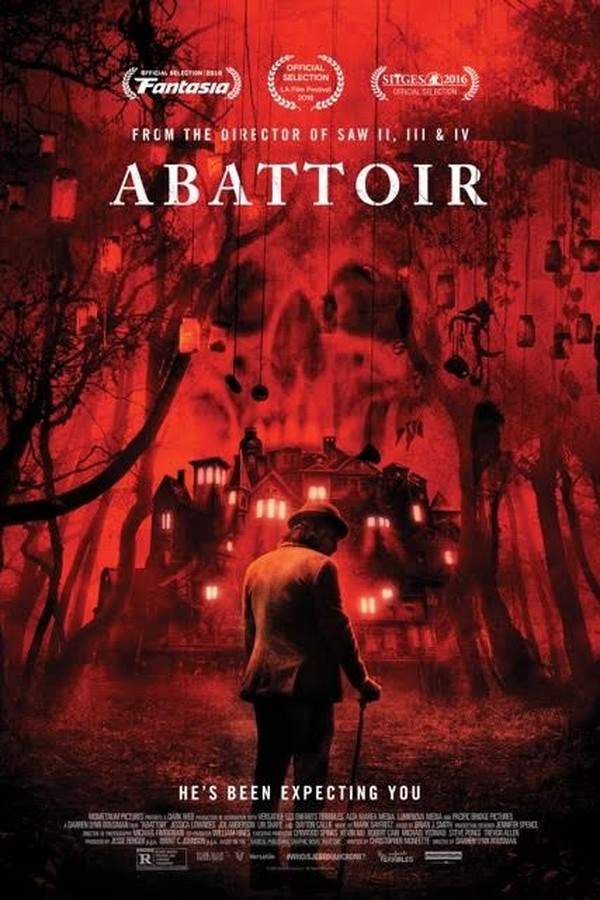
Abattoir (2016) movie poster

Plot Summary

Abattoir (2016) Plot Summary Explained

Release, runtime and language
2016 · 98 min · English
JustWatch #13,029 10
Directed by
Darren Lynn Bousman
Starring
Joe Anderson, Lin Shaye, Dayton Callie, Jessica Lowndes

When her family is murdered, investigative reporter Julia Talben is consumed by a desperate search for answers. Her investigation leads her down a dark path, uncovering a disturbing mystery connected to the enigmatic Abattoir, a bizarre house constructed from countless rooms of despair. Joined by her former lover, Detective Grady, Julia must confront the sinister forces within the house and unravel the chilling secret: how is a haunted house built?

On this page (6)
  1. 1 Where to watch
  2. 2 What happens: full plot
  3. 3 Plot questions answered
  4. 4 Movie threads
  5. 5 Movies like Abattoir
  6. 6 Every angle

Where to watch

Where to Watch Abattoir (2016)

Where can you watch Abattoir? Stream, rent or buy it in the US, including on Philo, Starz and Hoopla: current JustWatch availability with up-to-date prices.

Streaming availability powered by JustWatch

Full plot summary · contains spoilers

What Happens in Abattoir: Full Plot Summary

The whole story of Abattoir (2016) explained, from the opening scene to the final frame: every key event, every twist and what it all adds up to. Read it as a quick recap before the sequel, to check a scene you missed, or to finally understand what really happened.

Real estate journalist Julia Talben, Jessica Lowndes, feels stalled in her current assignments and longs for crime reporting, though she finds some comfort in her sister Amanda, her nephew Charlie, and a cordial relationship with her former lover and local detective Joe Anderson Grady. When tragedy strikes Amanda’s family as Richard Renshaw breaks into their home, the next morning Renshaw calls Julia at work and apologizes for the murders. Julia rushes to the scene and discovers the brutal crime in Charlie’s room, while Grady calmly moves to detain Renshaw.

After the funerals, Julia seeks closure by talking to Renshaw to understand his motives, but Grady counsels her to move on. He eventually drives her to the house again, only to find it already sold less than a week after the killings and, more disturbingly, that Charlie’s room has been removed. The sale appears to have sidestepped several standard procedures. Enter the unsettling detail: the buyer left only a P.O. box. A realtor named Kyle reveals a parallel incident from his past, where an elderly man bought a high-rise after a murder and removed the room where the crime occurred, selling at a loss. Kyle hands Julia a business card from Jebediah Crone found among the closing papers and hints to keep Crone out of the investigation.

Julia and Grady run a title search and uncover Revelation Holdings, a shell company that purchased six other properties over fifty years, each time removing a room tied to a recent tragedy. Their interviews with current owners confirm the pattern, and Crone is connected to every transaction. The couple delves deeper, and Julia discovers that her own home bears the label New English in adoption records. A package from New English arrives at her workplace, containing a VHS tape that seems to show her family’s murder, yet the background walls reveal a different house entirely. The realization broadens: several victims had roots in New English.

A chance to confront Renshaw is granted, and he explains Crone’s macabre scheme: Crone collects tragedies to amplify a tear in reality, aiming to conjure the “miracle of New English.” He apologizes for the violence and then slams his head into a wall. Grady urges Julia to abandon the investigation, but she presses on, eventually traveling to New English with him. A sheriff warns her that the town offers little room for outsiders and urges departure, but Julia’s persistence drives her to uncover cradle-to-grave histories. In New English, she learns that many residents fearfully avoid her, yet she does manage to access court records and locate her birth mother’s address.

At Allie’s residence, the two encounter a touch of kindness amid the town’s hostility. Allie, who reveals herself as Julia’s birth mother, explains the town’s dark past: Jebediah Crone becomes a prominent pastor during a crushing economic depression, drawing followers with dangerous promises. A sermon reel arrives, showing Crone urging followers to abandon God and turn to sacrifice, even reviving a disabled man’s walk through a crowd’s violent act. Allie clarifies that Crone’s vow is to build “a house of many rooms” to restore New English, and the townspeople soon rally to his cause.

Back with new evidence, Julia notices blood on the walls of Crone’s video and suspects it’s staged. Grady uncovers a report of Crone’s death and revival, and Julia recalls Allie’s line about Crone “going to hell and bringing back its secrets.” As the pair pore over newspapers and photos in Allie’s home, townspeople—Crone among them—enter Allie’s room and abduct Grady’s car, leaving Julia and Grady stranded.

A shocking discovery follows: a photograph of Allie with Amanda as a child reveals that Allie is Julia’s birth mother, and the sisters were separated to spare them from becoming sacrifices. Realizing she’s now a target, Julia and Grady attempt to leave, but Crone’s followers close in. The sheriff intervenes and drives Crone away, warning Julia and Grady to leave New English undisturbed, but their plan is not finished.

Ignoring the warning, the duo investigates the forest, finding jars with vows from residents pledging to offer their children as sacrifices. They uncover more removed rooms tied to a school fire that killed the child population, confirming Crone’s intentions. Deeper still, they discover the rooms torn from various buildings, while Crone’s group closes in. The sheriff is overpowered by Crone’s followers, Julia is kidnapped, and she awakens in one of the removed rooms. A vast house built from the missing rooms looms in the woods, and Crone presents her with a brutal choice: leave now and share the story without an ending, or enter the house to search for her family of souls.

Inside, the rooms haunt the spirits of those who died there, reliving their tragedies as Crone explains that gathering these misfortunes weakens the barrier to the afterlife. Grady, having found Julia, follows and confronts the same offer, warning that entering could be another tragedy. Julia reaches Charlie’s room and sees only their deaths echoed in the past; Grady approaches, and in a desperate moment, she fatally stabs him. Crone arrives to relish the moment, declaring that Grady’s death has become another tragedy to feed the Abattoir, bringing the last child back to New English for another tragedy—and, in a final, cruel twist, Allie arrives and shoots Julia, fulfilling her earlier pledge.

- Supporting performances by Lin Shaye and Dayton Callie add texture to a town steeped in secrets and sacrifice, while the central mystery of Crone’s “miracle” rattles the line between grief and reality.
Last updated: October 09, 2025 at 16:15

Was this helpful?

Plot questions answered

Abattoir Plot Explained: Your Questions Answered

The questions people ask most about Abattoir (2016): what happens in the confusing scenes, why the characters do what they do, the twists, hidden details and what the ending means. Each answer contains spoilers.

Q1

Why did Richard Renshaw kill Julia's sister and nephew?

Richard Renshaw was manipulated by Jebediah Crone as part of his cult's plan to gather tragedies. Renshaw explains that Crone uses tragedies to amplify a tear in reality for his 'miracle of New English.' Though Renshaw was not directly related to Julia, he was coerced into committing the murders to feed Crone's scheme. He called Julia afterward to apologize because he was conflicted about what he'd done.

  • richard renshaw
  • julia talben
  • murders
  • jebediah crone
  • manipulation
Q2

What is the Abattoir and how was it built?

The Abattoir is a massive house constructed from dozens of rooms that were physically removed from buildings where tragedies occurred. Over fifty years, Jebediah Crone's shell company Revelation Holdings purchased properties after murders, fires, and other deadly events, then removed the specific rooms where those tragedies took place. These removed rooms were reassembled in the forest to create the Abattoir, which serves as a focal point for Crone's supernatural ritual.

  • abattoir
  • jebediah crone
  • haunted house
  • removed rooms
  • revelation holdings
Q3

What is the miracle of New English that Crone is trying to create?

The miracle is Crone's attempt to tear open the barrier between the living and the dead by gathering enough tragedies in one location. By collecting rooms where people died violent deaths and assembling them into the Abattoir, Crone believes he can open a portal to bring back the souls of New English's sacrificed children. The film suggests this relates to a past event where the town sacrificed its children during an economic depression, and Crone wants to reverse that tragedy.

  • miracle
  • new english
  • jebediah crone
  • afterlife
  • sacrifice
Q4

Why is Julia connected to New English?

Julia was adopted as an infant and grew up believing her birth place was simply listed as 'New English' on her adoption records. In reality, New English is a town where Jebediah Crone rose to power as a cult leader who convinced residents to sacrifice their children. Julia's birth mother Allie reveals that the sisters, Julia and Amanda, were separated at birth to protect them from becoming sacrifices. This makes Julia a target once Crone discovers she's returned.
  • julia talben
  • adoption
  • new english
  • allie
  • birth mother
  • amanda talben
Q5

Why does Julia kill Grady at the end?

Inside the Abattoir, Julia enters Charlie's room and experiences visions of her family's murder. When Grady approaches her, Julia is overwhelmed by grief and confusion, believing he's another manifestation of the house's haunting. In a tragic moment of mistaken identity and psychological break, she stabs and kills him. Crone then uses Grady's death as another tragedy to power the Abattoir, bringing Julia closer to becoming the final sacrifice.

  • grady
  • julia talben
  • death
  • stabbing
  • tragedy
  • abattoir
Q6

Why does Allie (Julia's birth mother) shoot her at the end?

Allie had previously pledged her child to Crone's cult as part of the original sacrifices in New English. When she was separated from Julia and Amanda at birth, she made a vow that she would be the one to offer the final sacrifice when the time came. Though she showed Julia kindness and revealed the truth about her past, Allie was bound by her vow. She fulfills this pledge by shooting Julia from behind, completing the cycle of sacrifice that Crone has been orchestrating.

  • allie
  • julia talben
  • birth mother
  • sacrifice
  • vow
  • shooting
Q7

Why does Crone remove rooms from houses after tragedies?

Crone removes rooms because he believes the emotional energy of violent deaths remains anchored to the location where they occurred. By physically extracting these rooms and assembling them in the Abattoir, he concentrates all that negative energy in one place. Each room serves as a vessel for the tragedy, and together they weaken the barrier between worlds, allowing Crone to attempt his supernatural miracle of bringing back the dead.

  • rooms
  • tragedy
  • jebediah crone
  • ritual
  • energy
  • supernatural
Q8

What were the vows in the jars found in the forest?

The jars contained written pledges from New English residents who promised to offer their own children as sacrifices to Crone's cult. These vows represented the original agreements made during the town's dark period when Crone convinced families to sacrifice their children during the economic depression. The jars were buried in the forest alongside the removed rooms, forming a physical record of the collective sacrifice that Crone has been working to complete.

  • jars
  • vows
  • sacrifices
  • forest
  • cult
  • new english
  • children
Q9

What did Renshaw mean by the tear in reality?

Renshaw explained that Crone uses collected tragedies to amplify an 'emotional tear in reality.' This refers to Crone's belief that intense negative emotions from violent deaths can create a weak point in the barrier between the living world and the afterlife. By gathering enough tragedies in the Abattoir, Crone aims to widen this tear permanently, allowing him to resurrect the dead, specifically the children who were sacrificed in New English decades earlier.

  • tear in reality
  • supernatural
  • afterlife
  • tragedies
  • jebediah crone
  • resurrection
Q10

Why did Renshaw call Julia to apologize before she knew about the murders?

Renshaw called Julia at work the morning after the murders to apologize, revealing he had a personal connection to her past through Crone's manipulation. This call served as both a confession and a warning, Renshaw was being controlled by Crone to commit the murders as part of the ritual. His apology suggests he was conflicted about his actions and wanted Julia to understand she was being targeted specifically because of her connection to New English.

  • richard renshaw
  • phone call
  • apology
  • murders
  • jebediah crone
  • manipulation
Q11

Why did the sheriff help Crone initially and then turn against Julia?

The sheriff of New English was either directly controlled by Crone's cult or intimidated into compliance. Initially, he warned Julia to leave town, which appeared protective but actually served Crone's goal of keeping outsiders away. Later, when Crone's followers overpowered him in the forest, the sheriff was killed. His ambiguous allegiance showed how deeply Crone's influence had permeated the town over decades.

  • sheriff
  • new english
  • cult
  • jebediah crone
  • killed
  • followers

Movie threads

More Movies Like Abattoir, by Mood & Story

Curated lists built around what makes Abattoir tick: the same mood, the same kind of story or the same emotional payoff. Each list explains why these movies belong together.

Supernatural investigations driven by grief like Abattoir

Characters driven by personal tragedy uncover dark, otherworldly conspiracies. Explore a list of movies like Abattoir where personal loss and mourning fuel a descent into supernatural mysteries. If you liked the grief-stricken investigation in Abattoir, you'll find similar stories of characters confronting paranormal forces while grappling with their own trauma.

  • grief-stricken
  • sinister
  • paranoid
  • oppressive
  • determined
  • despairing
  • Tone: dark, melancholic, despairing
  • Pacing: steady, investigative
Why these movies?

The story pattern: The narrative typically starts with a devastating personal loss that shatters the protagonist's world. This grief becomes the engine for an investigation, which quickly reveals a larger, supernatural conspiracy. The protagonist's emotional journey parallels the uncovering of the mystery, often blurring the lines between psychological breakdown and genuine paranormal threat.

Why they belong together: Movies are grouped here for their shared emotional core: the fusion of a detective-style investigation with a heavy, personal tragedy. They share a dark tone, a steady, investigative pacing, and the theme that the greatest horrors are often born from human suffering.

Movies with psychologically sinister haunted houses like Abattoir

Stories where a building's malevolent design preys on its inhabitants' psyches. Discover films similar to Abattoir that feature haunted houses as active, malevolent entities. If you were fascinated by the Abattoir's construction from rooms of despair, you'll enjoy these stories of buildings with a dark purpose and a psychological grip on their victims.

  • oppressive
  • claustrophobic
  • sinister
  • despairing
  • architectural horror
  • psychological trap
  • Tone: oppressive, dark, despairing
  • Pacing: steady, atmospheric
Why these movies?

The story pattern: The plot revolves around characters entering or investigating a unique structure with a horrific history and purpose. The house itself is a puzzle box of terror, its layout and nature reflecting its evil intent. Surviving or escaping requires understanding the building's twisted rules, often at great psychological cost.

Why they belong together: These films are connected by their treatment of the haunted house trope, elevating the setting to a conceptual villain. They share an oppressive atmosphere, a focus on psychological trauma induced by the environment, and a high level of dread centered on the unholy nature of the location itself.

If you liked this

Movies Like Abattoir

Similar movies to Abattoir: the same genre, themes or kind of story. Each one comes with its own plot summary, timeline and ending explained.

Browse all movie summaries

Every angle

Abattoir (2016) Explained: Plot, Timeline & Characters

Everything about Abattoir in one place: what happens in the plot summary, the timeline in chronological order, the characters and meaning and a spoiler-free summary. What's After the Movie adds the cast, box office and post-credit scenes.

Coming soon on iOS and Android

The Plot Explained Movie Summary App

Plot summaries, endings explained and timelines on your phone. Catch up on any movie in minutes, save your favorites and never miss a twist again.

Be the first to know when we launch. Your email stays private, always.

Learn more about the app