Plot Explained Spoilers guaranteed!
Plot Explained

Browse by genre

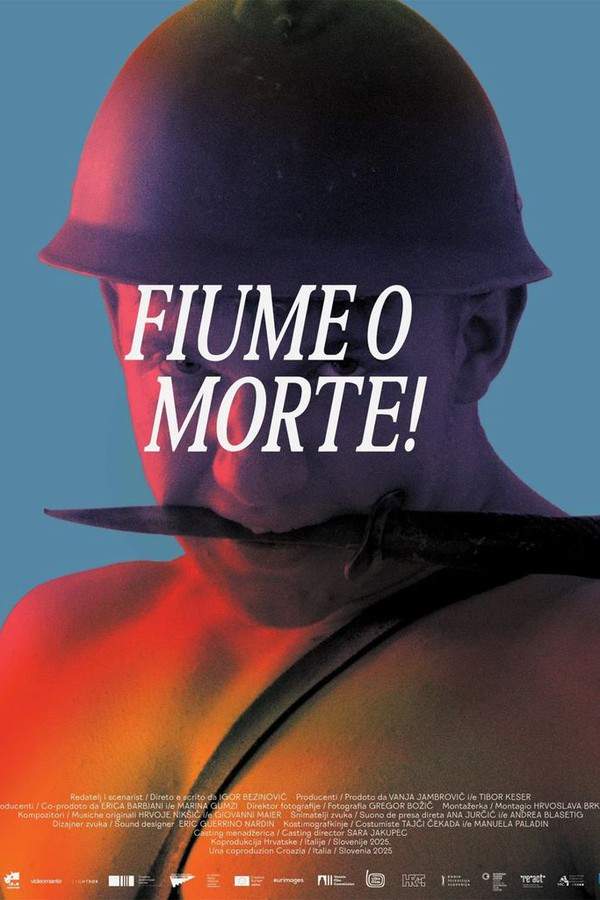
Fiume o morte! (2026) movie poster

Spoiler-Free Summary

Fiume o morte! (2026) Spoiler-Free Summary – What It's About

Release, runtime and language
2026 · 1 h 52 m · Croatian
Loading streaming availability…
Directed by
Igor Bezinovic
Starring
Nikola Tutek, Tihomir Buterin, Andrea Marsanich, Massimo Ronzani, Milovan Vecerina Cico, Albano Vucetic
Budget
$700K

During September 1919, Italian poet Gabriele D'Annunzio commanded a band of irregulars to seize the Adriatic port of Fiume, now in Croatia. Was he an egotistical dreamer intent on founding his own state, a nationalist‑driven utopian, or a fascist indifferent to the local populace who helped clear the path for Mussolini’s rise?

On this page (6)
  1. 1 Where to watch
  2. 2 What it is about
  3. 3 Is it worth watching?
  4. 4 After you watch
  5. 5 Movie threads
  6. 6 Every angle
Loading streaming availability…

Spoiler-free summary · safe to read

What Is Fiume o morte! About? (No Spoilers)

The plot of Fiume o morte! (2026) without spoilers: what it is about, who it follows and where it takes place, told without the twists or the ending. Enough to decide whether it is your next watch, not enough to ruin it.

markdown

In the coastal city now known as Rijeka, director Igor Bezinović wanders through streets layered with history, asking ordinary residents what they remember — or think they remember — about Gabriele D'Annunzio, the Italian poet and nationalist whose bold actions once put this port at the center of European attention. Their answers are hesitant, fragmentary, sometimes surprising, painting a picture of a figure whose presence lingers in faded plaques, whispered family stories, and the texture of daily life. What emerges is less a portrait of certainty than a meditation on how a city holds — or forgets — its past.

The film weaves together archival photographs, measured voiceover, and staged reenactments performed largely by the city's own inhabitants. Locals step into the shoes of soldiers, dignitaries, and even D'Annunzio himself, transforming familiar corners of Rijeka into a living collage where history and memory blur. Cameras also linger on the often-unseen labor behind such a project: auditions, rehearsals, debates about tone and truth, and the delicate negotiations that shape how a community chooses to represent itself. The result is a documentary that feels both intimate and inquisitive, less interested in delivering verdicts than in tracing the process by which stories get told at all.

At the heart of the inquiry lies a provocative question: was D'Annunzio an egotistical dreamer chasing a personal kingdom, a sincere utopian intoxicated by poetry and nationhood, or something darker — a proto-fascist whose ambitions helped pave the way for a more devastating future? The film offers no rush to judgment, instead letting archival spectacle, contemporary reflection, and the charged atmosphere of post–Great War Europe sit uneasily side by side. As the reenactors rehearse speeches and military rituals in settings that locals pass every day, the past feels less like a closed chapter and more like an ongoing conversation — one that the present-day city is still learning how to have.

Last updated: August 25, 2026 at 10:12

Was this helpful?

What to expect

Is Fiume o morte! Worth Watching? What It Feels Like

Is it dark, sad, slow, intense or confusing? The mood of Fiume o morte! (2026) in a few tags, without a word about how it ends. Each tag opens a list of movies that feel the same.

After you watch

Seen Fiume o morte!? Now Read the Spoilers

Once you have watched Fiume o morte! (2026), come back for the full story: the plot summary with spoilers, the timeline in chronological order, the characters and meaning.

Movie threads

More Movies Like Fiume o morte!, by Mood & Story

Curated lists built around what makes Fiume o morte! tick: the same mood, the same kind of story or the same emotional payoff. Each list explains why these movies belong together.

Community reenactment documentaries like Fiume o morte!

When ordinary townspeople pick up the costumes of a past they never lived. Movies like Fiume o morte! where residents and local performers reenact the contested events of their own city. If you liked Fiume o morte!, you'll find similar layered documentaries that blend oral history, staged reconstruction, and participatory filmmaking to explore how communities carry the weight of a difficult past.

  • participatory
  • community-driven
  • layered
  • reflective
  • observational
  • nostalgic
  • Tone: melancholic, reflective
  • Pacing: steady, observational
Why these movies?

The story pattern: These films typically move between past and present, weaving archival records with on-the-ground interviews and amateur or community performances. The narrative rarely resolves into a single verdict; instead, it circles around the same place, the same streets, the same contested figure. Characters are both historians and actors, and the audience is invited to watch memory being reconstructed in real time rather than being handed a tidy retelling.

Why they belong together: They share a participatory, observational mood, a steady pace that lets images and testimonies breathe, and a structural complexity that comes from layering multiple forms of evidence. Melancholy runs through them because the past is unresolved, and ambiguity lingers because no single voice is allowed to close the question. Viewers come away thinking about place, memory, and the strange intimacy of performing history you did not live.
Films tracing the origins of fascism and political extremism like Fiume o morte!

Stories that trace how charismatic radicals paved the road to authoritarian rule. If you liked Fiume o morte!, these are similar films about nationalist uprisings, charismatic political figures, and the ambiguous roots of modern authoritarianism. Expect historical documentaries and dramas that revisit the figures and movements that preceded Mussolini, Hitler, and other twentieth-century dictators, with complex arguments and no easy conclusions.

  • political
  • historical
  • nationalism
  • contested memory
  • ideology
  • unresolved
  • Tone: melancholic, somber
  • Pacing: steady, reflective
Why these movies?

The story pattern: Stories in this thread usually begin with a specific place and a specific year, then widen outward to ask how an extraordinary moment of political theater fed into larger historical currents. They follow a single magnetic figure whose ideology is hard to pin down, surrounded by followers, opponents, and bystanders whose motives remain unclear. The structure tends to circle rather than march forward, ending in ambiguity that mirrors the historical debate itself.

Why they belong together: They share an interest in the gray zone between romantic nationalism and outright fascism, and they resist simple moral verdicts. Pacing is patient, tone is melancholic or somber, and endings tend to be ambiguous because the question of how democracy curdles into extremism rarely has a clean answer. Viewers drawn to one will likely be drawn to the others because all of them treat the past as a live argument rather than a closed case.

Every angle

Fiume o morte! (2026) Explained: Plot, Timeline & Characters

Everything about Fiume o morte! in one place: what happens in the plot summary, the timeline in chronological order, the characters and meaning and a spoiler-free summary. What's After the Movie adds the cast, box office and post-credit scenes.

Coming soon on iOS and Android

The Plot Explained Movie Summary App

Plot summaries, endings explained and timelines on your phone. Catch up on any movie in minutes, save your favorites and never miss a twist again.

Be the first to know when we launch. Your email stays private, always.

Learn more about the app