













Plot Explained Spoilers guaranteed!
Plot Explained

Browse by genre

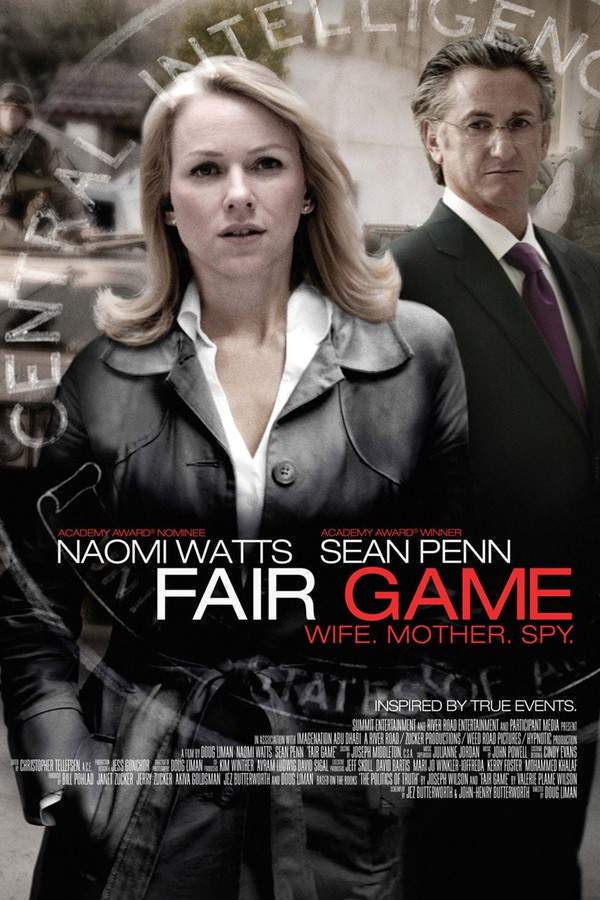
Fair Game (2010) movie poster

Plot Summary

Fair Game (2010) Plot Summary Explained

Release, runtime and language
2010 · 108 min · English
JustWatch #5,736 28
Directed by
Doug Liman
Starring
Naomi Watts, Sean Penn
Budget
$22M

Fair Game explores the true story of Valerie Plame, a covert CIA operative whose carefully constructed life is shattered when her identity is leaked to the public. The film delves into the political fallout and personal cost as Plame fights to uncover the truth behind the calculated exposure, navigating a complex web of espionage and government secrets.

On this page (7)
  1. 1 Where to watch
  2. 2 What happens: full plot
  3. 3 Plot questions answered
  4. 4 The book behind the movie
  5. 5 Movie threads
  6. 6 Movies like Fair Game
  7. 7 Every angle

Where to watch

Where to Watch Fair Game (2010)

Where can you watch Fair Game? Stream, rent or buy it in the US, including on Fawesome, Kanopy and Plex: current JustWatch availability with up-to-date prices.

Streaming availability powered by JustWatch

Full plot summary · contains spoilers

What Happens in Fair Game: Full Plot Summary

The whole story of Fair Game (2010) explained, from the opening scene to the final frame: every key event, every twist and what it all adds up to. Read it as a quick recap before the sequel, to check a scene you missed, or to finally understand what really happened.

Valerie Plame is a dedicated employee of the Central Intelligence Agency, but her covert role remains a closely guarded secret known only to her immediate family. As a highly skilled agent, she participates in a range of sensitive and perilous operations around the globe.

Her husband, Joseph C. Wilson, is a seasoned diplomat who has served as a U.S. ambassador to various African nations, including Gabon and Sao Tome and Principe. With his extensive experience, Wilson is approached by Plame’s CIA colleagues to undertake a mission to Niger. Their goal is to ascertain whether Iraq is attempting to procure yellowcake uranium for the potential development of nuclear weapons. After conducting his investigations, Wilson confidently concludes that the claims are unfounded.

In an unexpected turn of events, military action is initiated by President George W. Bush, who references these dubious uranium reports during his 2003 State of the Union address, asserting their significance in the justification for war. In response, Wilson publishes an op-ed in the New York Times, refuting the government's narrative and claiming the reports to be completely false.

The consequences of Wilson's assertions are profound, as Plame's identity as a CIA operative is publicly exposed, possibly linked to a leak from White House officials, including Scooter Libby, the Vice President's chief of staff. This revelation appears to be a political maneuver aimed at undermining Wilson’s credibility regarding the allegations of intelligence manipulation by the Bush administration as a pretext for war. Consequently, Plame is abruptly terminated from the CIA, leaving her ongoing assignments in jeopardy and placing a strain on her marriage.

The tension escalates when Plame distances herself from Wilson, particularly due to his participation in interviews that invite public scrutiny and threats against their safety. However, Wilson ultimately convinces her that confronting the formidable power of the White House is essential for them as citizens. In a bold move, Plame reconciles with Wilson and decides to testify before a Congressional committee. Meanwhile, Libby faces legal repercussions, being convicted of perjury and obstruction of justice, and receiving a 30-month prison sentence, which President Bush later commutes.

Last updated: November 03, 2024 at 23:30

Was this helpful?

Plot questions answered

Fair Game Plot Explained: Your Questions Answered

The questions people ask most about Fair Game (2010): what happens in the confusing scenes, why the characters do what they do, the twists, hidden details and what the ending means. Each answer contains spoilers.

Q1

Why was Valerie Plame's identity leaked to the public?

Valerie Plame's identity was leaked as retaliation for her husband Joseph Wilson publicly challenging the Bush administration's justification for the Iraq War. After Wilson wrote a New York Times op-ed disproving claims that Iraq was trying to acquire yellowcake uranium, White House officials, specifically Scooter Libby, leaked Plame's covert CIA status to undermine Wilson's credibility and punish him for contradicting the administration's narrative.

  • valerie plame
  • identity leak
  • cia operative
  • retaliation
  • joseph wilson
  • white house
Q2

Why did Joseph Wilson write the New York Times op-ed?

Wilson wrote the op-ed to expose what he believed was a deliberate manipulation of intelligence by the Bush administration. After being sent by the CIA to investigate claims that Iraq was seeking yellowcake uranium from Niger, Wilson concluded the allegations were false. When Bush cited these same dubious claims in his 2003 State of the Union address to justify war, Wilson felt compelled to go public with his findings to correct the record.

  • joseph wilson
  • op-ed
  • new york times
  • iraq war
  • yellowcake uranium
  • bush administration
Q3

Why was Valerie Plame fired from the CIA?

Plame was terminated from the CIA as a direct consequence of her identity being leaked publicly. Once her covert status was exposed through the media, her ability to conduct undercover operations was compromised, making her position at the agency untenable. The exposure also placed her ongoing assignments and sources at risk, forcing the CIA to remove her from active duty.

  • valerie plame
  • cia termination
  • fired
  • career damage
  • exposure
Q4

What was the mission to Niger about?

The CIA sent Joseph Wilson to Niger to investigate whether Iraq was attempting to purchase yellowcake uranium, a key component for nuclear weapons development. Wilson was chosen because of his diplomatic experience in Africa. After conducting interviews and reviewing documents, Wilson determined the allegations were unfounded, there was no credible evidence Iraq was pursuing uranium from Niger.

  • niger
  • yellowcake uranium
  • cia mission
  • iraq nuclear
  • wmd
Q5

Why did President Bush commute Scooter Libby's prison sentence?

President Bush commuted Libby's 30-month prison sentence in 2007, a decision that drew significant public criticism. Though Libby was convicted of perjury and obstruction of justice for his role in leaking Plame's identity, Bush determined the sentence was excessive. Critics viewed the commutation as protecting a White House official while allowing the actual leak to go unpunished.

  • scooter liberty
  • bush commutation
  • prison sentence
  • perjury
  • obstruction justice
Q6

Why did Valerie Plame distance herself from Joseph Wilson?

Valerie Plame withdrew from her husband primarily due to the intense public scrutiny and threats that followed Wilson's interviews and op-ed. The exposure of her CIA identity placed both their safety at risk, and she felt his continued public engagement invited dangerous attention to their family. The strain of living under constant threat and the politicization of their personal life created significant marital tension.

  • valerie plame
  • joseph wilson
  • marital strain
  • threats
  • public scrutiny
  • safety
Q7

What was the connection between Wilson's op-ed and Plame's identity being leaked?

The leak was directly retaliatory. When Wilson published his op-ed contradicting the administration's Iraq War justification, White House officials viewed it as a direct challenge to their authority. By exposing Plame's CIA identity, they sought to discredit Wilson by implying his findings were influenced by his wife's intelligence work, thereby undermining his credibility and distracting from the substantive claims in his article.

  • retaliation
  • political revenge
  • credibility attack
  • white house leak
Q8

Why did the Iraq War justification matter so much in this story?

The uranium claims were central to Bush's case for invading Iraq. The administration cited Iraq's alleged pursuit of nuclear materials as evidence of weapons of mass destruction. When Wilson proved the claims were baseless, it undermined a key rationale for war. His public contradiction exposed what many called a pretext for war, making his op-ed politically explosive and triggering the retaliatory leak.

  • iraq war
  • weapons of mass destruction
  • pretext
  • intelligence manipulation
  • bush state of union
Q9

What happened to Scooter Libby after the leak?

Scooter Libby was charged with perjury, obstruction of justice, and making false statements to FBI investigators about his role in leaking Plame's identity. He was convicted on all counts in 2007 and sentenced to 30 months in prison. While he acknowledged authorizing the leak, he maintained his innocence regarding the specific criminal charges. His conviction represented a rare legal consequence for White House officials involved in the scandal.

  • scooter liberty
  • trial
  • conviction
  • perjury
  • obstruction justice
  • legal consequences
Q10

Why did Valerie Plame decide to testify before Congress?

Plame testified before Congress to fight back against the injustice she suffered and to hold accountable those responsible for destroying her career. After reconciling with Wilson, she chose to confront the powerful institutions that had targeted her family. Her testimony was a deliberate act of resistance, using her personal experience to expose the political retaliation and hold government officials accountable.

  • congressional testimony
  • valerie plame
  • justice
  • accountability
  • political retaliation

Movie threads

More Movies Like Fair Game, by Mood & Story

Curated lists built around what makes Fair Game tick: the same mood, the same kind of story or the same emotional payoff. Each list explains why these movies belong together.

Whistleblower Dramas Under Fire like in Fair Game

Stories of individuals whose lives shatter after exposing powerful secrets. If you were gripped by the high-stakes true story in Fair Game, explore more movies about individuals whose lives are turned upside down after exposing powerful secrets. These tense dramas focus on the personal cost of truth-telling against formidable opposition.

  • tense
  • gripping
  • high stakes
  • frustrating
  • persecuted
  • dramatic
  • Tone: tense, frustrating, gripping
  • Pacing: steady, escalating crisis
Why these movies?

The story pattern: The narrative typically follows a protagonist who discovers a grave injustice or abuse of power. Their decision to reveal the truth triggers a catastrophic chain of events, leading to public exposure, career destruction, and intense personal strain. The story chronicles their fight for survival and justice against a system designed to crush them.

Why they belong together: Movies in this thread share a high-intensity, tense atmosphere driven by the protagonist's vulnerability against a powerful adversary. They feature heavy emotional weight, a steady pace of escalating crises, and often a bittersweet conclusion where principles are upheld but at a tremendous personal loss.


Movies about Institutional Paranoia like Fair Game

When the very institutions you serve turn against you, creating a claustrophobic nightmare. For viewers who appreciated the tense atmosphere of betrayal in Fair Game, this collection features stories where characters find themselves persecuted by the powerful organizations they once trusted. Discover similar movies about navigating a web of secrets and fighting back against systemic corruption.

  • paranoid
  • tense
  • claustrophobic
  • gripping
  • high stakes
  • betrayal
  • Tone: tense, paranoid, bleak
  • Pacing: steady, deliberate dread
Why these movies?

The story pattern: The story begins with a protagonist deeply embedded within a powerful institution. A conflict arises, causing the institution to view them as a threat. The narrative unfolds as the protagonist's world closes in, with their career, relationships, and safety being methodically targeted, forcing them into a desperate struggle for vindication.

Why they belong together: These films are united by a palpable atmosphere of paranoia and a tense, gripping tone. They depict a high-stakes battle where an individual is pitted against a faceless system, resulting in a heavy emotional journey with a steady, deliberate pace that builds dread and emphasizes the psychological toll.

If you liked this

Movies Like Fair Game

Similar movies to Fair Game: the same genre, themes or kind of story. Each one comes with its own plot summary, timeline and ending explained.

Browse all movie summaries

Every angle

Fair Game (2010) Explained: Plot, Timeline & Characters

Everything about Fair Game in one place: what happens in the plot summary, the timeline in chronological order, the characters and meaning and a spoiler-free summary. What's After the Movie adds the cast, box office and post-credit scenes.

Coming soon on iOS and Android

The Plot Explained Movie Summary App

Plot summaries, endings explained and timelines on your phone. Catch up on any movie in minutes, save your favorites and never miss a twist again.

Be the first to know when we launch. Your email stays private, always.

Learn more about the app