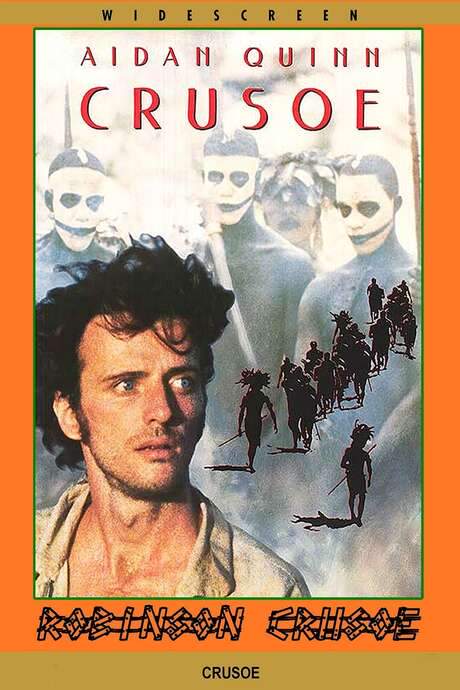
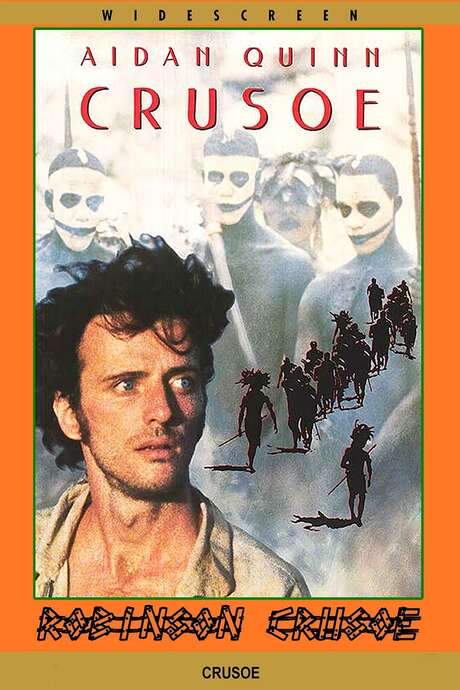
In Tidewater, Virginia, 1808, Crusoe, Aidan Quinn, sets sail for Africa to buy enslaved people. A furious storm tears through the sea, and the ship wrecks, leaving Crusoe as the sole survivor. He washes up on a lush tropical island, where he discovers that a dog named Scamp and a small flock of geese have also endured the disaster. With Scamp by his side, Crusoe learns to adapt to the island’s harsh rhythms, carving out a basic life and turning the wrecked vessel’s remains into tools and shelter. He gradually grows more confident, venturing farther with his rifle in hand as he learns to read the island’s dangers and opportunities.
Soon Crusoe encounters a group of indigenous tribesmen who are not natives of the island and who practice cannibal rituals. In his quest to return home, he begins felling trees to build a boat, hoping to escape the isolation. The effort pushes him to convert a cavern into a sturdy, if rudimentary, homestead. Tragedy strikes when Scamp falls ill and dies the next morning, plunging Crusoe into a deep, aching loneliness that presses him to continue surviving on his own terms.
As his loneliness deepens, a flotilla of small boats arrives for a ceremonial cannibal funeral, including the ritual cremation of their chief and the sacrifice of three companions. The chief sits in a grand, armchair-like throne as the flames rise. In the midst of the chaos, Crusoe fires his rifle to disrupt the ceremony, enabling the would-be victim—Lucky, a wary cannibal who gradually earns Crusoe’s cautious trust—to escape, and Crusoe himself also slips away. The two men meet in the forest, and though Crusoe is wary and brandishes his weapon, Lucky does not perceive him as a threat, allowing them to retreat to the beach with the impression that the cannibals have left.
From this moment, Lucky remains a wary ally as Crusoe brings him back to the cave, but the tribal bond is fragile; Crusoe keeps Lucky tethered outside the cave, and the next morning he finds Lucky has vanished. He follows the smoke to the ritual site and discovers the severed head of Lucky, a grim reminder of the island’s dangers. Crusoe’s life is further upended when he is grabbed by one of the cannibals, The Warrior, Ade Sapara, who ties him to a tree near the cave. The following day, Crusoe tries to turn the tables with revenge, firing at his captor during their struggle, and they stumble into quicksand. The Warrior slips free, leaving Crusoe to sink, but mercy arrives when the cannibal lowers Crusoe a branch to safety. The two begin to communicate through improvised language, and gradually they recognize a shared goal: to build a small boat to return home.
Together they complete a first craft, and just as hope seems within reach, a ship arrives—European sailors who have come not to aid Crusoe, but to seize his new ally. Realizing this, Crusoe hurries to signal the vessel from higher ground, unaware that the crew intends to capture the cannibal rather than rescue Crusoe alone. Craving liberty and a real chance at life, Crusoe eventually makes a bold move: he stows away aboard the ship, concealing himself amid the crew. Among the sailors is Dr Martin, Michael Higgins, a scientist who has studied cannibals and plans to take his “friend” back to London. Crusoe, however, strongly opposes the plan to render his ally a prize, and he works in secret to free his friend without drawing attention. After a tense struggle and careful scheming, Crusoe escapes the ship and, through a hard-won journey, ultimately leaves the island behind. The experience teaches him that liberty and life are precious, and it reshapes his understanding of what it means to be free.