Plot Explained Spoilers guaranteed!
Plot Explained

Browse by genre

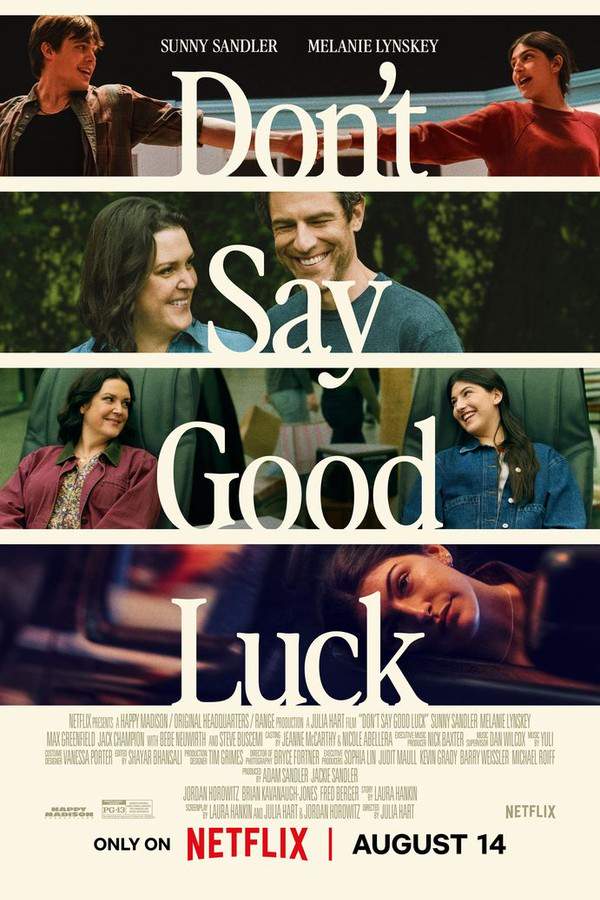
Don't Say Good Luck (2026) movie poster

Ending Explained

Don't Say Good Luck (2026) Ending Explained – Final Scene & Meaning

Release, runtime and language
2026 · English
Echo score 76
Loading streaming availability…
Directed by
Julia Hart
Starring
Stephanie Beatriz, Steve Buscemi, Melanie Lynskey, Scarlett Estevez, Jack Champion, Jon Lovitz

In this coming‑of‑age dramedy, Sophie Birenbaum finally lands the coveted lead in her high‑school musical and prepares for her moment onstage, only to find that escalating family tensions at home create far more chaos than any rehearsal, forcing her to juggle ambition, responsibility and the messy realities of growing up.

On this page (6)
  1. 1 Where to watch
  2. 2 What happens at the end
  3. 3 Final events in order
  4. 4 Ending questions answered
  5. 5 Movie threads
  6. 6 Every angle
Loading streaming availability…

Ending explained · contains spoilers

What Happens at the End of Don't Say Good Luck?

How Don't Say Good Luck (2026) ends, what the final scene means, which earlier moments set it up and how to read the ending if the film leaves it open. The full ending explained, with every spoiler.

Sophie completes the school production of Waitress and finally reaches the emotional truth of She Used to Be Mine, a song her teacher previously felt she had not fully inhabited. She then performs it again in the backyard for her mother, Elizabeth. Elizabeth is still alive in the last scene, but her recurrent cancer remains terminal; the film offers neither a recovery nor an on-screen death. The private performance becomes their goodbye while both can still participate in it, transforming the show Sophie once felt guilty about pursuing into something she and her mother can share during their limited remaining time.

The omission of Elizabeth's death keeps the ending on the relationship rather than the physical mechanics of dying. Sophie has treated being a devoted daughter and continuing her teenage life as incompatible choices, but Elizabeth insists that anticipatory grief should not make her abandon the stage. Singing lets Sophie express what she cannot fix or comfortably say, and it lets Elizabeth witness her daughter moving forward without confusing that movement with abandonment. Art does not cure the illness or package Sophie's future after loss. It gives fear and love a form they can hold together, ending the story on presence instead of waiting for the inevitable absence.

Last updated: August 25, 2026 at 14:20

Was this helpful?

The last 4 events

How Don't Say Good Luck Ends: The Final Events in Order

The last events of Don't Say Good Luck (2026) in chronological order, the run-up to the ending explained above. The complete timeline has all 15 events, scene by scene.

Open the full timeline
  1. Support from Friends

    At school, Carolyn reassures Sophie of her support despite earlier tensions. Sophie learns about Carolyn’s new relationship with Erin, which she embraces, feeling a sense of relief as she gathers strength from the support of her friends.

    Where
    School
  2. The Decision to Perform

    Initially, Sophie considers passing her role to Mallory to be with her mother but ultimately decides to return and perform. This decision highlights her growth and the importance of fulfilling her commitment to the play.

  3. Mending Family Relationships

    In the midst of preparing for the show, Elizabeth reconciles with her parents, who come to support Sophie during the performance. This family gathering underscores the importance of unity in the face of their challenges.

  4. Summer Celebration

    As summer arrives, Sophie's family decorates their backyard with the same touches as the beach house from the musical. Sophie performs a song for her mother, creating a touching memory that symbolizes their bond amid the trials they face.

    Where
    Backyard

Ending questions answered

Don't Say Good Luck Ending: Your Questions Answered

The questions people ask most about the ending of Don't Say Good Luck (2026): what the final scene means, how the twist works, what happens to each character and how to read the ending. Each answer contains spoilers.

Q1

Why doesn't the ending show Elizabeth dying?

Don't Say Good Luck deliberately avoids depicting Elizabeth's death to keep the emotional focus on the mother-daughter relationship rather than the physical mechanics of dying. By leaving Elizabeth alive in the final scene, the film centers on what the characters still have together instead of what they are about to lose. The omission transforms the backyard performance into a shared goodbye while both can still actively participate in it.

  • elizabeth death scene
  • why no death
  • ending meaning
  • bittersweet ending
Q2

What is the meaning of the backyard performance in the ending?

The backyard performance serves as a private, intimate version of the school show that Sophie once felt guilty about pursuing. By singing the same song for Elizabeth alone, Sophie turns her personal achievement into a shared gift between mother and daughter. It becomes their goodbye ritual while both are still present and able to take part in the moment.

  • backyard performance
  • sophie sings for mother
  • private performance
  • ending meaning
Q3

Why does Sophie sing "She Used to Be Mine" a second time for her mother?

Sophie repeats the song because the first performance in the school musical finally reached an emotional truth she had been missing, and she wants to share that breakthrough directly with Elizabeth. The second performance lets her say what she cannot comfortably articulate in conversation. It is both a personal farewell and a way of letting her mother witness her daughter moving forward.

Foreshadowing: Earlier rehearsal scenes show her teacher feeling she had not yet fully inhabited the song.

  • she used to be mine twice
  • sophie sings again
  • second performance
  • emotional truth
Q4

What does anticipatory grief mean in the context of the ending?

Anticipatory grief refers to the mourning that begins before an actual loss, and Elizabeth warns Sophie against letting it consume her remaining time. In Don't Say Good Luck, this concept shapes the mother's insistence that Sophie continue performing rather than collapse into premature sorrow. The ending embraces grief but rejects the idea that it should replace living.

  • anticipatory grief
  • grief before death
  • elizabeth advice
  • premature mourning
Q5

Why does Elizabeth tell Sophie not to give up the musical?

Elizabeth understands that Sophie has begun treating devotion to her mother and her teenage ambitions as mutually exclusive, and she refuses to let that false choice stand. By encouraging her to stay onstage, Elizabeth gives Sophie permission to keep growing even as her own health declines. It is one of the clearest expressions in Don't Say Good Luck of a parent prioritizing her child's future over her own need to be needed.

Foreshadowing: Elizabeth has consistently supported Sophie's theatrical ambitions throughout the film.

  • elizabeth encourages sophie
  • don't quit musical
  • mother daughter bond
  • false choice
Q6

How does the ending resolve Sophie's guilt about pursuing the lead role?

The private backyard performance reframes the musical from something Sophie felt guilty about into something she and her mother can share. Instead of the show pulling Sophie away from Elizabeth, it becomes the vehicle through which she expresses what she cannot say in words. Don't Say Good Luck does not erase the guilt but transforms it into connection during their limited remaining time.

  • sophie guilt musical
  • feeling guilty about show
  • mother daughter reconciliation
  • lead role
Q7

What does the beach-set backyard scene symbolize?

The family decorates their lawn to resemble a beach set because they want to give Elizabeth and Sophie a setting that feels somewhere beyond the ordinary confines of illness and hospital rooms. It transforms their home into a stage where art, memory, and tenderness can coexist. The set also mirrors the musical world Sophie has been inhabiting, blurring the line between performance and real life.

  • beach set backyard
  • family decorates lawn
  • beach stage
  • performance and reality
Q8

What does the ending say about art and dealing with grief?

The ending suggests that art cannot cure illness or fully prepare anyone for loss, but it can give shape to feelings that are otherwise too large to hold. Through the song, Sophie and Elizabeth find a way to share fear and love at the same time. Don't Say Good Luck ends on the idea that creative expression is not a solution but a container for what cannot be fixed.

  • art and grief
  • music as expression
  • creative expression loss
  • emotional container
Q9

Is the ending of Don't Say Good Luck hopeful or tragic?

The ending is bittersweet, holding both loss and growth at the same time. Elizabeth's terminal cancer is not resolved, and the film offers no recovery, but Sophie emerges with her voice, her relationship with her mother intact, and permission to keep living. The story refuses false hope while still insisting that presence and love remain possible in the face of inevitable absence.

  • hopeful or tragic ending
  • bittersweet ending
  • don't say good luck ending
  • presence and loss
Q10

What is the significance of "She Used to Be Mine" for Sophie?

The song is about a woman reckoning with a version of herself that has been lost, and it mirrors Sophie's fear of losing both her mother and the carefree identity she had before the cancer returned. Reaching its emotional truth signals that Sophie has finally metabolized her grief rather than performing around it. The song becomes the film's emotional climax because it names exactly what Sophie is afraid of becoming.

Foreshadowing: Earlier rehearsal scenes show Sophie struggling to connect with the song's emotional core.

  • she used to be mine significance
  • waitress musical
  • song meaning
  • lost identity
Q11

What does the ending suggest about Sophie's future?

The ending positions Sophie as someone who will carry grief forward without letting it erase her ambitions or her ability to connect. Elizabeth's blessing to keep performing suggests Sophie is meant to continue in the arts and in life beyond her mother's death. Don't Say Good Luck does not specify what comes next, but it frames Sophie's future as something worth living into rather than something to mourn before it begins.

  • sophie's future
  • what happens next
  • life after mother's death
  • moving forward

Movie threads

More Movies Like Don't Say Good Luck, by Mood & Story

Curated lists built around what makes Don't Say Good Luck tick: the same mood, the same kind of story or the same emotional payoff. Each list explains why these movies belong together.

Teen grief stories like Don't Say Good Luck

Coming-of-age stories where adolescence ends the moment illness knocks. Discover more coming-of-age dramas about teenagers facing a parent's terminal illness, blending grief and loss with high school life, first love, and family bonds. If you liked Don't Say Good Luck, these emotionally heavy, bittersweet movies will stay with you long after the credits roll.

  • teen grief
  • terminal illness
  • bittersweet
  • growing up too fast
  • family bonds
  • tender sadness
  • Tone: bittersweet, tender, heavy
  • Pacing: variable, punctuated peaks
Why these movies?

The story pattern: The protagonist is a high schooler whose world splits between ordinary teenage concerns and the looming presence of a parent's declining health. The story unfolds along a linear emotional arc, with everyday scenes punctuated by medical crises. The young person tries to keep their ambitions, friendships, and identity intact while the family hides the truth or fights to maintain normalcy. The ending often offers a moment of tender closure, sometimes a private ritual or a public performance, that honors both the life lived and the future still ahead.

Why they belong together: These films share a heavy, bittersweet emotional register and a focus on how grief reshapes adolescence. They balance warmth and humor with deep sadness, often using music, performance, or family ritual as emotional anchors. Pacing tends to vary between steady ordinary scenes and dramatic peaks tied to illness or loss.


Performances born from heartbreak like in Don't Say Good Luck

Dramedies where art, music, or performance become a lifeline against heartbreak. Explore more movies like Don't Say Good Luck where music, theater, and stage performance become a refuge from grief and family crisis. These bittersweet musical dramas and dramedies use art as a lifeline, blending high school musicals, first love, and the heavy realities of loss into one unforgettable emotional arc.

  • theatrical
  • musical
  • performance
  • art as refuge
  • coming of age
  • bittersweet
  • Tone: bittersweet, warm, hopeful, heavy
  • Pacing: variable with dramatic peaks
Why these movies?

The story pattern: A young artist is preparing for a defining performance, whether a school musical, recital, audition, or final show, while their private life is collapsing around them. Rehearsals and ordinary teenage rhythms carry the narrative, with the performance itself becoming the emotional climax. Whether or not the show goes on, the act of performing becomes a way to speak what words cannot. The arc moves from nervous ambition through quiet resilience to a final curtain that doubles as farewell or rebirth.

Why they belong together: These films share the tonal blend of musical warmth with personal grief, and use performance as both setting and metaphor. They tend to be variable in pacing, heavy in emotional weight, and bittersweet in resolution. Many are YA-adjacent dramas centered on young protagonists discovering their voice through art while life unravels.

Every angle

Don't Say Good Luck (2026) Explained: Plot, Ending, Timeline & Characters

Everything about Don't Say Good Luck in one place: what happens in the plot summary, the timeline in chronological order, the characters and meaning, the ending explained and a spoiler-free summary. What's After the Movie adds the cast, box office and post-credit scenes.

Coming soon on iOS and Android

The Plot Explained Movie Summary App

Plot summaries, endings explained and timelines on your phone. Catch up on any movie in minutes, save your favorites and never miss a twist again.

Be the first to know when we launch. Your email stays private, always.

Learn more about the app