Plot Explained Spoilers guaranteed!
Plot Explained

Browse by genre

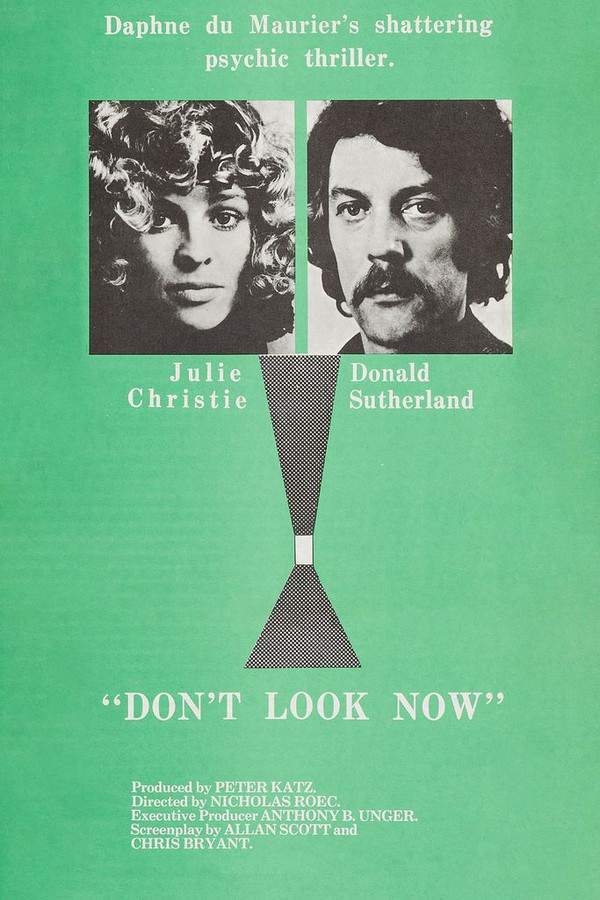
Don't Look Now (1973) movie poster

Plot Summary

Don't Look Now (1973) Plot Summary Explained

Release, runtime and language
1973 · 110 min · English
Loading streaming availability…
Directed by
Nicolas Roeg
Starring
Donald Sutherland, Julie Christie, Renato Scarpa, Massimo Serato, Ann Rye, Clelia Matania

Following a devastating loss, a couple seeks solace in Venice, hoping to mend their fractured relationship. While exploring the city's historic canals and architecture, the woman experiences unsettling visions and a growing sense of spiritual awareness. Her husband, struggling with his own grief, initially dismisses her concerns, but he too begins to question his beliefs as a disturbing presence emerges, blurring the lines between reality and illusion and putting their lives in danger.

On this page (7)
  1. 1 Where to watch
  2. 2 What happens: full plot
  3. 3 Plot questions answered
  4. 4 The book behind the movie
  5. 5 Movie threads
  6. 6 Movies like Don't Look Now
  7. 7 Every angle
Loading streaming availability…

Full plot summary · contains spoilers

What Happens in Don't Look Now: Full Plot Summary

The whole story of Don't Look Now (1973) explained, from the opening scene to the final frame: every key event, every twist and what it all adds up to. Read it as a quick recap before the sequel, to check a scene you missed, or to finally understand what really happened.

Some time after the tragic drowning of their young daughter, Christine, at their English countryside residence, John Baxter and his heartbroken wife Laura embark on a trip to Venice. Here, John has accepted a commission from a bishop to restore an ancient church. During a meal at a local restaurant, Laura encounters two elderly sisters, Heather and Wendy, where Heather, despite being blind, astonishingly claims to have psychic abilities and reveals that she can "see" the deceased Christine. This unsettling revelation leaves Laura shaken, causing her to faint at the table.

After being taken to the hospital, Laura recounts Heather's words to John, who remains skeptical but is pleasantly surprised by the noticeable uplift in Laura's spirits. That evening, following their hospital visit, passionate intimacy ensues between John and Laura. Later, while heading out for dinner, they lose their way and briefly separate. In this moment, John catches a fleeting glimpse of a small figure clad in a red coat, reminiscent of the one Christine wore when she perished.

The following day, Laura reconnects with Heather and Wendy for a séance in hopes of communicating with Christine. Upon her return to the hotel, Laura informs John that Christine warned her of impending danger, urging them to leave Venice. An argument ensues, but that same night they receive a distressing phone call: their son has suffered injuries at boarding school. Laura quickly departs for England, while John remains in Venice to finish the restoration. Shortly after, he faces death when the scaffold he is on collapses, a moment he interprets as the danger foretold by the sisters.

Later, believing Laura is in England, John is taken aback when he spots her aboard a boat in a funeral procession, accompanied by the sisters. With concerns growing about Laura's mental state and the looming threat of a serial killer in Venice, John reports her mysterious behavior to the police. The investigating inspector grows suspicious of John, initiating an undercover surveillance. In a desperate effort to find Laura and the sisters, John unsuccessfully searches the city, encountering the childlike figure in the red coat once more.

Upon reaching out to his son's school to confirm his condition, John discovers that Laura is indeed there. Confused, he races back to the police station to inform them of his wife's whereabouts. Meanwhile, the police have brought Heather in for questioning. An apologetic John offers to escort her back to the hotel.

Once they return, Heather unexpectedly slips into a trance. Urgently sensing danger, she implores her sister to pursue John, who has already left. As John ventures out, he suddenly spots the mysterious figure in red again and decides to chase it down. He corners the figure in an abandoned palazzo, believing it to be a child. However, when the figure turns to face him, the shocking reality unfolds—it is a deformed female dwarf. As John stands frozen in disbelief, the dwarf unsheathes a meat cleaver and cuts his throat. In his dying moments, John realizes that the unsettling visions he had experienced were premonitions of his own murder and impending funeral.
Last updated: November 15, 2024 at 20:45

Was this helpful?

Plot questions answered

Don't Look Now Plot Explained: Your Questions Answered

The questions people ask most about Don't Look Now (1973): what happens in the confusing scenes, why the characters do what they do, the twists, hidden details and what the ending means. Each answer contains spoilers.

Q1

Why did John ignore the psychic sisters' warnings about danger in Venice?

John dismissed the warnings because he was fundamentally skeptical of the supernatural. After losing his daughter Christine, he struggled with grief and rationalized his wife's increased spirituality as a coping mechanism. When Heather claimed to see Christine and warned of impending danger, John interpreted it as harmful nonsense that could derail Laura's recovery. His skepticism persisted even after the scaffold collapse, which he dismissed as coincidence rather than the predicted danger. This refusal to believe ultimately led to his death, proving the warnings were genuine premonitions.

Foreshadowing: Earlier in the film, John's rational nature is established when he remains skeptical after Laura faints at the restaurant, choosing to focus on her improved mood rather than Heather's psychic claims.

  • john baxter
  • skepticism
  • psychic warnings
  • heather
  • venice danger
Q2

Was Laura actually in England when John saw her in the funeral procession?

The film creates deliberate ambiguity about Laura's whereabouts. John believes Laura is in England caring for their injured son, yet he sees her aboard a funeral boat accompanied by the psychic sisters. Later, when John contacts the school, he confirms his son was never injured and that Laura was indeed in England. This contradiction suggests John may have been seeing a supernatural apparition or that his mental state was deteriorating. The funeral procession he witnessed was likely a premonition of his own death, which the psychic sisters had warned about.

Foreshadowing: The psychic sisters warned Laura that Christine warned of danger, and John's visions of a small figure in red had been premonitions throughout the film.

  • laura baxter
  • funeral procession
  • england
  • psychic sisters
  • venice
Q3

Who was the figure in the red coat that John kept seeing in Venice?

The mysterious figure in the red coat that John glimpsed throughout the film was revealed to be a deformed female dwarf. When John finally cornered the figure in an abandoned palazzo, expecting to find a child, he discovered the dwarf, who attacked him with a meat cleaver. The red coat resembled the one Christine wore when she drowned, making the figure a supernatural manifestation related to John's guilt and grief. The dwarf was not Christine but rather a representation of the danger the psychic sisters had warned about.

Foreshadowing: John first glimpses the figure in red while lost and separated from Laura, and he spots it multiple times throughout his search for the sisters, each sighting increasing his dread.

  • red coat
  • dwarf
  • figure
  • christine
  • venice
  • abandoned palazzo
Q4

What caused the scaffold collapse at the church John was restoring?

The scaffold collapse appears to be a genuine accident rather than sabotage, though the film leaves it ambiguous. John was working on restoring an ancient church commissioned by a bishop when the scaffold gave way. He survived the fall and interpreted it as the danger the psychic sisters had warned about. However, the true danger came later from the dwarf. The collapse can be seen as either a coincidental accident or a supernatural event meant to further test John's belief in the sisters' warnings.

Foreshadowing: John had accepted the church restoration job shortly after arriving in Venice, and the sisters' warning about danger preceded this life-threatening incident.

  • scaffold collapse
  • church restoration
  • venice
  • bishop
  • john baxter
Q5

Why did the Venice police become suspicious of John Baxter?

The police grew suspicious of John because he reported his wife's mysterious behavior while simultaneously being unable to account for his own actions. John told police that Laura was in England with their injured son, yet he was seen searching for her frantically in Venice. His frantic pursuit of the sisters and strange stories about premonitions made him appear unstable or potentially dangerous. The police also discovered he was alone in Venice while his wife supposedly stayed in England, raising questions about his credibility and intentions.

Foreshadowing: John's increasingly desperate search for Laura and the sisters, combined with his vague explanations about visions, created suspicion during a time when a serial killer was active in Venice.

  • police
  • venice
  • john baxter
  • suspicion
  • investigation
Q6

What did John realize at the moment of his death?

At the moment of his death, John realized that all his unsettling visions, the glimpses of the figure in the red coat, the funeral procession, the scaffold collapse, were premonitions of his own murder and funeral. His skepticism toward the psychic sisters' warnings had been misplaced. The danger Christine supposedly warned about was not an accident or generic threat but specifically John's death at the hands of the dwarf. His rational worldview was catastrophically wrong, and his dismissal of the supernatural warnings led directly to his demise.

Foreshadowing: Throughout the film, John dismissed each vision as grief-induced幻觉, never considering they might be genuine premonitions of his own fate.

  • john baxter
  • death
  • realization
  • premonitions
  • funeral
  • dwarf
Q7

Why did Laura faint after meeting the psychic sisters at the restaurant?

Laura fainted because Heather's claimed revelation was emotionally devastating. When Heather, despite being blind, declared she could see Christine, Laura was overwhelmed by the possibility that her dead daughter might be reaching out from beyond. The combination of grief, hope, and the uncanny nature of the claim caused Laura to faint at the table. This reaction contrasted sharply with John's skeptical dismissal, and it marked the beginning of Laura's deeper involvement with the sisters and their attempts to communicate with Christine.

Foreshadowing: The fainting incident occurred shortly after Laura and John arrived in Venice seeking to escape their grief, establishing how vulnerable Laura was to supernatural claims.

  • laura baxter
  • faint
  • psychic sisters
  • heather
  • christine
Q8

Why did Laura leave Venice after the phone call about their son's injuries?

Laura left Venice because she received a phone call claiming their son had been injured at boarding school. This urgent news prompted her to return to England immediately to care for him. However, this created confusion because later, when John verified his son's condition at the school, he learned his son was never injured and Laura was actually there with him. This contradiction suggests either the phone call was fabricated or part of a manipulation by the psychic sisters, though the film leaves the true nature of this event ambiguous.

Foreshadowing: The phone call occurred right after Laura and John argued about the sisters' warning that Christine urged them to leave Venice due to danger.

  • son
  • injuires
  • phone call
  • laura
  • england
  • boarding school
Q9

What did the psychic sisters know about the danger in Venice?

The psychic sisters knew that death awaited John in Venice. Through their séance, they claimed to contact Christine, who warned of impending danger. While they believed the danger was directed at both John and Laura, it was specifically John's fate that Christine warned about. Heather's trance near the end of the film revealed her sensing immediate danger, prompting her to urge Wendy to follow John. Their warnings were genuine supernatural premonitions, though the nature of the danger, the dwarf, was not something they could clearly articulate.

Foreshadowing: The sisters' warning came directly from their séance communication with Christine, and Heather's psychic abilities were established when she accurately claimed to see the deceased daughter.

  • heather
  • wendy
  • danger
  • psychic
  • christine
  • seance
  • premonition
Q10

Why did John chase the figure in the abandoned palazzo?

John chased the figure because he believed it was the key to understanding the mystery surrounding Laura and the sisters. Throughout his time in Venice, John had glimpsed the small figure in the red coat multiple times, and his desperation to find Laura drove him to pursue it. He believed he would find either the sisters or answers about what was happening. When he finally cornered the figure in the abandoned palazzo, he expected to find a child, not recognizing that the red coat was a supernatural decoy drawing him to his death.

Foreshadowing: John's earlier sightings of the figure in red had occurred during his frantic searches for Laura and the sisters, and each sighting drew him deeper into the mystery.

  • john baxter
  • chase
  • dwarf
  • abandoned palazzo
  • red coat

Movie threads

More Movies Like Don't Look Now, by Mood & Story

Curated lists built around what makes Don't Look Now tick: the same mood, the same kind of story or the same emotional payoff. Each list explains why these movies belong together.

Movies about grief and supernatural visions like Don't Look Now

Stories where a profound personal loss opens the door to unsettling supernatural forces. If you liked the way Don't Look Now intertwines deep personal tragedy with eerie supernatural elements, you'll find similar stories here. These movies explore how grief can manifest as premonitions or visions, creating a tense and melancholic atmosphere where characters struggle to discern truth from their sorrow.

  • haunting
  • melancholic
  • unsettling
  • desperate
  • suspenseful
  • somber
  • Tone: tense, melancholic, bleak
  • Pacing: slow, deliberate
Why these movies?

The story pattern: The narrative pattern typically follows a character reeling from a devastating loss, who begins to experience inexplicable visions or warnings. Their skepticism or the skepticism of those around them creates central conflict, often leading to a tragic or bleak conclusion that validates the very premonitions they tried to ignore.

Why they belong together: Movies are grouped here for their shared thematic core of processing immense grief through a supernatural lens. They share a heavy emotional weight, a tense and melancholic tone, and a focus on the psychological unraveling that occurs when the metaphysical intrudes upon personal tragedy.

Slow burn atmospheric thrillers with a haunting setting like Don't Look Now

Atmospheric thrillers where a vivid setting becomes a character in a simmering story of dread. For viewers who appreciated the slow-building tension and the integral role of Venice's canals in Don't Look Now, this section features similar movies. These films use their settings to create a dreamlike, claustrophobic, or haunting atmosphere where psychological dread unfolds at a deliberate pace.

  • slow burn
  • atmospheric
  • unsettling
  • claustrophobic
  • dreamlike
  • suspenseful
  • Tone: tense, unsettling, dreamlike
  • Pacing: slow burn, atmospheric
Why these movies?

The story pattern: The narrative unfolds gradually, allowing the atmosphere of the setting to seep into the story. The plot is often secondary to the building sense of unease and the characters' psychological deterioration within their environment. The pacing is intentionally slow, making the eventual climax feel both inevitable and deeply unsettling.

Why they belong together: These films are connected by their masterful use of pacing and setting to create a specific, immersive vibe. They share a slow, deliberate rhythm, a high-tension tone, and a focus on atmospheric dread where the location is as important as the characters in driving the narrative forward.

If you liked this

Movies Like Don't Look Now

Similar movies to Don't Look Now: the same genre, themes or kind of story. Each one comes with its own plot summary, timeline and ending explained.

Browse all movie summaries

Every angle

Don't Look Now (1973) Explained: Plot, Timeline & Characters

Everything about Don't Look Now in one place: what happens in the plot summary, the timeline in chronological order, the characters and meaning and a spoiler-free summary. What's After the Movie adds the cast, box office and post-credit scenes.

Coming soon on iOS and Android

The Plot Explained Movie Summary App

Plot summaries, endings explained and timelines on your phone. Catch up on any movie in minutes, save your favorites and never miss a twist again.

Be the first to know when we launch. Your email stays private, always.

Learn more about the app