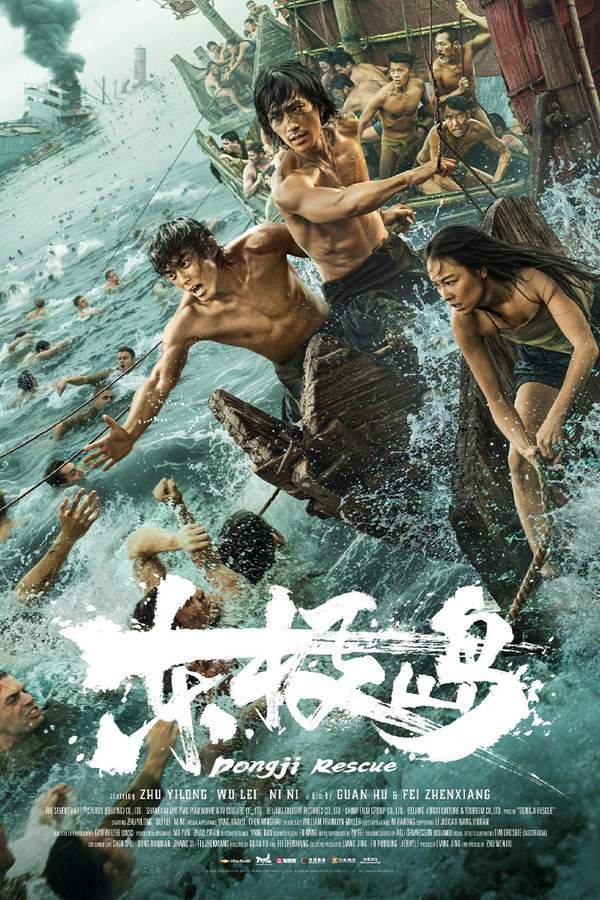
In the brutal theater of World War II, a maritime tragedy unfolds when the Japanese cargo ship Lisbon Maru is torpedoed on September 27, 1942, while transporting 1,816 British prisoners from Hong Kong toward Japan. The vessel sinks in the cold waters off Zhoushan, China, setting off a chain of desperate choices, secret loyalties, and quiet acts of courage that ripple through a small island under occupation.
On nearby Dongji Island, two local figures, Ah Bi and Ah Dang, live with the weight of wartime danger overhead. One day, Ah Dang discovers an Englishman adrift at sea and pulls him aboard his boat, only to face opposition from Ah Bi, who fears the rescue could bring catastrophe. After a dispute, Ah Dang persists and returns to sea, eventually bringing the survivor ashore. The rescued man is Thomas Newman, a British prisoner, and his presence tests the fragile balance of a village trying to stay safe under Japanese control. To bridge communication, Ah Bi enlists Chen, a local schoolteacher, while Ah Bi also informs Mr. Wu—the father of Ah Hua—about the new arrival. Although Ah Bi tries to keep Newman at a distance, Ah Dang remains a steadfast ally, stepping between danger and Newman’s safety.
Soon, Japanese troops arrive, and their sharp-eyed commander, Lieutenant Commander Hideo Wada, demands the whereabouts of the escaped Englishman. When the villagers insist they know nothing, Hideo responds with ruthless punishment, executing a man and a young boy to terrify the community into revealing nothing. Newman, unwilling to let the villagers suffer for his presence, surrenders, but suspicion falls on him when his hat gives him away as the culprit the villagers tried to hide. As punishment, Hideo selects several villagers—Wan Liang, Ah Lu, and Qian Jin—to be taken away. Refusing to let them be arrested, Mr. Wu takes responsibility and insists that the rest of the village remain ignorant. In a merciless moment, Hideo shoots Mr. Wu dead. Soon after, Ah Dang volunteers to become a prisoner as well, choosing solidarity over self-preservation.
A harsh fate awaits aboard the Lisbon Maru. Newman is beheaded, and his severed head is cast into the sea as a grim message to the island below. Meanwhile, the captives are confined to an overcrowded hold while Admiral Hisao Wataru orders the crew to evacuate the sinking ship by small boats, leaving the prisoners to drown as water rapidly fills the compartments. Ah Dang, fighting for a sliver of escape, fends through the chaos, attempting to find a path to freedom.
Back on Dongji Island, villagers labor to bury the dead but are fired upon by Japanese soldiers, inflaming Chen, a former soldier who reclaims a pistol, wounds a guard, and is ultimately captured and burned alive. The island’s strain continues as Ah Bi secretly boards the Lisbon Maru to seek a rescue for Ah Dang. Ah Dang, however, is not ready to flee; he breaks open a sealed door in a cargo hold to release the restrained prisoners. The attempt triggers instant chaos and a hail of gunfire from Japanese troops. In a dramatic confrontation, Ah Dang charges Hideo and defeats him, but is fatally shot. Ah Bi returns to the scene with him to Dongji Island, and in a final, devastating act, she destroys the armed guards and, at last, frees the surviving British prisoners, honoring Ah Dang’s last wish to save as many as possible.
The human drama shifts back to Ah Hua, a pivotal figure who challenges a village tradition. She tears down a wall in her home to reveal an ancestral altar, and with a resounding call to defy a long-standing prohibition on women sailing, she rekindles a spirit of defiance among the villagers. Her courage becomes a catalyst for collective action, and the community unites to mount a final rescue of the remaining prisoners. The tale closes with the sense that the villagers’ newfound resolve—fueled by loss, memory, and a willingness to break with the past—steers the outcome. As the island crowds gather to witness the rescue, the Japanese forces withdraw, and the survivors begin to chart a cautious road toward reconciliation and remembrance.
- Thomas Newman, William Franklyn-Miller — the British prisoner whose presence sparks a sequence of heroic choices.
- Dang, Lei Wu — a stubborn local figure whose moral stubbornness helps guide the fate of Newman and others.
- Bi, Yilong Zhu — a pivotal local contact who aids in communication and involvement with the escape.
- Hua, Ni Ni — a voice of defiance whose actions help shift the village’s tradition toward courage and rescue.
This story blends wartime peril with intimate acts of bravery, showing how individuals in a small corner of the world respond to catastrophe—through protection, sacrifice, and the hard-won decision to defy oppressive orders in the name of humanity.