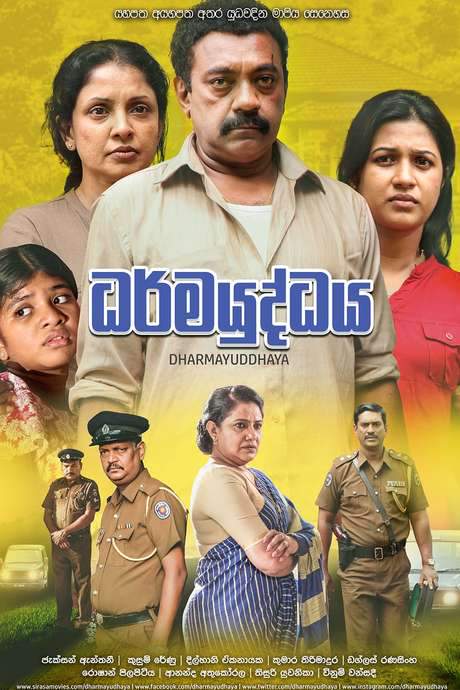
Harischandra, Jackson Anthony is an orphan-turned real estate businessman in Manudampura, a man whose life revolves around his family and a simple, almost ritualistic love for films. He runs a small office that doubles as his living room, where the TV is always on and the days blend into one another. He is married to Rani, Dilhani Ekanayake, and they have two daughters, Achini, Thisuri Yuwanika, and Sachini. The household appears stable at first glance, defined by routine, a tight-knit dynamic, and a sense that everyone knows their place in the person-to-person hierarchy that sustains them.
During a nature camp, Achini, Thisuri Yuwanika, is recorded in a bathroom by a hidden cell phone belonging to Shane, the spoiled son of MP Vishaka Samaranayake [Kusum Renu]. Shane uses this footage as leverage, threatening Achini to open a storeroom door at night or else he will post the video online to humiliate her. When Rani confronts Shane, he doubles down, demanding that Rani sleep with him instead of Achini. In a moment of heat and desperation, Achini strikes Shane with a pipe, killing him instantly. Horrified by the consequences, Rani and Achini decide to hide the body in a compost pit, a decision that Sachini witnesses. The night grows heavier with fear, and the family is suddenly tethered to a dangerous plan that could crush them under the weight of the truth.
Harischandra, alerted to the gravity of the situation, concocts a plan to shield his family from the law. He removes the broken phone and then drives Shane’s car into a river, a move that is noticed by his rival, Constable Vimal, [Kumara Thirimadura]. The murder date is pinned to August 2, and in the days that follow, the family pretends normalcy, taking a meditation trip to Matale, watching a movie, and dining out to bolster their alibi. The investigation begins when Vishaka, the MP, starts to question the disappearances and traces the car to the river. To her dismay, the alibi appears solid at first glance, with a trail of receipts—restaurant bills, movie tickets, and bus tickets—that seem to anchor their whereabouts. The investigation intensifies as Vishaka seeks independent confirmation from the establishments’ owners, but each account appears to support the family’s version of events.
The plot thickens when the Theravada monk-turned-informant reveals that a DVD set had circulated about the Matale meditation program, inviting Vishaka to reassess the timeline. She realizes that Harischandra did more than merely claim an alibi; he actively manipulated memory by planting suggestions with the owners, convincing them they were in Matale on August 2–3. With this new angle, Vishaka arrests Harischandra and his family, and Vimal uses brute force to extract the truth from them. Sachini breaks under the pressure, revealing where the body was buried. Yet a further twist emerges: Shane’s friend Damith reveals that Shane had taken explicit pictures of Achini, exposing a troubling side to Shane and confirming that he sought to exert power over a young girl. Digging the compost pit again, they find only a calf carcass rather than a human body, and Harischandra had anticipated this, having moved Shane’s body elsewhere to mislead investigators. The community cries out as Vimal is beaten by a mob and suspended, and Vishaka resigns, genuine remorse replacing their earlier certainty.
In the aftermath, Vishaka and her husband apologize to Harischandra and his family, acknowledging their role in enabling Shane’s dangerous behavior and the broader harms he caused. A remorseful Harischandra finally confesses that his family’s actions were driven by fear of Shane’s predatory intent toward Achini, not malice toward the truth. He signs a police register at the new station, where the Inspector, Roshan Pilapitiya, insists that Harischandra won’t be able to fool the authorities again. Harischandra replies that the police exist to protect citizens like him, but the closing flashback hints at a chilling reality: he may have hidden Shane’s body in the foundations of the very police station, a place that would never be suspected, leaving readers with a shadowy question about justice, guilt, and what people are willing to do to protect their families.