






Plot Explained Spoilers guaranteed!
Plot Explained

Browse by genre

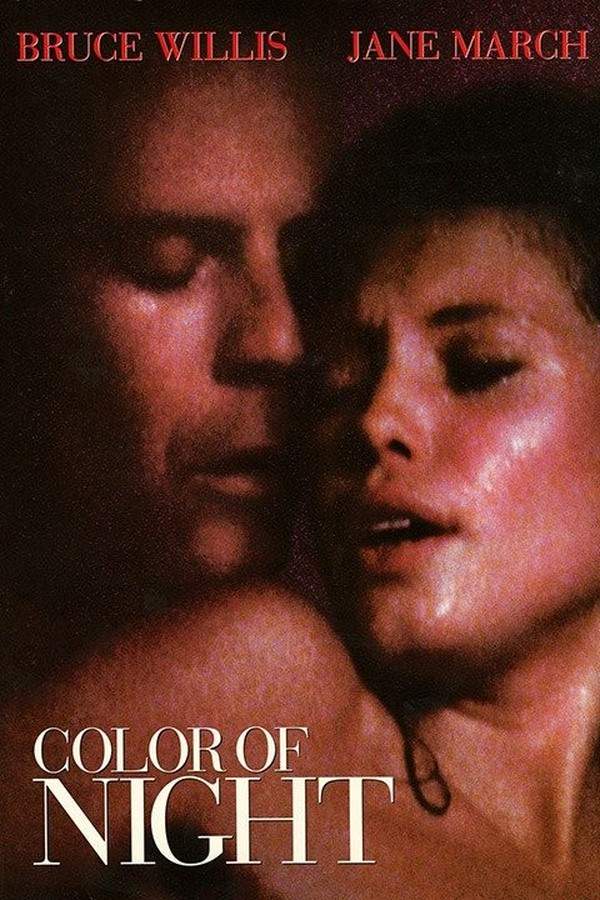
Color of Night (1994) movie poster

Timeline

Color of Night (1994) Timeline Explained – Every Event in Order

Release, runtime and language
1994 · 121 min · English
Directed by
Richard Rush
Starring
Bruce Willis, Brad Dourif, Lesley Ann Warren, Lance Henriksen, Rubén Blades, Jane March
Budget
$40M

A color-blind psychoanalyst finds himself the target of a relentless stalker after taking over the therapy group of a friend who was recently murdered. The group's patients share a connection to a mysterious young woman, with whom the analyst begins experiencing intense and unsettling encounters. As he investigates the killer’s identity, he must confront his own psychological vulnerabilities and the dark secrets of those around him.

On this page (6)
  1. 1 Where to watch
  2. 2 Events in order (15)
  3. 3 Timeline questions answered
  4. 4 Movie threads
  5. 5 Movies like Color of Night
  6. 6 Every angle

Where to watch

Where to Watch Color of Night (1994)

Where can you watch Color of Night? Stream, rent or buy it in the US, including on Hoopla, Amazon Video and Apple TV Store: current JustWatch availability with up-to-date prices.

Streaming availability powered by JustWatch

15 events in order · contains spoilers

Color of Night Timeline: Events in Chronological Order

Every key event of Color of Night (1994) in order, scene by scene, with when and where it takes place. Use it to untangle flashbacks, time jumps and parallel storylines, to refresh your memory before the sequel or to find the exact scene you are thinking of.

  1. Bill Capa's Office

    Bill Capa, a renowned psychoanalyst in New York, attends to wealthy clients with pressing psychological issues. During one of his sessions, his patient Michelle arrives visibly distressed, seeking help but not receiving the compassion she desperately needs from Bill.

    Where
    New York City
  2. Michelle's Tragic Leap

    In a moment of deep despair and feeling dismissed, Michelle takes a tragic step and jumps from Bill's office window. The impact of this event is profound, leading to Bill witnessing the horrifying scene of her bright green dress stained with her blood.

    Where
    Bill's Office
  3. Color Blindness Incident

    Following Michelle's death, Bill experiences acute stress that results in a drastic change in his perception. He develops color blindness, forced to view the world in shades of gray, symbolizing his internal turmoil and guilt over the incident.

  4. Seeking Guidance

    Driven by guilt and a desire to heal, Bill reaches out to his mentor, Dr. Larry Ashland. Larry encourages Bill to move beyond his guilt, prompting him to take a break and seek new surroundings away from New York.

    Where
    New York City
  5. Journey to California

    Bill decides to visit a college friend in California as part of his healing process. This relocation indicates his effort to escape the shadows of his past and begin anew, allowing him to step outside of his comfort zone.

    Where
    California
  6. Group Therapy Introduction

    Upon arriving in Los Angeles, Bill reconnects with Dr. Bob Moore, who invites him to attend a therapy group session. Hesitant but curious, Bill meets a diverse range of individuals, each facing their unique psychological challenges.

    Where
    Los Angeles
  7. Meeting the Group

    In the therapy session, Bill becomes acquainted with various group members, including Clark, a man obsessed with cleanliness, and Sondra, whose nymphomania and kleptomania create chaotic paths in her life. Their unique struggles reveal the multifaceted nature of mental health.

  8. Threats and Fortifications

    After the session, Bob drives Bill to his luxury Malibu home, which is fortified due to death threats he has received. This precarious environment introduces an element of danger, suggesting that not all is as safe as it appears within their group therapy setting.

    Where
    Malibu
  9. Bob's Murder

    Tragedy strikes when Bob is inexplicably found murdered in his office. Detective Martinez begins investigating the murder, suspecting that one of the patients might be involved, which intensifies the already fragile dynamics within the group.

    Where
    Bob's Office
  10. Bill Takes Charge

    In lieu of Bob's death, Bill feels compelled to lead the group therapy sessions, stepping into a role that requires sensitivity and leadership. His decision brings the group closer together, but also places him under scrutiny from Detective Martinez.

  11. Emerging Connections

    Amidst the chaos, Bill encounters Rose, a young woman who complicates his emotional healing journey. Their initial meeting following a car accident sparks an undeniable connection that adds depth to Bill's personal challenges.

  12. Tension with Detective Martinez

    As Martinez investigates Bob's murder, he persists in questioning Bill for answers, further complicating Bill's new responsibilities as a leader. Bill feels the pressure of being both a therapist and a potential suspect in the unfolding drama.

  13. Confrontation with Dale

    Bill's journey leads him to a dangerous confrontation with Dale Dexter, Richie's older brother. This encounter reveals the dark and tumultuous pasts of the group members, connecting them to the overarching narrative of trauma and violence.

  14. Revelation and Rescue

    In a gripping climax, Bill uncovers the truth behind the murders and confronts the challenges that threaten Rose's safety. Their bond deepens as they navigate through danger, culminating in Rose's daring act of bravery to save Bill from peril.

  15. A New Beginning

    As the storm clears, Bill and Rose find solace in each other, marking a transformative moment in Bill’s healing. He regains his ability to see color, symbolizing hope and renewal, heralding a poignant reunion that speaks to the power of love amidst trauma.

    Where
    Malibu

Last updated: October 27, 2024 at 20:53

Was this helpful?

Timeline questions answered

Color of Night Timeline Explained: Your Questions Answered

When does it happen, and why in that order? The questions people ask about the chronology of Color of Night (1994): time jumps, flashbacks, cause and effect between scenes and the correct order of events, each answered with spoilers.

Q1

Why did Michelle jump from Bill Capa's office window?

Michelle jumped because she felt dismissed and invalidated during her therapy session. When she arrived in a distressed state seeking help, Bill callously told her to "look in the mirror" and then distracted himself with a phone call. Overwhelmed by her problems and feeling completely unheard, she tragically took her own life in that moment of despair.

Foreshadowing: Earlier in the session, Bill's insensitivity is visible when he prioritizes the phone call over Michelle's visible emotional distress.

  • michelle suicide
  • jump
  • therapy session
  • dismissed patient
Q2

How did Bill Capa develop color blindness after Michelle's death?

Bill developed acute stress-induced color blindness as a psychological response to witnessing Michelle's suicide. When he saw her bright green dress soaked in red blood against the pavement, the traumatic image triggered a severe stress reaction that permanently altered his visual perception, causing him to see the world only in shades of gray.

  • color blindness
  • stress
  • michelle death
  • trauma
  • visual change
Q3

Who killed Dr. Bob Moore in the therapy group?

Bob Moore was killed by Dale Dexter, Richie's older brother. Dale was the one sending the death threats to Bob and systematically murdered him as part of a twisted plan connected to his brother's suicide and his own history of familial abuse.

Foreshadowing: Richie's troubled history and the revelation of his abusive older brother hint at the violence to come.

  • bob moore murder
  • killer
  • dale dexter
  • death threats
Q4

Who is Rose and what is her connection to the therapy group?

Rose is revealed to be "Bonnie," one of the patients in the therapy group, and she is also Richie's sister who was abused by her older brother Dale Dexter. She became involved with the group seeking help for her own trauma and ultimately developed a connection with Bill Capa.

Foreshadowing: Rose's meeting with Bill shortly after Bob's murder and her mysterious connection to the group's darker secrets hinted at her deeper involvement.

  • rose
  • bonnie
  • identity
  • therapy group
  • richie sister
Q5

Why does Rose rear-end Bill's car after the group meeting?

Rose deliberately rear-ends Bill's car as an intentional strategy to insert herself into his life. Drawn to him after hearing about him through the therapy group, she manufactured the collision as a way to meet him and begin a connection that would ultimately help her escape her dangerous brother Dale.

  • rose
  • car accident
  • jeep
  • meeting bill
  • intentional
Q6

Why does Detective Martinez suspect Bill Capa of involvement in Bob's murder?

Detective Martinez suspects Bill because Bill was the last person to see Bob alive, he suddenly took over the therapy group after Bob's death, and he repeatedly refuses to provide information about the patients despite being their therapist. Martinez believes Bill may be protecting someone in the group or involved himself.

  • detective martinez
  • suspect
  • bill capa
  • questioning
  • investigation
Q7

What happened to Rose as a child involving her brother Dale?

Rose suffered severe childhood abuse at the hands of her brother Dale Dexter, who systematically manipulated and violently abused her throughout her youth. This traumatic history drove her to seek therapy and ultimately made her a target when Dale resurfaced, leading to Richie's suicide and threatening Rose's life.

Foreshadowing: The revelation about Richie's suicide connects to the pattern of abuse within the Dexter family.

  • rose childhood abuse
  • dale dexter
  • family trauma
  • richie suicide
Q8

Why does Dale Dexter target the therapy group members and kill Bob Moore?

Dale Dexter kills Bob Moore because he believes Bob failed to help his brother Richie, who committed suicide. Viewing the therapy group as responsible for Richie's death and seeing them as dangerous, Dale begins eliminating members he holds responsible, starting with Bob and threatening others in a twisted quest for revenge.

Foreshadowing: Richie's troubled state and history of legal troubles foreshadow the violence stemming from his family's dysfunction.

  • dale dexter
  • motivation
  • revenge
  • richie suicide
  • therapy group
Q9

What does Bill regaining his color vision at the end symbolize?

Bill's restoration of color vision symbolizes his psychological healing and emotional renewal through his connection with Rose. Throughout the film, his gray-scale perception represents his guilt, trauma, and emotional disconnection. By allowing himself to love and be protected by Rose, he finally overcomes his psychological blocks and sees the world in color again.

  • color vision ending
  • healing
  • rose
  • metaphor
  • red
  • transformation
Q10

Why does Bill agree to lead the therapy sessions after Bob's death?

Bill agrees to lead the therapy sessions because he believes he can handle the sensitive situation with more compassion than Detective Martinez would show. He also sees this as an opportunity to use his psychological training to help people and potentially identify the killer among the patients, while simultaneously working through his own guilt.

  • bill takes over
  • therapy group
  • lead sessions
  • bob death
Q11

How does Rose save Bill from Dale Dexter in the climax?

Rose saves Bill by confronting her abusive brother Dale directly and physically intervening to prevent him from killing Bill. This act represents her final break from the cycle of abuse and trauma that defined her life, choosing to protect the person she loves rather than remain a victim.

  • rose saves bill
  • confrontation
  • dale dexter
  • rescue
  • final showdown
Q12

What is Bill's special ability to detect violent patients in the group?

Bill possesses a unique psychological insight that allows him to perceive violent tendencies in people, which is why Bob invited him to the group in the first place. Despite this ability, Bill initially fails to detect any murderous intent among the patients, adding to the mystery of who killed Bob and creating tension with Detective Martinez.

  • detect violent tendencies
  • psychological insight
  • bill ability
  • patients

Movie threads

More Movies Like Color of Night, by Mood & Story

Curated lists built around what makes Color of Night tick: the same mood, the same kind of story or the same emotional payoff. Each list explains why these movies belong together.

Thrillers with Dangerous Therapy Groups like Color of Night

Healing becomes a deadly game when the therapist's own sanity is threatened. Explore movies like 'Color of Night' where therapy sessions become the backdrop for murder and psychological warfare. These films feature unstable patients, vulnerable therapists, and a web of secrets that turns the sanctuary of healing into a deadly arena.

  • tense
  • unsettling
  • paranoid
  • psychological
  • gritty
  • erotic
  • Tone: dark, paranoid
  • Pacing: steady
Why these movies?

The story pattern: These narratives typically place a therapist, often grappling with personal trauma, in charge of a group of unpredictable patients. A crime occurs, often a murder, and the investigation forces the therapist to question every patient's story while confronting their own vulnerabilities. The line between healer and suspect becomes dangerously thin.

Why they belong together: Movies in this thread share a core premise of a therapy setting as a source of danger, blending psychological analysis with a murder mystery. They are grouped by their tense atmosphere, focus on identity and deception, and the theme of a professional's expertise being useless against raw, personal danger.


Erotic Psychological Mysteries like Color of Night

Where obsession, lust, and murder intertwine in a shadowy psychological puzzle. If you liked the blend of mystery, psychology, and intense eroticism in 'Color of Night', discover similar movies. These thrillers feature a morally complex hero drawn into a web of secrets by a seductive stranger, where every encounter blurs the line between clue and temptation.

  • erotic
  • noir
  • tense
  • stylish
  • unsettling
  • obsessive
  • Tone: dark, erotic, tense
  • Pacing: steady
Why these movies?

The story pattern: The plot follows an investigator, often an outsider or professional, who is pulled into a dark world by a compelling and mysterious love interest. The sexual tension is high and directly tied to the unfolding mystery, creating a situation where the protagonist's judgment is clouded by passion, leading to violent confrontations and a hard-won resolution.

Why they belong together: These films are connected by their specific tonal mix: a dark, stylish atmosphere, a steady-paced psychological mystery, and intense erotic scenes that are integral to the plot. The viewing experience is defined by this fusion of suspense and sensuality, resulting in a heavy, unsettling, yet gripping vibe.

If you liked this

Movies Like Color of Night

Similar movies to Color of Night: the same genre, themes or kind of story. Each one comes with its own plot summary, timeline and ending explained.

Browse all movie summaries

Every angle

Color of Night (1994) Explained: Plot, Timeline & Characters

Everything about Color of Night in one place: what happens in the plot summary, the timeline in chronological order, the characters and meaning and a spoiler-free summary. What's After the Movie adds the cast, box office and post-credit scenes.

Coming soon on iOS and Android

The Plot Explained Movie Summary App

Plot summaries, endings explained and timelines on your phone. Catch up on any movie in minutes, save your favorites and never miss a twist again.

Be the first to know when we launch. Your email stays private, always.

Learn more about the app