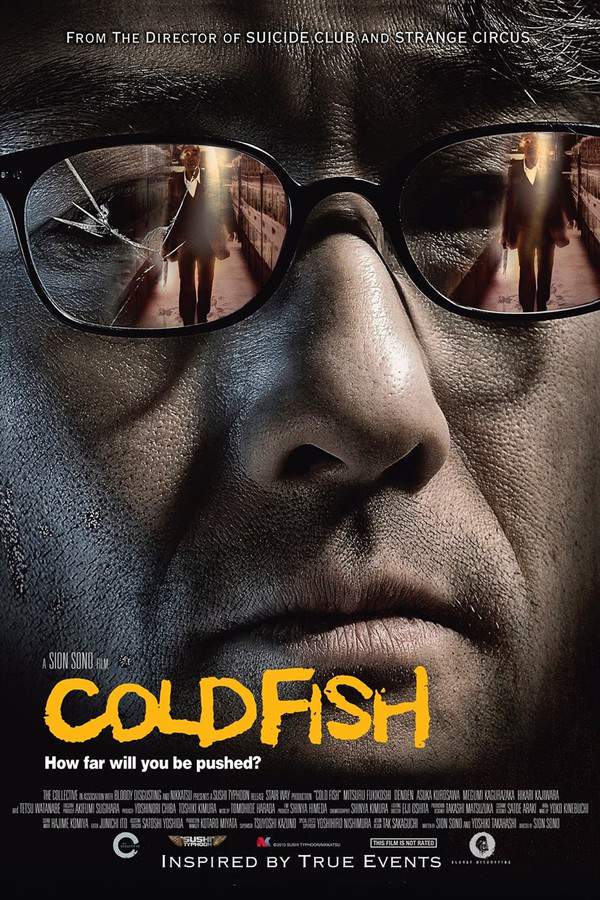
Cold Fish
Year: 2011
Runtime: 144 min
Language: Japanese
Director: Shion Sono
A mild-mannered man's life takes a dark turn when his teenage daughter is caught shoplifting. A seemingly helpful couple offers a solution, having her work at their fish store, but this offer hides a sinister secret. As Shamoto investigates, he's drawn into a terrifying and brutal world, uncovering a disturbing truth about the couple and facing a descent into madness. Inspired by true events, the film explores the terrifying consequences of hidden darkness and the fragility of ordinary life.
Where to Watch Cold Fish?
Find where to stream, rent, or buy Cold Fish (2011) in the US with current JustWatch availability, up-to-date pricing, and platform listings for subscription, rental, and digital purchase options.




Streaming availability powered by 
Warning: spoilers below!
Haven’t seen Cold Fish yet? This summary contains major spoilers. Bookmark the page, watch the movie, and come back for the full breakdown. If you're ready, scroll on and relive the story!
Cold Fish (2011) – Full Plot Summary & Ending Explained
Read the complete plot breakdown of Cold Fish (2011), including all key story events, major twists, and the ending explained in detail. Discover what really happened, and what it all means.
Nobuyuki Shamoto is a quiet and unassuming man who runs a small tropical fish shop in the city of Shizuoka, Japan. Despite his calm exterior, his personal life is marked by unhappiness and familial struggles. His home environment is tense and strained, especially due to his teenage daughter, Mitsuko, who is notably rude and violent, often lashing out at her stepmother, Taeko, and displaying troubling behavior. The tension within the family reaches a boiling point when Mitsuko is caught stealing from a local supermarket, an incident that sets off a chain of events that will dramatically change their lives.
A mysterious stranger, Yukio Murata, enters their lives following this incident. Murata is cheerful, loud, and charismatic, and he quickly makes an impression on Nobuyuki and his family. After intervening to help Mitsuko in the supermarket, Murata invites them to visit his much larger and more successful fish shop. During this visit, Murata offers Mitsuko a job and suggests that he and Nobuyuki should become business partners. Grateful for the opportunity and the promise of a brighter future, Nobuyuki gradually becomes involved in Murata’s business endeavors, which initially seem promising and full of potential for growth.
At first, everything appears exciting and full of promise. Murata introduces Nobuyuki to an array of expensive fishes, connects him with new clients, and shares visions of increasing wealth and success. The business boost brings hope for a better life, and Nobuyuki begins to feel a sense of optimism. But as the story unfolds, a much darker reality begins to surface. Murata and his wife, Aiko, are revealed to be serial killers who operate a criminal enterprise under the guise of their fish shop. Their true intent is far from innocent: they use their business as a cover to scam, murder, and dispose of individuals they perceive as threats.
Murata’s manipulative and controlling nature starts to show as he coerces Nobuyuki into helping with his grisly activities. Murata employs a mix of pressure, flattery, and intimidation to keep Nobuyuki under his thumb, forcing him to assist in hiding bodies and cleaning up after murders. As Nobuyuki becomes more deeply entangled in this horrifying scheme, he begins to question his moral compass and struggles with feelings of fear and helplessness. Meanwhile, Mitsuko seems to be adapting to her new life at Murata’s shop, but Nobuyuki remains unaware of the true extent of her situation or how much she’s being affected by her environment.
As the narrative advances, the emotional and psychological toll on Nobuyuki intensifies. His involvement deepens, and he feels increasingly trapped. The manipulation reaches a breaking point when Nobuyuki, pushed to the edge and feeling humiliated, finally lashes out in a desperate act of violence—he kills Murata. This act of vengeance is both an outburst of his despair and a symbol of his final break from Murata’s influence. However, by this stage, the damage has already been inflicted: his life is broken, his family is torn apart, and he is haunted by the bloodshed he has committed.
The story concludes with a haunting image: Nobuyuki, now completely changed by the horrific events, stands alone, covered in blood, embodying the tragic consequences of his descent into darkness. The film leaves viewers with a powerful message about how circumstances, manipulation, and moral corruption can transform an ordinary man into someone unrecognizable, forever marked by the choices made in a moment of desperation.
Last updated: August 19, 2025 at 05:13
Cold Fish (2011) Plot Questions Answered – Summary FAQ
Explore frequently asked questions about Cold Fish (2011) with spoiler-rich answers covering the full plot summary, major story beats, character motivations, hidden details, and ending meaning. This movie summary FAQ helps explain confusing scenes, plot twists, and narrative decisions in clear, searchable detail.
Why does Nobuyuki agree to partner with Murata despite barely knowing him?
Nobuyuki agrees because Murata presents a tempting opportunity during a vulnerable moment. After Mitsuko's shoplifting incident, Nobuyuki is desperate for a solution and Murata appears helpful, offering Mitsuko a job and promising business growth. Murata's charismatic, outgoing personality contrasts sharply with Nobuyuki's quiet life, making the prospect of success feel within reach. The promise of financial improvement and a better future for his troubled family blinds Nobuyuki to the warning signs.
Murata's immediate intervention at the supermarket, while helpful, also shows his willingness to insert himself into strangers' lives.
How does Murata manipulate Nobuyuki into helping with murders?
Murata uses a combination of flattery, pressure, and intimidation. He first creates a sense of obligation by helping Nobuyuki's family, then gradually introduces Nobuyuki to his criminal activities. Once Nobuyuki becomes complicit, Murata threatens to expose his involvement, trapping him. The manipulation includes making Nobuyuki feel valued as a partner while simultaneously using his family as leverage, creating a psychological hold that feels impossible to escape.
Murata's cheerful demeanor during the initial meeting hides his true predatory nature.
Why does Nobuyuki finally kill Murata?
Nobuyuki kills Murata after reaching his breaking point from持续 psychological torture and humiliation. Throughout their partnership, Murata has been pushing him further into criminal activities while making him feel trapped and powerless. The accumulation of fear, moral conflict, and despair leads Nobuyuki to a desperate act of violence, the only way he sees to escape Murata's hold. This killing represents both his final rebellion and the completion of his moral corruption.
Earlier scenes show Nobuyuki questioning his morality and feeling increasingly trapped, building toward this violent release.
What happens to Mitsuko while working at Murata's fish shop?
Mitsuko is offered a job at Murata's shop after the shoplifting incident, and she appears to adapt to this new environment. However, the full extent of what she experiences remains unclear as the story primarily follows Nobuyuki's perspective. She becomes part of Murata's world, which is tainted by criminality and murder, exposing her to dangerous influences. Her adjustment represents the film's exploration of how ordinary environments can harbor extraordinary evil.
The contrast between Mitsuko's violent behavior at home and her adaptation to Murata's shop hints at her vulnerability to dark influences.
Why doesn't Nobuyuki go to the police when he discovers Murata is a killer?
Nobuyuki doesn't go to the police because by the time he understands Murata's true nature, he is already complicit in the crimes. He has helped hide bodies and clean up after murders, making him an accessory. Additionally, Murata manipulates him into believing there's no way out, using threats against his family. Nobuyuki's passive personality and fear of consequences trap him in Murata's criminal enterprise.
Early scenes establish Nobuyuki as passive and conflict-avoidant, which explains his inability to take decisive action against Murata.
What is Murata's motive for killing people?
The summary indicates Murata and his wife Aiko operate as serial killers who use their fish shop as a front to scam, murder, and dispose of individuals they perceive as threats. Their motive appears to be a combination of thrill-seeking and eliminating anyone who could expose or interfere with their criminal operation. They prey on people drawn to their business, viewing their ventures as opportunities for murder rather than legitimate commerce.
Murata's initial friendliness masks a predatory nature, as he seeks out vulnerable people like Nobuyuki and his family.
What role does Murata's wife Aiko play in the crimes?
Aiko Murata is revealed as Murata's partner in their serial killing operation. She participates in the criminal enterprise that operates under the guise of their successful fish shop. While the summary focuses more on Murata's interactions with Nobuyuki, Aiko is indicated as a full participant in the murders and scams they commit together, making their marriage a partnership in crime as well as life.
The couple's seemingly successful business partnership hints at their collaborative criminal nature.
What happens to Nobuyuki's family by the end of the film?
By the end, Nobuyuki's family is destroyed. The film shows that his involvement in Murata's criminal world tears his family apart. After killing Murata, Nobuyuki stands alone, completely transformed and covered in blood, symbolizing his complete moral disintegration. His life is permanently broken, and the family unit he desperately tried to improve is forever lost.
The family's initial dysfunction and Mitsuko's troubled behavior foreshadow their ultimate destruction.
What does the title Cold Fish refer to?
The title 'Cold Fish' likely refers to multiple layers of meaning. Literally, it describes the tropical fish business that serves as the setting. Metaphorically, it represents the cold, predatory nature of the Muratas who operate their killing operation from an ostensibly legitimate business. It may also reflect the emotional coldness and moral numbness that develops in ordinary people like Nobuyuki when exposed to extreme evil, becoming 'cold' to violence and humanity.
The tropical fish shop setting creates an environment where beauty and predation coexist, mirroring the story's themes.
How does Nobuyuki's moral corruption unfold throughout the film?
Nobuyuki's moral corruption progresses gradually from reluctant helper to active participant. Initially, he's drawn in by opportunity, then becomes complicit through small favors that escalate. Once he helps hide bodies and clean up murders, he cannot extricate himself without incriminating himself. Each step deeper into Murata's world numbs his moral compass until he can commit murder himself. The film shows how ordinary people can be gradually corrupted when manipulated by someone more morally depraved.
Early scenes show Nobuyuki's unhappiness and passivity, making him susceptible to the promise of something more fulfilling in his life.
Is Cold Fish based on a true story?
Yes, Cold Fish is inspired by true events. The film is based on the real-life crimes of a Japanese couple who operated a pet shop and used it as a front for their criminal activities. The filmmakers adapted these true events into a fictionalized narrative, using the premise of a fish shop to explore themes of manipulation, moral corruption, and how hidden darkness can lurk behind ordinary business fronts.

Explore Movie Threads
Discover curated groups of movies connected by mood, themes, and story style. Browse collections built around emotion, atmosphere, and narrative focus to easily find films that match what you feel like watching right now.
Ordinary lives shattered by hidden darkness like in Cold Fish
Stories where an average person is dragged into a horrifying, brutal reality.If you liked the terrifying premise of Cold Fish, you'll find more movies like it here. These films explore the chilling theme of ordinary people whose lives are destroyed after stumbling upon a sinister world, leading to psychological trauma and a brutal descent.















Narrative Summary
The narrative pattern typically begins with a protagonist living a mundane, often fragile life. A chance encounter or a seemingly benign offer acts as a gateway, pulling them into a dangerous and manipulative relationship with a charismatic but evil force. The story charts their gradual loss of innocence, their forced participation in horrific acts, and their eventual psychological disintegration or transformation.
Why These Movies?
Movies in this thread share a core thematic focus on the fragility of normalcy and the horror of discovering malevolence hiding in plain sight. They are united by a dark, oppressive tone, heavy emotional weight, and a steady pacing that builds an inescapable sense of dread as the protagonist's world collapses.
Slow burn descent into moral abyss like in Cold Fish
A methodical unraveling of a character's sanity and ethics under extreme pressure.Fans of the harrowing character journey in Cold Fish will appreciate these similar movies. This collection features stories with a steady pace focused on a protagonist's gradual psychological unraveling and loss of morality, resulting in a bleak and heavy viewing experience.













Narrative Summary
The narrative is built around a central character arc rather than a complex plot. The protagonist, often initially passive or morally grounded, is systematically broken down. Through a series of compromises, manipulations, or traumatic events, their identity erodes until they commit acts they once would have found unthinkable. The ending is typically bleak, leaving the character permanently scarred or transformed by their journey into darkness.
Why These Movies?
These films are grouped by their shared focus on a specific character journey: the slow, psychological disintegration of an individual. They prioritize a steady, dread-filled pacing and a heavy, bleak emotional tone to make the audience feel the inescapable weight of the protagonist's moral collapse.
Unlock the Full Story of Cold Fish
Don't stop at just watching - explore Cold Fish in full detail. From the complete plot summary and scene-by-scene timeline to character breakdowns, thematic analysis, and a deep dive into the ending - every page helps you truly understand what Cold Fish is all about. Plus, discover what's next after the movie.
Cold Fish Timeline
Track the full timeline of Cold Fish with every major event arranged chronologically. Perfect for decoding non-linear storytelling, flashbacks, or parallel narratives with a clear scene-by-scene breakdown.

Characters, Settings & Themes in Cold Fish
Discover the characters, locations, and core themes that shape Cold Fish. Get insights into symbolic elements, setting significance, and deeper narrative meaning - ideal for thematic analysis and movie breakdowns.


