Year: 1983
Runtime: 144 mins
Language: Hindi
Director: Shyam Benegal
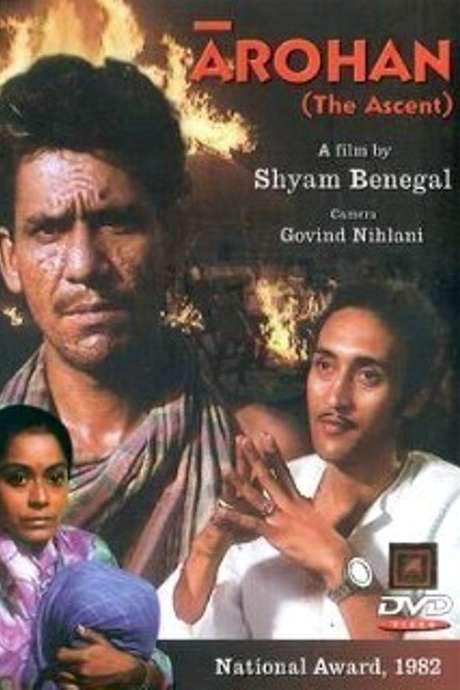
Hari Mondal (Om Puri) is a destitute farmer in the remote Bengal hamlet of Giripur, Birbhum, living with his wife, two sons, his brother, his widowed aunt Kalidashi (Gita Sen) and her daughter Panchi. Set in the mid‑1960s, the story unfolds as the Naxalbari uprising spreads across Bengal, drawing oppressed peasants into a movement led by young communists advocating a socialist republic.
Get a spoiler-free look at Arohan (1983) with a clear plot overview that covers the setting, main characters, and story premise—without revealing key twists or the ending. Perfect for deciding if this film is your next watch.
In the lush, river‑lined fields of mid‑sixties Bengal, a quiet hamlet clings to ancient rhythms while the distant rumble of the Naxalbari uprising begins to stir the air. The world of the film is one of cracked mud paths, weather‑worn thatched roofs, and a social order that has long balanced on the fragile backs of tenant farmers. An undercurrent of political idealism threads through the village, hinting at a larger struggle for a socialist future that feels both distant and impossibly close.
Hari Mondal is a modest farmer whose life revolves around the land he tills and the family that shares his modest home. He lives with his wife, two sons, his brother, the widowed aunt Kalidashi and her daughter Panchi. Their daily existence is shaped by the customs of tenancy, the lingering pressure of a powerful landlord family, and the ever‑present need to secure enough to survive. The bonds between the family members are warm yet tinged with the unspoken anxieties that come from living on the edge of poverty and subservience.
The younger generation—Bolai and Panchi—feel the tug of the new political wave more acutely. They are drawn to ideas of equality, to the promise of a society where the landless might finally have a voice, and to the bright allure of the city that seems to hold possibilities far beyond the fields. Their aspirations create a quiet tension with Hari’s more cautious, lived‑in approach, revealing the clash between tradition and the yearning for change that defines the era.
Against this backdrop, the village hums with a mix of hope and unease. The tone is contemplative, painted in earthy hues and punctuated by the soft crackle of radios broadcasting revolutionary slogans. As the community navigates the slow grind of everyday labor, the looming promise of reform hangs over each decision, setting the stage for a story that examines dignity, resilience, and the cost of pursuing justice in a world poised on the brink of transformation.
Last Updated: December 04, 2025 at 16:19
Discover curated groups of movies connected by mood, themes, and story style. Browse collections built around emotion, atmosphere, and narrative focus to easily find films that match what you feel like watching right now.
Patient films about the grinding weight of poverty and injustice on rural lives.If you appreciated the patient, somber portrayal of a farmer's struggle in Arohan, you'll find similar movies here. These films focus on the slow grind of social injustice in rural settings, exploring themes of land rights, class struggle, and the heavy personal cost of resistance. Discover more movies like Arohan that capture this specific, gritty vibe.
Stories in this thread typically follow a protagonist or community trapped in a cycle of rural poverty and exploitation. The narrative unfolds patiently, focusing on the gradual escalation of tension as characters confront an oppressive system, often leading to devastating personal losses and a bleak realization of their powerlessness.
Movies are grouped here for their shared commitment to a slow, immersive pace and a bleak tone that highlights the desperation of rural life. They share a high emotional weight and intensity, derived from themes of social injustice, and create a similarly somber, oppressive mood through their gritty realism.
Stories where political ideals clash with brutal reality, leaving only devastation.Fans of Arohan's depiction of the Naxalbari movement's impact on a family will find more poignant films here. These stories explore the intersection of political idealism and personal sacrifice, often ending in tragedy and despair. Find movies like Arohan that share its bleak outlook on revolutionary struggle and its devastating human cost.
The narrative pattern involves ordinary individuals being drawn into a larger political conflict, inspired by ideals of change. However, the movement is met with overwhelming force, and the story charts the protagonist's journey from hope to disillusionment, culminating in the destruction of their family, freedom, or spirit, with no redemptive outcome.
These movies are connected by a consistently bleak tone, high intensity derived from political violence and injustice, and a heavy emotional weight centered on sacrifice and defeat. They share a desperate, tense mood and explore the theme of how grand political struggles devastate individual lives.
Don't stop at just watching — explore Arohan in full detail. From the complete plot summary and scene-by-scene timeline to character breakdowns, thematic analysis, and a deep dive into the ending — every page helps you truly understand what Arohan is all about. Plus, discover what's next after the movie.
Read a complete plot summary of Arohan, including all key story points, character arcs, and turning points. This in-depth recap is ideal for understanding the narrative structure or reviewing what happened in the movie.
Track the full timeline of Arohan with every major event arranged chronologically. Perfect for decoding non-linear storytelling, flashbacks, or parallel narratives with a clear scene-by-scene breakdown.
Discover the characters, locations, and core themes that shape Arohan. Get insights into symbolic elements, setting significance, and deeper narrative meaning — ideal for thematic analysis and movie breakdowns.
Visit What's After the Movie to explore more about Arohan: box office results, cast and crew info, production details, post-credit scenes, and external links — all in one place for movie fans and researchers.