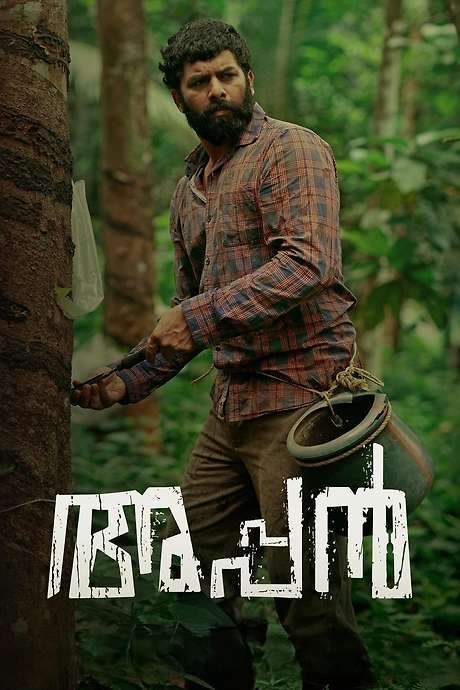
Njoonju, Sunny Wayne is a rubber tapper who shares a modest home with his father, his mother, his wife, and their young son in a small, quiet village. The family’s routine is marked by quiet dignity, even as the household bears the strain of a difficult patriarch.
Ittychan, Alencier Ley Lopez, Njoonju’s father, is bedridden but remains relentlessly narcissistic, cruel, and a womaniser. His presence dominates the home, and despite his condition, he continues to harass, abuse, and torture his wife, Kuttyamma, and his son. Their lives are overshadowed by fear and longing for relief from his tyranny, a tension that weighs heavily on every member of the family. The village itself seems to sense the danger he poses, and many residents have their own painful memories of his behavior.
To complicate the already fragile balance, Ittychan manipulates those around him to bring their next‑door neighbor and prostitute, Sheela, into the house to care for him. At first, the family and Sheela clash, each wary of the other’s motives. Yet as time unfolds, warmth begins to build between them. The family comes to see Sheela as a decent person who has found herself in dire circumstances, a result of a cruel past and a coercive present. In a powerful turn of revelation, it becomes clear that Ittychan had killed Sheela’s father to possess her, dragging her into this town and into a life of hardship, which helps explain why Sheela’s current situation feels like a trap she cannot escape. Sheela, for her part, discovers a family they are not all bad, offering a glimmer of humanity amidst the cruelty she has endured.
Noonju contemplates leaving the village to seek a new life, but his sense of filial duty keeps him tethered to his family’s side. He tries to reconcile his own desires with the obligations of sonhood, a struggle that defines much of the film’s emotional core. Meanwhile, Ittychan’s circle is unsettled when his friend dies by suicide after learning that a man named Kuriakose has been released from jail. The news threads through the village with a heavy, almost ominous weight, hinting at the violence that has shaped these lives.
On a Christmas evening, Kuriakose, Ashraf Mallisery, arrives at the family’s home. His wife was one of Ittychan’s victims, a fact that fuels a volatile confrontation. He comes with a dangerous resolve to kill Ittychan, a plan that immediately places Njoonju in a perilous position as he tries to shield his father. In the heat of the struggle, Ittychan—not wanting to lose his leverage—tries to bargain for his life by urging Kuriakose to kill Njoonju and take the woman, offering a grim swap: his own life for theirs. The moment erupts in fury, and Sheela, furious at his treachery, strikes Ittychan down with a stabbing blow. Kuriakose departs, leaving behind a house that now bears the marks of violence but also a fragile sense of possibility for reconciliation.
In the aftermath, Njoonju and his family tell the neighbors that Ittychan died from a mild attack, a clarification that masks the real intensity of what happened. The story closes with a quiet note of hope: the family, alongside Sheela, appears to build a peaceful life within that home, suggesting that even after the darkest chapters, a measure of harmony might endure.
- The film explores themes of power and vulnerability within a tightly knit family, the long shadows cast by abuse, and how those shadows can be confronted when hard truths emerge.
- The characters’ loyalties are tested, and the arrival of Kuriakose intensifies the moral tensions that have long defined Ittychan’s household.
- The Christmas setting adds a stark contrast between ritual celebration and the brutal reality at the heart of the family’s struggle, underscoring the film’s message about pain, resilience, and the possibility of renewal.