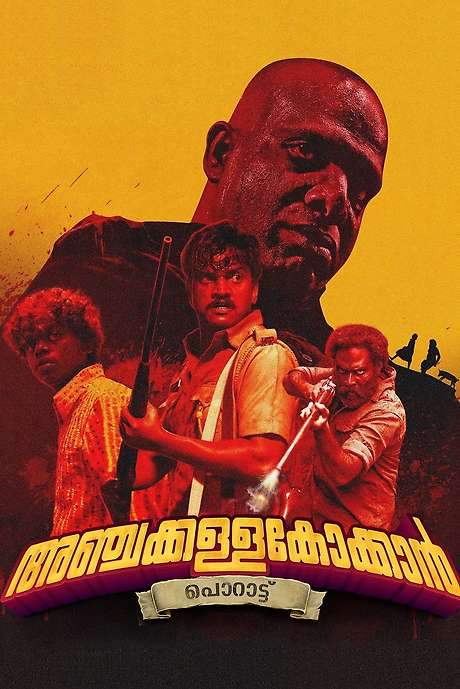
In 1986, Chaapra, Sreejith Ravi the planter, is murdered on a night he shares drinks with Punnari Rajan and Chippan. The morning after, a meek, stammering Vasudevan, Lukman Avaran, arrives in the village to take charge as a police constable, stepping into a tense local world where every porch whispers of old loyalties and fresh fears. He quickly meets Nadavaramban Peter, Chemban Vinod Jose, a sympathetic fellow officer who helps him settle into the rough rhythm of village policing and the uneasy web of politics that frames the case.
The investigation begins with a careful, patient questioning of everyone connected to Chaapra, including his maid Padmini, as villagers weigh what happened and why. Chaapra’s two sons, known as the Gillappis, add chaos to the already fragile peace, terrorizing those who cross their path and bringing the case under a tighter, more perilous spotlight. In the shadows, Punnari Rajan had already struck a land deal with Chaapra and, with the help of a local politician, Maveli Antu, tries to orchestrate a formal surrender to the police before elections can complicate the agenda. The plan seems to hinge on a swift, scandal-proof resolution, and it seems to hinge on a single, fateful surrender—one that never quite arrives as expected.
Into this brew steps Kollan Shankaran / Shankarabharanam, Manikanda Achari, who unexpectedly turns up at the station and surrenders as the murderer, changing the course of the investigation in dramatic fashion. As the layers begin to peel back, a more personal truth emerges: Nadavaramban Peter is entangled with Padmini, Chaapra’s former ally in the estate, and it is hinted that their liaison has colored the murder with motive and opportunity. The narrative tightens around a plan hatched to punish Chaapra and settle old scores, a plan that uses Kolliyan, a criminal ally, to carry out the night-time stabbing.
Vasudevan’s internal uncertainty about Sankaran’s motive deepens as the clues accumulate. But the plot thickens when Sankaran himself reveals a brutal past—Peter had once killed Sankaran’s daughter during an epileptic crisis, a crime that was obscured by appearances and fear. The local tale of health and mercy is upended by the truth, and the tension intensifies as the neighbor’s discovery threatens to unleash a reckoning long buried.
Inside the police station, Sankaran’s plan to confront Peter becomes a direct, violent confrontation. Peter understands the danger Vasudevan poses and tightens his grip, recruiting Kolliyan to finish off Sankaran. Outside, the Gillappis escalate their vendetta by exposing Maveli Antu and Punnari Rajan’s misappropriation of Chaapra’s funds, culminating in a deadly attack during a public speech that aims to cripple the political order and draw attention away from the murder investigation.
A dramatic turn occurs when Sankaran, escaping a moment of confinement with a makeshift key and a friend’s deceit, re-enters the station to strike at Peter and Kolliyan. A fierce confrontation erupts as Gillapis, Kolliyan, and Peter collide, and a bomb is unleashed, killing the elder Gillapi and triggering a wider melee. The younger Gillapi’s weapon finally takes Sankaran’s life, and a gunfight erupts among the shattered loyalties of the village—Kolliyan, Peter, and the last of the Gillapi faction.
Amid the smoke and confusion, Vasudevan finds a way to break free from Peter’s control. He reclaims his long-suppressed, volatile nature and fights back with a sudden, brutal resolve, turning the tables on his enemies and defeating them in the heat of the moment. The clash brings a thunderous, cathartic end to the immediate danger, but it also reveals the deeper currents that shaped Vasudevan’s life and choices.
In the end, Vasudevan’s backstory comes into sharper focus: his father was a Porat drama artist known for a fierce, almost demonic heat, and this legacy is the shadow that looms over his son. Raised to fear the demon Kokkan so he would not follow his father’s path, Vasudevan nonetheless inherits a volatile streak that his mother tries to soften. The showdown exposes how this dual legacy—anized by fear and nurtured by violence—neatly threads through the film’s climax. The resolution leaves Vasudevan standing amid the wreckage of the night’s violence, his own violent impulses finally unleashed and directed toward Peter, ending with a brutal, decisive act that restores a grim sense of justice in a village where years of hidden tensions finally broke into the open.