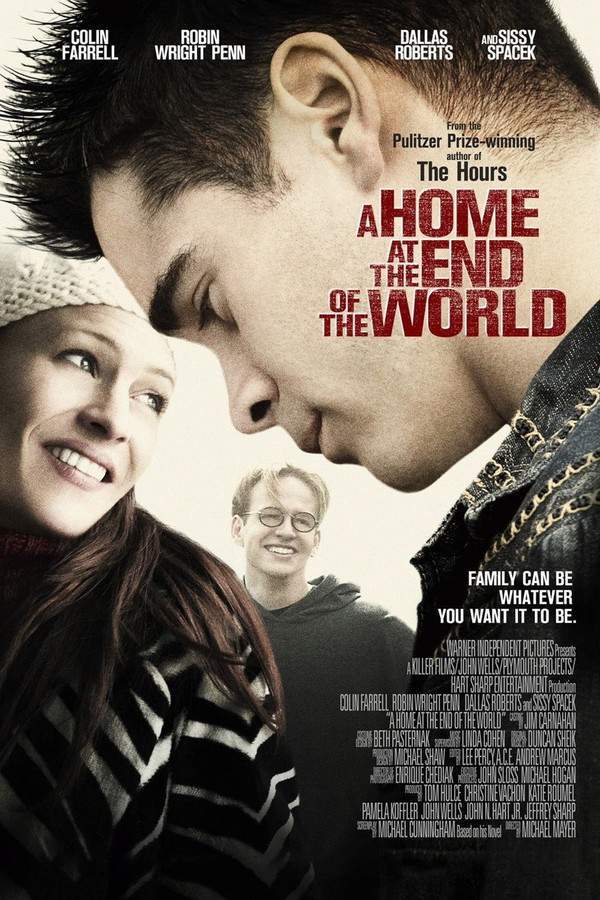


Year: 2004
Runtime: 97 min
Language: English
Director: Michael Mayer
Budget: $6.5M
A poignant drama about two young men who form a deep and enduring friendship. Years later, they reunite in New York City as adults, where one man finds himself at a crossroads, torn between his long-time friend and a new romantic relationship. This situation threatens the unique and unconventional family they’ve created over time, testing the strength of their bond and forcing them to confront difficult choices about love and loyalty.
Find where to stream, rent, or buy A Home at the End of the World (2004) in the US with current JustWatch availability, up-to-date pricing, and platform listings for subscription, rental, and digital purchase options.
Warning: spoilers below!
Haven’t seen A Home at the End of the World yet? This summary contains major spoilers. Bookmark the page, watch the movie, and come back for the full breakdown. If you're ready, scroll on and relive the story!
Trace every key event in A Home at the End of the World (2004) with our detailed, chronological timeline. Perfect for unpacking nonlinear stories, spotting hidden connections, and understanding how each scene builds toward the film’s climax. Whether you're revisiting or decoding for the first time, this timeline gives you the full picture.
Last updated: November 03, 2024 at 14:37
Find frequently asked questions about the A Home at the End of the World (2004) timeline, including chronological order, nonlinear jumps, cause-and-effect links, and scene sequence clarifications. This timeline FAQ helps explain when key events happen, how moments connect, and why the story unfolds in that specific order.
Bobby befriends Jonathan because Jonathan bears a striking resemblance to Bobby's older brother, who recently died in a tragic accident. Bobby was struggling to cope with the loss of his brother, and seeing Jonathan offered him a sense of hope and connection to the person he lost most.
After Bobby's father dies, Bobby is left without a family. Jonathan's parents, particularly his mother Alice, welcome Bobby into their home because they recognize his difficult situation and the void in his life. Bobby brings warmth and joy into their home, making the arrangement beneficial for everyone.
Clare has been in love with Jonathan for years, but her feelings are unrequited. When Bobby arrives, Clare develops feelings for him, partly because she sees him as someone who could love her back. Her romance with Bobby creates tension and jealousy between the three of them.
After Clare becomes pregnant and the trio faces mounting tension in the city, they decide to seek a fresh start. They relocate to Woodstock, New York, where they open a restaurant called "Home" and try to build a family together away from the complications of city life.
Jonathan is diagnosed with AIDS. Bobby discovers a sore on Jonathan's hip, which marks the beginning of his illness. The film handles this subtly, showing the disease casting a shadow over their otherwise peaceful life in Woodstock.
The timeline hints at Jonathan's health concerns as Clare begins her visit to her mother, foreshadowing the serious diagnosis.
Bobby and Jonathan's relationship is complex and evolves over decades. While they share moments of physical intimacy, their bond remains primarily brotherly. Jonathan has romantic feelings for Bobby, but Bobby seems to view their connection as more familial, shaped by the resemblance to his late brother.
Alice, Jonathan's mother, feels trapped in her traditional marriage and mundane life. Bobby's carefree spirit and his appreciation for her cooking bring warmth back into her life. When Bobby introduces her to marijuana, it sparks a renewed passion and connection between them.
Ned's death forces Bobby to confront loss once again in his life. After Ned passes away, Alice and Ned decide to relocate to a drier climate, which leads to Bobby reaching out to Jonathan in NYC. Ned's death serves as a pivotal moment that propels Bobby back into Jonathan's life and sets the stage for the next chapter.
Bobby returns to the desert to be with Alice after Ned passes away. This return marks another cycle of loss for Bobby, who has already lost his mother and brother. It also creates distance between Bobby and Jonathan, leaving Jonathan to grapple with feelings of inadequacy.
The restaurant is called "Home" as a symbol of the unconventional family Bobby, Jonathan, and Clare have created. It represents their shared dream of building a permanent, loving home together despite not following traditional family structures. The name reflects their journey from loneliness to belonging.
At the end, Bobby and Jonathan affirm their commitment to each other despite Jonathan's illness. They spread Ned's ashes together, which becomes a moment of closure about mortality and their unresolved feelings. The film ends with them together in their unconventional but deeply committed relationship.
Their earlier moments of intimacy and Jonathan's confession of feelings foreshadow this eventual affirmation of their bond.
Bobby introduces Alice to marijuana as part of sharing his world with her family. This act breaks through Alice's stagnant life and brings her joy. The shared experience of smoking pot becomes a bonding moment between Bobby and Alice, helping both of them find happiness in different ways.
Discover curated groups of movies connected by mood, themes, and story style. Browse collections built around emotion, atmosphere, and narrative focus to easily find films that match what you feel like watching right now.
Stories where unconventional families provide warmth against a backdrop of loss.If you enjoyed the unconventional family dynamics in A Home at the End of the World, you'll appreciate these movies about found families. They share a similar bittersweet tone, blending intimate connections with themes of love, loyalty, and loss, perfect for fans of emotionally heavy, character-driven dramas.
The narrative typically follows a group of characters who build a life together outside conventional norms. Their bonds are tested by external challenges or internal conflicts, often related to love triangles, personal tragedies, or the simple passage of time, leading to an ending that affirms connection while acknowledging impermanence.
These films are grouped by their shared focus on the joy and pain of chosen family. They balance tender, intimate moments with a melancholic atmosphere, often featuring a slow, reflective pace that allows deep emotional investment in the characters' relationships and the inevitable changes they face.
Epic stories tracing the intricate evolution of lifelong bonds.Find movies similar to A Home at the End of World that explore lifelong friendships. These films follow characters from youth to adulthood, capturing the joys and challenges of enduring bonds with a poignant, often bittersweet feel, ideal for viewers who love reflective, character-evolving stories.
Stories in this thread use a linear, chronological structure to trace the evolution of a key friendship from childhood or youth into adulthood. Major life events—romances, career changes, personal tragedies—act as turning points that strengthen or strain the bond, examining loyalty and the changing nature of love over time.
These films are united by their longitudinal view of friendship. They share a reflective, sometimes nostalgic mood, a moderate narrative complexity that allows for deep character exploration, and a emotional resonance built from witnessing a relationship endure across a significant span of time.
Don't stop at just watching - explore A Home at the End of the World in full detail. From the complete plot summary and scene-by-scene timeline to character breakdowns, thematic analysis, and a deep dive into the ending - every page helps you truly understand what A Home at the End of the World is all about. Plus, discover what's next after the movie.
Read a complete plot summary of A Home at the End of the World, including all key story points, character arcs, and turning points. This in-depth recap is ideal for understanding the narrative structure or reviewing what happened in the movie.
Discover the characters, locations, and core themes that shape A Home at the End of the World. Get insights into symbolic elements, setting significance, and deeper narrative meaning - ideal for thematic analysis and movie breakdowns.
Discover movies like A Home at the End of the World that share similar genres, themes, and storytelling elements. Whether you’re drawn to the atmosphere, character arcs, or plot structure, these curated recommendations will help you explore more films you’ll love.
A Home at the End of the World (2004) Plot Summary & Movie Recap
A Home at the End of the World (2004) Scene-by-Scene Movie Timeline
A Home at the End of the World (2004) Spoiler-Free Summary & Key Flow
Movies Like A Home at the End of the World – Similar Titles You’ll Enjoy
It's Only the End of the World (2017) Film Overview & Timeline
End of the Century (2019) Complete Plot Breakdown
Enduring Love (2004) Spoiler-Packed Plot Recap
Seeking a Friend for the End of the World (2012) Movie Recap & Themes
Beside Still Waters (2014) Spoiler-Packed Plot Recap
The End (2024) Detailed Story Recap
Sex (2025) Spoiler-Packed Plot Recap
My Best Friend (2018) Ending Explained & Film Insights
Between Here & Now (2018) Story Summary & Characters
Postcards from the End of the World (2019) Detailed Story Recap
When a Man Comes Home (2007) Detailed Story Recap
End of Love (2008) Spoiler-Packed Plot Recap
Between Love & Goodbye (2009) Full Movie Breakdown
Permanent Residence (2009) Full Summary & Key Details
Three Kilometres to the End of the World (2024) Story Summary & Characters