Plot Explained Spoilers guaranteed!
Plot Explained

Browse by genre

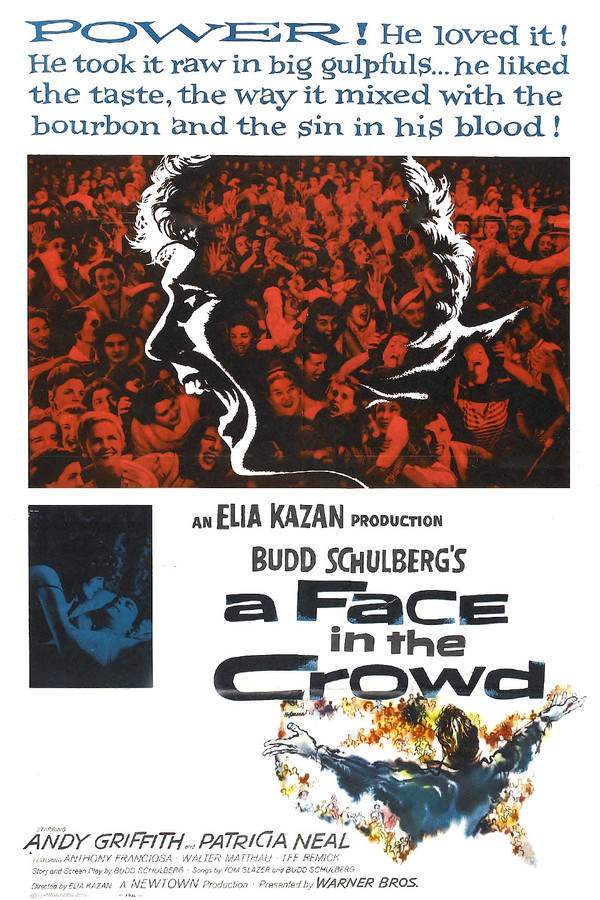
A Face in the Crowd (1957) movie poster

Plot Summary

A Face in the Crowd (1957) Plot Summary Explained

Release, runtime and language
1957 · 126 min · English
Loading streaming availability…
Directed by
Elia Kazan
Starring
Patricia Neal, Walter Matthau, Anthony Franciosa, Alexander Kirkland, Andy Griffith, Lee Remick

A radio producer discovers a captivating man with a natural talent for performance while he's serving time. Recognizing his potential, the producer helps launch him to stardom as "Lonesome" Rhodes. However, as his fame and influence grow, the performer's increasing ego and ambition threaten to destroy his artistry and the lives of those around him.

On this page (6)
  1. 1 Where to watch
  2. 2 What happens: full plot
  3. 3 Plot questions answered
  4. 4 Movie threads
  5. 5 Movies like A Face in the Crowd
  6. 6 Every angle
Loading streaming availability…

Full plot summary · contains spoilers

What Happens in A Face in the Crowd: Full Plot Summary

The whole story of A Face in the Crowd (1957) explained, from the opening scene to the final frame: every key event, every twist and what it all adds up to. Read it as a quick recap before the sequel, to check a scene you missed, or to finally understand what really happened.

The film is set in late 1950s America, a period when television was swiftly taking over radio as the premiere source of entertainment. Enter Lonesome Rhodes, a coarse yet charismatic character who, despite his abrasive nature, quickly captures the hearts of rural audiences. This magnetic allure is discovered by Marcia Jeffries, a small-town radio host, when she stumbles upon Rhodes in a county jail located in the fictional town of Pickett, Arkansas. She promptly secures him a radio show, launching his chaotic journey into the world of broadcasting.

Before long, Rhodes’s talent draws the attention of talent scouts, leading to an appearance on television in Memphis, Tennessee. Here, he meets Mel Miller, a scholarly Vanderbilt alumnus responsible for crafting his on-air scripts. Rhodes's reputation grows as he unabashedly insults his sponsors, particularly the "Luffler Mattress" company. Surprisingly, this reckless behavior boosts their sales, compelling the company to endure the ridicule they initially found offensive—mainly because of the influence of the owner’s wife, a devoted Lonesome Rhodes fan.

An ambitious office employee, portrayed by Anthony Franciosa, manages to secure Rhodes a lucrative contract in New York City, marking his ascent as the national TV spokesperson for Vitajex, a harmless dietary supplement. One of the film’s standout sequences showcases a frenetic montage of Rhodes's exaggerated advertisements, illustrating the American public's naiveté in the face of a cunning charlatan.

In true classical tragedy fashion, Rhodes ultimately succumbs to his insatiable quest for power and is betrayed by Jeffries, who, after nurturing his stardom, can no longer tolerate his open disdain for their audience. During the climax of a "Cracker Barrel" broadcast, Rhodes can be seen smiling and waving at the camera, all the while hurling insults off-air, calling viewers "idiots" and "morons." Realizing her role in crafting the monster, Jeffries retaliates by broadcasting his scornful remarks live, igniting a storm of outrage from betrayed fans, which floods the network with furious calls.

In a poignant visual metaphor, as audience approval rapidly declines, an oblivious Rhodes descends in an elevator, unaware of his diminishing popularity. The film culminates in chaos at Rhodes's penthouse, where Jeffries confesses her role in his downfall, and Walter Matthau ominously predicts his future—a return to the airwaves, though far less glamorous than before. There’s also a fleeting moment featuring an uncredited Rip Torn as "Barry Mills," symbolizing the next potential Lonesome Rhodes waiting in the wings.

In interviews for the 2006 DVD release and the consequential documentary, Andy Griffith, Patricia Neal, and Anthony Franciosa express immense pride in their contributions to this remarkable film, while Schulberg delves into its deeper origins.
Last updated: November 08, 2024 at 00:04

Was this helpful?

Plot questions answered

A Face in the Crowd Plot Explained: Your Questions Answered

The questions people ask most about A Face in the Crowd (1957): what happens in the confusing scenes, why the characters do what they do, the twists, hidden details and what the ending means. Each answer contains spoilers.

Q1

Why did Marcia Jeffries help Lonesome Rhodes launch his radio career?

Marcia Jeffries discovered Lonesome Rhodes while he was incarcerated in the county jail in Pickett, Arkansas. Recognizing his natural charisma and performance talent, she decided to give him a radio show, believing his rough-hewn, authentic personality would resonate with rural audiences. Her initial motivation was to bring genuine entertainment to her listeners and likely saw potential in his raw talent that others might have overlooked.

Foreshadowing: Early in the film, Jeffries's commitment to authentic rural programming suggests she values genuine connection with her audience, which later makes Rhodes's betrayal more painful for her.

  • marcia jeffries
  • lonesome rhodes
  • radio career
  • discovery
  • jail
Q2

How did Lonesome Rhodes transition from local radio to national fame?

Lonesome Rhodes rose from local radio in Arkansas to national television stardom through a combination of his natural charisma and strategic career moves. After his radio success attracted talent scouts, he was brought to Memphis, Tennessee for television, where Mel Miller, a Vanderbilt graduate, helped craft his on-air scripts. An ambitious office employee then secured him a lucrative contract in New York City as the national spokesperson for Vitajex, a dietary supplement, cementing his rise to national celebrity.

Foreshadowing: The film shows Rhodes's quick ascent through each medium, radio to television to national advertising, demonstrating how easily audiences were captivated by his persona.

  • lonesome rhodes
  • fame
  • television
  • vitajex
  • career transition
  • memphis
Q3

Why did the Luffler Mattress company tolerate Rhodes's insults on air?

Despite Lonesome Rhodes's public insults toward the Luffler Mattress company and its products, the company chose to endure his ridicule because his attacks actually boosted their sales. The owner's wife was a devoted fan of Rhodes, and she convinced her husband to stay on the show despite the humiliation. This paradox illustrates how Rhodes's controversial persona was so compelling that even negative publicity translated to financial success.

Foreshadowing: This early sponsorship controversy establishes the film\'s critique of how audiences can be manipulated by charismatic personalities regardless of the message.

  • luffler mattress
  • sponsorship
  • sales
  • insults
  • advertising
Q4

What caused Marcia Jeffries to turn against Lonesome Rhodes?

Marcia Jeffries turned against Lonesome Rhodes after years of watching him transform from an authentic, charming personality into a cynical, power-hungry figure who openly disdain the very audience that made him famous. During a live 'Cracker Barrel' broadcast, Rhodes smiled warmly at the camera while simultaneously hurling insults at viewers off-air, calling them 'idiots' and 'morons.' This hypocrisy and contempt for the people who supported him was the final straw for Jeffries.

Foreshadowing: Jeffries's earlier commitment to authentic rural programming and genuine connection with listeners makes Rhodes's betrayal of that audience especially infuriating to her.

  • marcia jeffries
  • betrayal
  • cracker barrel
  • audience
  • contempt
Q5

How did Marcia Jeffries expose Lonesome Rhodes's true feelings to the public?

Marcia Jeffries exposed Lonesome Rhodes by broadcasting his recorded derogatory comments live during the 'Cracker Barrel' television broadcast. While Rhodes smiled and waved at the camera for the audience, Jeffries simultaneously played his off-air insults calling viewers 'idiots' and 'morons.' This live exposure of his true contempt triggered a massive backlash, flooding the network with angry calls from betrayed viewers.

Foreshadowing: The film builds to this moment by showing Rhodes's increasing arrogance and his growing disconnect from his audience throughout his rise to fame.

  • live broadcast
  • exposure
  • traitor
  • audience backlash
  • television
Q6

Why did Lonesome Rhodes's career collapse so rapidly after the exposure?

Lonesome Rhodes's career collapsed rapidly because the live exposure revealed his fundamental hypocrisy, he had been openly contemptuous of the very audience that elevated him to stardom while maintaining a friendly public persona. The resulting public outrage was immediate and overwhelming, with furious viewers contacting the network in large numbers. The visual metaphor of Rhodes descending in an elevator, oblivious to his plummeting popularity, captures how quickly fame can evaporate when the illusion is shattered.

Foreshadowing: The film's tragic structure ensures that Rhodes's downfall is as swift as his rise, emphasizing the fragility of celebrity built on manipulation.

  • career collapse
  • fame
  • downfall
  • public outrage
  • celebrity
Q7

Who was Mel Miller and what was his role in Lonesome Rhodes's career?

Mel Miller was a Vanderbilt University graduate who became Lonesome Rhodes's script writer when Rhodes transitioned from radio to television in Memphis, Tennessee. As a scholarly, educated counterpart to Rhodes's rough charisma, Miller was responsible for crafting the clever, folksy language that made Rhodes's on-air persona so appealing. However, as Rhodes's fame grew, his reliance on Miller diminished, reflecting his growing disdain for the intellectual backing that had helped launch his career.

Foreshadowing: Miller's academic background contrasts sharply with Rhodes's natural charisma, suggesting an early tension between authenticity and manufactured appeal.

  • mel miller
  • script writer
  • vanderbilt
  • television
  • writing
Q8

What did the ending suggest about the cycle of media stardom?

The ending suggested that the cycle of media stardom is doomed to repeat itself. After Rhodes's downfall, Walter Matthau ominously predicts he will return to broadcasting, though in a far less glamorous capacity. More significantly, the film concludes with a fleeting appearance of Rip Torn as 'Barry Mills,' symbolizing another charismatic figure waiting in the wings to exploit the same vulnerabilities in American audiences that made Rhodes famous.

Foreshadowing: The film's title 'A Face in the Crowd' itself hints at the endless supply of ambitious personalities seeking fame through media manipulation.

  • cycle of fame
  • rip torn
  • media
  • repetition
  • celebrity
  • new star
Q9

Why did Lonesome Rhodes become increasingly arrogant as his fame grew?

Lonesome Rhodes became increasingly arrogant as his fame grew because success went to his head, transforming his authentic charm into naked ambition and contempt for others. The film depicts his descent into tyranny, where his insatiable quest for power overtook his original talent. He lost touch with the rural audience that originally connected with him, instead viewing them as 'idiots' and 'morons' beneath him. This corruption of a genuine talent into a cynical manipulator is the central tragedy of the film.

Foreshadowing: Early signs of his abrasive personality were present from the start, but his success initially channeled this energy into entertaining performances rather than overt cruelty.

  • arrogance
  • ego
  • fame
  • ambition
  • corruption
  • character arc
Q10

What was the purpose of the Vitajex advertisement montage?

The Vitajex advertisement montage served as a sharp critique of American public gullibility and the power of charismatic manipulation in advertising. The frenetic sequence showcased Rhodes's exaggerated, over-the-top commercials for the harmless dietary supplement, demonstrating how easily audiences could be persuaded by a confident personality rather than substantive content. This scene crystallizes the film's warning about the dangers of media personality worship and the susceptibility of the average consumer.

Foreshadowing: The montage appears after Rhodes's national TV contract is secured, marking the point where his influence becomes truly mass-market and manipulative.

  • vitajex
  • advertisement montage
  • critique
  • public gullibility
  • manipulation
Q11

What happened in the final confrontation at Rhodes's penthouse?

In the final confrontation at Rhodes's penthouse, Marcia Jeffries confessed her role in creating the 'monster' she helped launch to stardom. She acknowledged her responsibility in enabling Rhodes's rise while also exposing his betrayal of their shared audience. Walter Matthau's character ominously predicted Rhodes's eventual return to broadcasting, albeit in a diminished capacity, suggesting that neither the media industry nor the public truly learns from such cautionary tales.

Foreshadowing: The penthouse setting symbolizes the height of Rhodes's success, making his fall from this literal and metaphorical height more dramatic.

  • penthouse
  • confrontation
  • jeffries
  • matthau
  • confession
  • downfall

Movie threads

More Movies Like A Face in the Crowd, by Mood & Story

Curated lists built around what makes A Face in the Crowd tick: the same mood, the same kind of story or the same emotional payoff. Each list explains why these movies belong together.

Rise and Fall Dramas Like A Face in the Crowd

Stories that chart the intoxicating ascent and moral collapse of a charismatic figure. Explore movies like 'A Face in the Crowd' that follow the compelling and dark arcs of charismatic figures. If you enjoyed watching a captivating personality's rise to fame and subsequent moral collapse, you'll find similar stories of ambition, corruption, and tragic downfall in these gripping dramas.

  • cautionary
  • gripping
  • prophetic
  • unsettling
  • melancholic
  • critical
  • Tone: dark, cynical, critical
  • Pacing: steady, chronological
Why these movies?

The story pattern: These narratives typically follow a linear, chronological path from discovery to peak influence to a humbling descent. The central conflict revolves around the protagonist's internal battle with their newfound power, often resulting in the betrayal of their roots, the exploitation of their audience, and the loss of their own soul.

Why they belong together: Movies in this thread share a critical, often cynical perspective on fame and power. They are united by a steady pacing that methodically builds thematic weight, a dark tone that examines moral corruption, and a heavy emotional impact derived from witnessing a tragic character arc unfold.

Media Manipulation Movies Similar to A Face in the Crowd

Unsettling stories that dissect how media shapes public opinion and corrupts influence. Discover films similar to 'A Face in the Crowd' that offer a critical look at media, fame, and power. If you appreciated its prophetic and unsettling examination of how a personality can be crafted and corrupted to manipulate the masses, these thought-provoking stories will resonate.

  • prophetic
  • unsettling
  • critical
  • cynical
  • thought-provoking
  • cautionary
  • Tone: dark, unsettling, prophetic
  • Pacing: steady, analytical
Why these movies?

The story pattern: The narrative pattern often involves an observer or creator who witnesses their subject's transformation into a tool of manipulation. The story unfolds as a cautionary tale, highlighting the systemic forces at play and the psychological toll of building and maintaining a deceptive public image.

Why they belong together: These films are grouped by their shared thematic focus on media critique and the corrupting nature of influence. They create a similar viewing experience through an analytical, steady pace, a dark and unsettling tone, and a feeling of grim relevance that makes their social commentary feel particularly potent.

If you liked this

Movies Like A Face in the Crowd

Similar movies to A Face in the Crowd: the same genre, themes or kind of story. Each one comes with its own plot summary, timeline and ending explained.

Browse all movie summaries

Every angle

A Face in the Crowd (1957) Explained: Plot, Timeline & Characters

Everything about A Face in the Crowd in one place: what happens in the plot summary, the timeline in chronological order, the characters and meaning and a spoiler-free summary. What's After the Movie adds the cast, box office and post-credit scenes.

Coming soon on iOS and Android

The Plot Explained Movie Summary App

Plot summaries, endings explained and timelines on your phone. Catch up on any movie in minutes, save your favorites and never miss a twist again.

Be the first to know when we launch. Your email stays private, always.

Learn more about the app