Plot Explained Spoilers guaranteed!
Plot Explained

Browse by genre

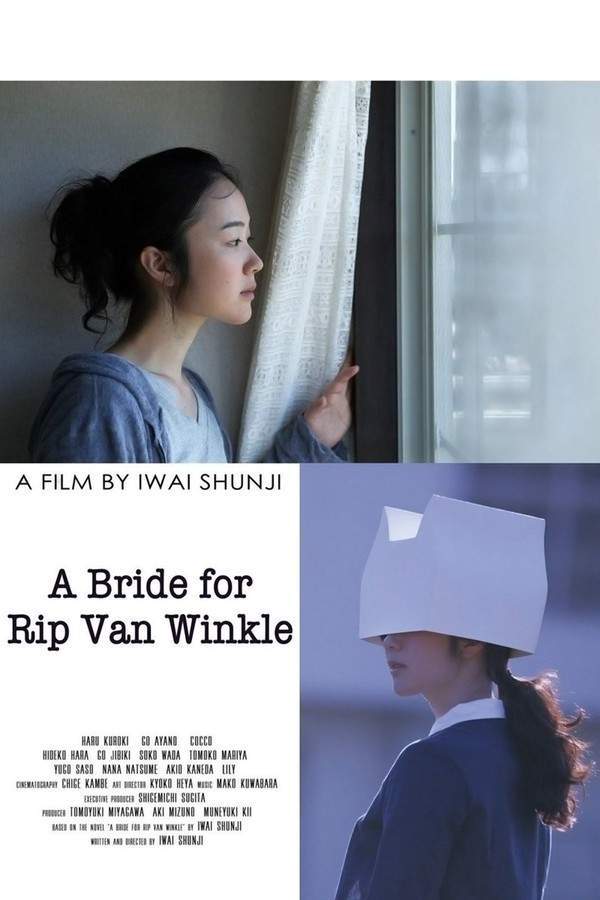
A Bride for Rip Van Winkle (2017) movie poster

Timeline

A Bride for Rip Van Winkle (2017) Timeline Explained – Every Event in Order

Release, runtime and language
2017 · 179 min · Japanese
Echo score 67
Loading streaming availability…
Directed by
Shunji Iwai
Starring
Haru Kuroki, Gô Ayano, Cocco, Gô Jibiki, Masahiro Noguchi, Nana Natsume

A shy teacher navigates love and deception in the digital age, finding connections through "Planet," a social network service. As her wedding day nears, her online friendships become increasingly complicated, blurring the lines between reality and illusion and leading to a web of secrets. Seeking solace, she discovers a mysterious resident in an old mansion, who helps her rediscover herself and confront the deceptive nature of online relationships and the search for truth.

On this page (5)
  1. 1 Where to watch
  2. 2 Events in order (15)
  3. 3 Timeline questions answered
  4. 4 Movie threads
  5. 5 Every angle
Loading streaming availability…

15 events in order · contains spoilers

A Bride for Rip Van Winkle Timeline: Events in Chronological Order

Every key event of A Bride for Rip Van Winkle (2017) in order, scene by scene, with when and where it takes place. Use it to untangle flashbacks, time jumps and parallel storylines, to refresh your memory before the sequel or to find the exact scene you are thinking of.

  1. Solace on Planet

    Nanami is an apathetic, part-time junior high school teacher whose only comfort comes from connecting with others on Planet, a new social networking service. Disconnected from her real life, she pours her energy into these online relationships instead.

  2. A message from Tetsuya

    A young man named Tetsuya messages Nanami on Planet and asks to meet her in person. The two begin dating, and their relationship quickly deepens into an engagement.

  3. Meeting the parents

    Nanami's parents meet Tetsuya's family ahead of the wedding. Although Nanami's parents are actually divorced, they pretend to still be together for the sake of harmony, a small deception that foreshadows bigger lies to come.

  4. From teacher to housewife

    Nanami loses her job as a junior high school teacher. Quiet and underconfident, she decides to give up her career entirely and become a housewife for Tetsuya as the wedding plans move forward.

  5. The guest list crisis

    As the wedding preparations progress, Nanami can only get two family members to attend her ceremony. Tetsuya begs her to increase her guest list, worried that the wedding will look strange if it is filled entirely with his side of the family.

  6. Renting guests from Amuro

    Desperate, Nanami reaches out to her online friend Amuro, a self-proclaimed jack-of-all-trades who runs several businesses, including one that hires actors for weddings. He agrees to provide actors who will pose as Nanami's friends and relatives on her big day.

  7. The wedding day

    On the day of the ceremony, the hired actors attend the wedding pretending to be Nanami's guests. The event goes ahead smoothly, but its picture-perfect appearance rests entirely on performance.

  8. A distant husband and a mysterious earring

    As Nanami settles into married life, she finds Tetsuya despondent and seemingly lacking interest in her. Then she discovers an earring in their flat and becomes convinced he is having an affair. Unsure of what to do, she contacts Amuro, who promises to investigate her husband for a fee.

    Where
    Nanami's flat
  9. The hotel room trap

    A man contacts Nanami claiming to be the partner of the woman Tetsuya is supposedly cheating with. He convinces her to meet him in a hotel room, where he then attempts to seduce her. Nanami flees to the bathroom and calls Amuro, who turns up and reveals the man is actually one of his own actors.

    Where
    A hotel room
  10. The mother-in-law's confrontation

    A few weeks after the ceremony, Tetsuya's mother confronts Nanami with allegations of lying and cheating. She has also discovered that Nanami's parents are divorced, and she presents a video of Nanami's hotel encounter with the actor.

    When
    A few weeks after the wedding
  11. Confronting Tetsuya and the breakup

    Nanami tells her mother-in-law that it is Tetsuya who has been cheating, then talks to Tetsuya himself. He seems genuinely unaware of the affair, even when Nanami mentions the girl's name, and grows furious. In his anger, he splits with her.

  12. A new start as a hotel maid

    Heartbroken and depressed, Nanami checks herself into a hotel. She manages to get hired there as a maid, beginning a quiet new chapter of her life.

    Where
    A hotel
  13. Playing family with Mashiro

    Amuro contacts Nanami and asks her to help out by acting as a family member for another wedding. She joins a fake family of hired actors, including the actress Mashiro, and the two go out drinking together.

  14. Housekeeping at the old mansion

    Amuro offers Nanami a housekeeping job at an old mansion, where she discovers that Mashiro works as the other maid. The mansion's sole resident has an infectious spirit that gradually helps Nanami open her heart.

    Where
    An old mansion
  15. Nothing is what it seems

    Nanami soon realizes that Amuro, the mansion, and Mashiro are not what they appear to be. The warmth and stability she had just begun to feel starts to unravel, as she learns that even dreams have limits.

Last updated: October 11, 2026 at 16:44

Was this helpful?

Timeline questions answered

A Bride for Rip Van Winkle Timeline Explained: Your Questions Answered

When does it happen, and why in that order? The questions people ask about the chronology of A Bride for Rip Van Winkle (2017): time jumps, flashbacks, cause and effect between scenes and the correct order of events, each answered with spoilers.

Q1

What is Amuro's deeper scheme involving the old mansion?

Amuro's business extends well beyond renting actors for weddings; the story reveals that the mansion, Mashiro, and Nanami's new life of caretaking are all part of something more complex that he has organized. The warmth and stability Nanami begins to feel in that house is itself a constructed reality rather than a genuine escape, showing that even her recovery is another performance staged by him. The exact scope of Amuro's enterprise is left ambiguous, but the implication is that he engineers entire lives for vulnerable clients and profits from keeping them dependent on his services.

Foreshadowing: Amuro is described early on as a 'jack-of-all-trades' running multiple businesses, hinting that the wedding-rental operation is only the surface of something larger.

  • amuro
  • mansion
  • scheme
  • deception
  • fake family
  • manipulation
Q2

Was Tetsuya actually having an affair?

The film never confirms that Tetsuya was unfaithful. The earring Nanami finds in their flat raises suspicion but proves nothing, and when she later names a supposed mistress, he appears genuinely confused and has no idea who she is talking about. The man who lured her to the hotel room is exposed as one of Amuro's actors, which strongly suggests that the whole infidelity scenario was manufactured to destabilize her marriage and draw her deeper into Amuro's orbit.

Foreshadowing: The earring discovery happens immediately after Amuro promises to 'investigate' Tetsuya for a fee, linking the two events from the start.

  • tetsuya
  • affair
  • cheating
  • earring
  • nanami
  • suspicion
Q3

What does the line 'even dreams have their limits' really mean?

The line is the story's thesis about performance and self-deception. Nanami spends the entire film retreating into manufactured environments, from the social network Planet to a marriage built on hidden truths to the peaceful rhythms of the mansion, each one offering a kind of personal dream. The revelation that Amuro, Mashiro, and the mansion itself were part of a constructed scheme tells her that no artificial refuge, however comforting, can truly replace genuine human connection.

Foreshadowing: The parents' decision to fake their marriage for the wedding establishes the pattern that every 'dream' in Nanami's life is ultimately staged.

  • dreams
  • limits
  • ending
  • symbolism
  • reality
  • illusion
Q4

What is the connection between Mashiro, Amuro, and the old mansion?

Mashiro is not simply a fellow actress Nanami meets through the fake wedding job; she is part of Amuro's broader network of performers who move between different assignments, including private work at the mansion. Together with Amuro she forms the inner circle of an operation that builds artificial families, weddings, and sanctuaries for paying clients like Nanami. The mansion is therefore less a refuge and more a continuation of the same performance-based business that has surrounded Nanami since her wedding day.

Foreshadowing: Nanami and Mashiro bond quickly over drinks during the fake family job, foreshadowing that their friendship is part of a larger arrangement.

  • mashiro
  • amuro
  • mansion
  • performance
  • actors
  • fake family
Q5

How did Tetsuya's mother get the video of Nanami in the hotel room?

The film never fully explains the leak, but the most logical reading is that Amuro himself provided the recording, since he controlled the staged hotel encounter and personally arrived to 'rescue' Nanami there. His businesses revolve around image, performance, and manufactured situations, and handing the footage to the mother-in-law would further isolate Nanami from her marriage. The video becomes the weapon that tears the marriage apart in a single confrontation.

Foreshadowing: Amuro's rapid arrival at the hotel after Nanami's panicked call hints that he was directing the whole situation, not just responding to it.

  • mother-in-law
  • hotel room
  • video
  • exposure
  • amuro
  • manipulation
Q6

Who was the man who lured Nanami to the hotel room?

He claimed to be the partner of the woman Tetsuya was supposedly cheating with, but when Nanami locked herself in the bathroom and called Amuro for help, Amuro arrived and exposed him as one of his own hired actors. The encounter was not a real confrontation but another constructed scene designed to push Nanami's life further off course. It also produces the compromising footage that later destroys her marriage.

Foreshadowing: Nanami had already hired Amuro to investigate Tetsuya, making it plausible that he would orchestrate evidence rather than simply search for it.

  • hotel room
  • actor
  • amuro
  • trap
  • nanami
  • staged encounter
Q7

Why did Tetsuya react with fury and end the marriage instead of checking the affair claim?

By the time Nanami accuses him of cheating, his mother has already confronted her with the hotel video and the lie about her parents' divorce, so Tetsuya is primed to see Nanami as the deceiver in the relationship. When she names a mistress he has never heard of, he reads it as another fabrication rather than something worth verifying. His anger collapses the marriage before any real investigation can take place.

Foreshadowing: Tetsuya's insistence on a balanced guest list earlier shows he cares deeply about appearances, making him primed to react to perceived dishonesty.

  • tetsuya
  • breakup
  • anger
  • mother-in-law
  • confrontation
  • trust
Q8

Why did Nanami give up her teaching career to become a housewife?

Nanami was already a part-time junior high school teacher with an apathetic, underconfident disposition, and she lost that position during the wedding preparations. Rather than searching for a new role, she internalized her quiet nature and her sense of inadequacy about contributing financially. Believing that being a full-time housewife for Tetsuya was the role she could best fulfill, she abandoned her career entirely, setting herself up for greater dependence on a marriage built on lies.

Foreshadowing: Her preference for the digital distance of Planet over real-world teaching establishes her tendency to retreat from demanding roles.

  • nanami
  • teaching
  • career
  • insecurity
  • housewife
  • dependence
Q9

Why were Nanami's divorced parents pretending to still be together?

Nanami and her mother, Harumi, agreed to maintain the appearance of an intact family so the wedding would not be disrupted by scandal or uncomfortable questions from Tetsuya's family. The deception was meant to project normalcy and protect Nanami's standing with her future in-laws. It also plants the first major lie at the center of the marriage and foreshadows the larger pattern of performance that runs through the rest of the story.

Foreshadowing: Tetsuya's mother later exposes this exact lie, showing that the wedding-day deception was always going to come back to haunt them.

  • parents
  • divorce
  • wedding
  • deception
  • family
  • facade
Q10

Why was Tetsuya so insistent on increasing Nanami's guest list?

Tetsuya was worried about the optics of a wedding where his side of the family filled nearly every seat while only two people represented hers, which he felt would make the ceremony look unbalanced or shameful. His pressure pushes Nanami to seek outside help, which is how she first approaches Amuro's rental service. That single request sets off the entire chain of hired actors, manufactured situations, and eventual marital collapse.

Foreshadowing: Tetsuya's concern with how the wedding 'looks' mirrors his later reaction to the hotel video, both driven by appearances rather than facts.

  • tetsuya
  • guest list
  • wedding
  • appearances
  • family pressure
Q11

What role does the social network Planet play in the story?

Planet is the digital space where Nanami builds the only relationships she truly trusts, including the connection with Tetsuya that becomes her engagement and the friendship with Amuro that later reshapes her life. It functions both as a refuge from her apathetic, isolating real life and as the entry point into a web of performance, because every important contact she makes through it turns out to be mediated, staged, or commercially motivated. The platform is essentially the doorway through which deception enters her world.

Foreshadowing: Planet is introduced as her 'only real source of comfort,' a phrase that hints the comfort itself may be illusory.

  • planet
  • social network
  • online
  • nanami
  • isolation
  • digital
Q12

Why did Nanami move into a hotel and work as a maid after the breakup?

The breakup left Nanami without a home, a career, or any remaining ties from her previous life, and a hotel offered her anonymity and a structured place to stay while she processed her depression. Working there as a maid allowed her to quietly rebuild a routine without the pressure of her old social or professional identities. The setting also positions her to be noticed and recruited again by Amuro when he needs another performer for his expanding operations.

Foreshadowing: Her shift from teacher to housewife to hotel maid traces a steady retreat from public life, foreshadowing her eventual disappearance into the mansion.

  • nanami
  • hotel
  • maid
  • depression
  • isolation
  • new life

Movie threads

More Movies Like A Bride for Rip Van Winkle, by Mood & Story

Curated lists built around what makes A Bride for Rip Van Winkle tick: the same mood, the same kind of story or the same emotional payoff. Each list explains why these movies belong together.

Movies like A Bride for Rip Van Winkle about online deception and fragile identity

Stories where virtual connections unravel the fragile boundary between truth and performance. Looking for movies like A Bride for Rip Van Winkle? These are slow, melancholic dramas and mysteries that explore online relationships, catfishing, and digital identity. If you liked this film's quiet look at social media deception and the blurred line between virtual connection and real intimacy, you'll find similar stories of lonely characters confronting uncomfortable truths about who they have been talking to, and who they really are.

  • digital loneliness
  • online deception
  • identity crisis
  • quiet dread
  • introspective
  • surreal connections
  • Tone: melancholic, quietly unsettling
  • Pacing: slow, deliberate character study
Why these movies?

The story pattern: A solitary protagonist, often a woman, finds companionship or opportunity through an online community or messaging app. As digital intimacy deepens, the relationship proves entangled with deception, ghostwriters, or hidden agendas. The story gradually reveals that the online world has been a constructed substitute for genuine connection, culminating in a confrontation with the self rather than a clean resolution. Reality and performance collapse into each other, and the ending rarely restores innocence.

Why they belong together: They share a meditation on how digital intimacy can substitute for and distort real relationships, often told through quiet, character-driven pacing. Themes of catfishing, ghostwritten lives, manipulated online identities, and the loneliness of screen-mediated connection recur. The tone stays melancholic rather than sensational, treating deception as an existential rather than purely criminal problem.

Surreal melancholic dramas like A Bride for Rip Van Winkle with quiet awakenings

Atmospheric character studies drift between loneliness, strange houses, and soft self-rebirth. If you liked A Bride for Rip Van Winkle and want more like it, these atmospheric Japanese and international dramas deliver a similar dreamlike, contemplative experience. Expect slow pacing, heavy emotional weight, surreal mood, and ambiguous endings as lonely characters navigate mysterious households, rediscover themselves, and confront the fragile boundary between dreams and reality in stories with a haunting, bittersweet resonance.

  • dreamlike
  • melancholic
  • surreal
  • quiet revelation
  • old mansion
  • contemplative
  • Tone: melancholic, dreamlike, gently hopeful
  • Pacing: slow, reverie-like
Why these movies?

The story pattern: An isolated, often quietly broken protagonist enters a strange domestic space, a mansion, boarding house, or eccentric household, that functions less as a setting than as an inner landscape. Encounters with eccentric residents or hosts become mirrors for the protagonist's unresolved grief, identity questions, or past mistakes. Time bends, reality feels staged, and the climax is internal: a tentative rebirth, a confrontation with self-deception, or an ambiguous step into a changed life rather than a tidy resolution.

Why they belong together: They share a slow, dreamlike Japanese sensibility that favors atmosphere and ambiguity over plot mechanics. Common elements include a withdrawn female protagonist, mysterious older houses, eccentric surrogate-family figures, and a mood that hovers between melancholy and quiet revelation. Endings tend to be open-ended, leaving viewers to decide whether transformation has occurred or whether the whole journey was another layer of illusion.

Every angle

A Bride for Rip Van Winkle (2017) Explained: Plot, Timeline & Characters

Everything about A Bride for Rip Van Winkle in one place: what happens in the plot summary, the timeline in chronological order, the characters and meaning and a spoiler-free summary. What's After the Movie adds the cast, box office and post-credit scenes.

Coming soon on iOS and Android

The Plot Explained Movie Summary App

Plot summaries, endings explained and timelines on your phone. Catch up on any movie in minutes, save your favorites and never miss a twist again.

Be the first to know when we launch. Your email stays private, always.

Learn more about the app