



Plot Explained Spoilers guaranteed!
Plot Explained

Browse by genre

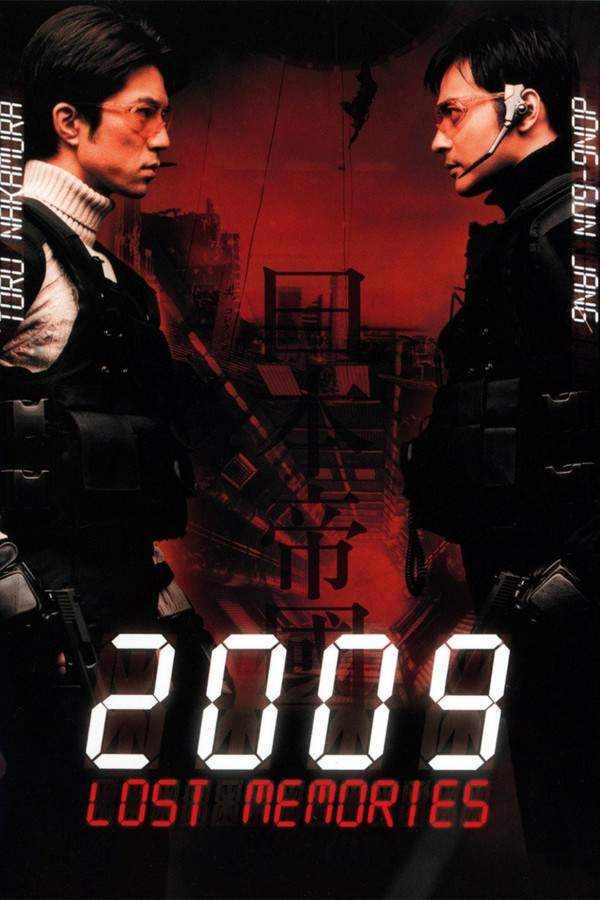
2009: Lost Memories (2005) movie poster

Timeline

2009: Lost Memories (2005) Timeline Explained – Every Event in Order

Release, runtime and language
2005 · 136 min · Korean
Directed by
Si-myung Lee

A catastrophic event looms, threatening to erase Korea's future and its history. Two rival agents, pulled from different points in time, are forced to work together to avert the disaster and protect their homeland. As they confront the dangers of manipulating time, they must question their loyalties and face the unforeseen consequences of altering the course of destiny in this action-packed thriller.

On this page (5)
  1. 1 Where to watch
  2. 2 Events in order (15)
  3. 3 Timeline questions answered
  4. 4 Movie threads
  5. 5 Every angle

Where to watch

Where to Watch 2009: Lost Memories (2005)

Where can you watch 2009: Lost Memories? Stream, rent or buy it in the US, including on Amazon Video, Apple TV Store and Google Play Movies: current JustWatch availability with up-to-date prices.

Streaming availability powered by JustWatch

15 events in order · contains spoilers

2009: Lost Memories Timeline: Events in Chronological Order

Every key event of 2009: Lost Memories (2005) in order, scene by scene, with when and where it takes place. Use it to untangle flashbacks, time jumps and parallel storylines, to refresh your memory before the sequel or to find the exact scene you are thinking of.

  1. Japan Tightens Control

    In 2009, Imperial Japan's grip over the Korean Peninsula intensified, leading to a heightened atmosphere of tension. The political environment grew tenser as both sides braced for conflict, showcasing the struggles faced by the region and its people.

    When
    2009
    Where
    Korean Peninsula
  2. Hostage Crisis at Keijo Museum

    A group of terrorists known as the Hureisenjin launched a daring hostage crisis at the Keijo Museum. This brazen act shocked the nation and triggered a response from the Japanese Bureau of Investigation, drawing agents Masayuki Sakamoto and Shojiro Saigo into the chaotic situation.

    Where
    Keijo Museum
  3. Discovery of the Lunar Soul

    As Sakamoto investigated the hostage crisis, he unveiled a connection to a mysterious crescent-shaped artifact dubbed the 'Lunar Soul.' This revelation illuminated the terrorists' motives and hinted at a greater scheme surrounding the artifact's powerful significance.

  4. Attack on Inoue Foundation Artifacts

    The situation escalated when the Hureisenjin ambushed a convoy transporting valuable artifacts tied to the Inoue Foundation. The attack underscored the lengths the terrorists would go to secure their goals and showcased Sakamoto's dual fight against time and threat.

  5. Sakamoto's Troubled Past

    Sakamoto wrestled with his father's dark legacy, who had been executed as a traitor linked to an earlier Hureisenjin attack in 1985. This haunting memory not only affected his credibility but also fueled his determination to unravel the Hureisenjin's plot.

    When
    1985
  6. Independent Mission to Harbin

    Despite being ousted from the case by his superiors, Sakamoto embarked on a personal mission to Harbin to uncover the truth about the Lunar Soul. His independence marked a turning point as he sought to connect the dots of the artifact's mysterious origins.

    Where
    Harbin
  7. Assassination of Takahashi

    Sakamoto faced heartbreak when his mentor, Takahashi, was brutally murdered in his home. This tragic event not only left Sakamoto shattered but also led to further complications as he became embroiled in murder accusations.

  8. Betrayal by Saigo

    In a shocking twist, Sakamoto learned that his ally Saigo would betray him the next time they crossed paths. This loyalty shift added another layer of complexity to Sakamoto's operations as he navigated his crumbling support system.

  9. The Temple Revelation

    While hiding, Sakamoto uncovered astonishing truths about a colossal stone temple capable of manipulating time. The implications of this discovery revealed interconnected timelines and the potential the terrorists believed they could exploit.

    When
    2009
  10. Inoue's Historical Manipulation

    The narrative unfolded to reveal that Inoue's actions in the present were tied to attempts to change the past. This manipulation gave rise to Japan's unexpected victories during pivotal moments in history, radically altering its position in the world.

    When
    1909
  11. Hureisenjin's Creation

    A Korean researcher, intent on restoring the original timeline, founded the Hureisenjin to counteract Inoue's manipulations. This organization's formation signified the beginning of a broader struggle over historical integrity.

  12. Alliance with Hureisenjin

    As Sakamoto learned more about the disturbed timeline, he decided to ally with the Hureisenjin. Together, they aimed to reclaim control of the temple stone and prepare for a confrontation against the JBI.

  13. Confrontation with the JBI

    Their plans were thwarted when the JBI raided the Hureisenjin's lair, resulting in chaos and loss. Amidst the turmoil, Sakamoto and Hye-rin managed to escape, setting the stage for the next phase of their mission.

  14. Final Showdown and Sacrifice

    In the climactic face-off, Sakamoto and Hye-rin activated the temple stone's powers, culminating in a tragic gunfight where Hye-rin was gravely injured. Sakamoto's struggle intensified as he now bore the heavy weight of protecting the timeline's future.

    Where
    Tanker Ship
  15. Return to the Restored Timeline

    Upon returning to 2009, Sakamoto found the world altered, with a young boy reminiscent of their past connection honoring Korean leaders at Independence Hall. The poignant scene illuminated the results of Sakamoto's actions and the legacies left behind.

    When
    2009
    Where
    Independence Hall

Last updated: November 22, 2024 at 14:27

Was this helpful?

Timeline questions answered

2009: Lost Memories Timeline Explained: Your Questions Answered

When does it happen, and why in that order? The questions people ask about the chronology of 2009: Lost Memories (2005): time jumps, flashbacks, cause and effect between scenes and the correct order of events, each answered with spoilers.

Q1

How did Japan change history in the movie?

Japan altered history by using a time-manipulating temple stone discovered in 2009. The ultranationalist group Uyoku dantai sent their leader Inoue back 100 years to October 1909 to prevent the assassination of Resident-General Itō Hirobumi. With Itō alive and Inoue's foreknowledge, Japan avoided its wartime defeats, remained aligned with the Axis but switched to ally with the US against Nazi Germany. The war ended in 1945 with Berlin being atomic-bombed instead of Hiroshima and Nagasaki, allowing Japan to maintain its colonial empire and gain a permanent UN Security Council seat.

  • time travel
  • temple stone
  • Itō Hirobumi
  • alternate history
  • 1909
  • Japan WWII
Q2

Who founded the Hureisenjin and what was their goal?

The Hureisenjin was founded by a Korean researcher who sought to restore the original timeline. After discovering Japan's manipulation of history through the temple stone, this researcher dedicated their life to tracking down Inoue and preventing his temporal interference. The group passed down knowledge of the distorted timeline across generations, with the ultimate goal of assassinating Itō Hirobumi in 1909 to restore Korea's actual historical path.

  • Hureisenjin
  • Korean researcher
  • restore timeline
  • Inoue
  • resistance
Q3

Why did Saigo betray Sakamoto?

Saigo's betrayal stemmed from knowing that restoring the original timeline would result in the atomic bombing of Hiroshima, which would kill his wife's family. Despite understanding Sakamoto's mission to save millions from Japanese colonial rule, Saigo chose to protect his own family. He became an adversary because the restored timeline meant certain death for his loved ones, making his personal tragedy too great to sacrifice for historical correction.

Foreshadowing: Saigo had pledged to become Sakamoto's enemy the next time they would meet after Takahashi's murder.

  • Saigo
  • betrayal
  • Sakamoto
  • Hiroshima
  • family
  • timeline restoration
Q4

How does the temple stone enable time travel?

The temple stone is a colossal ancient artifact discovered by archaeologists in 2009 beneath a stone temple. It possesses the extraordinary ability to manipulate time, allowing people to travel exactly 100 years into the past or future. When placed with the Lunar Soul artifact, the stone's powers activate fully. However, the stone's usage creates significant consequences, as altering the past fundamentally reshapes reality for everyone in the present.

  • temple stone
  • time travel
  • Lunar Soul
  • time manipulation
  • 1909
  • 2009
Q5

Why did Sakamoto ally with the Hureisenjin?

Sakamoto allied with the Hureisenjin after learning the shocking truth about Japan's altered history. Realizing that his own nation had committed grave historical wrongs through time manipulation, and that the Hureisenjin held the key to fixing the timeline, Sakamoto chose to join them. His change in allegiance was driven by moral conviction that Korea's suffering under Japanese colonialism was wrong and that restoring the original history was the just action.

  • Sakamoto
  • Hureisenjin
  • alliance
  • timeline
  • moral conviction
  • Japan colonial rule
Q6

What happened to Hye-rin in the end?

Hye-rin died from injuries sustained during the gunfight on the tanker ship while activating the temple stone with the Lunar Soul. She succumbed to her wounds, leaving Sakamoto as the sole protector of the timeline's fate. However, the ending reveals a twist: the Hye-rin who appeared beside Sakamoto before destroying the temple stone was actually a different version, a Korean researcher from the original timeline who had followed Inoue through time but never met Sakamoto in that reality.

  • Hye-rin
  • death
  • tanker ship
  • timeline
  • Korean researcher
  • sacrifice
Q7

Why was preventing Itō Hirobumi's assassination so important?

Itō Hirobumi's assassination on October 26, 1909 was historically significant because it marked a pivotal moment in Korea's struggle for independence from Japanese colonial rule. In the original timeline, Itō's death was a major event that galvanized Korean independence movements. By preventing his assassination, Inoue ensured Japan would not lose its colonial governor-general, allowing Japan to maintain control over Korea and eventually win World War II through altered historical circumstances.

  • Itō Hirobumi
  • assassination
  • 1909
  • Korean independence
  • colonial history
Q8

What changed in the ending when the timeline was restored?

When Sakamoto succeeded in restoring the original timeline, Japan lost its dominant world position and Korea regained independence. The most poignant change was at Independence Hall, where a young boy who had known Sakamoto in the alternate timeline now stood before a gallery honoring Korean heroes, including a portrait of Sakamoto and Hye-rin together, happily united. This visual confirmed that in the restored timeline, they had lived as beloved Korean independence figures rather than Japanese agents.

  • restored timeline
  • Independence Hall
  • Korea
  • Sakamoto
  • Hye-rin
  • ending
  • heroes
Q9

Why was Sakamoto's father executed as a traitor?

Sakamoto's father was executed as a traitor because he was accused of assisting a Hureisenjin attack on a cargo ship bound for Vladivostok in 1985. This dark family legacy haunted Sakamoto throughout the film, affecting his credibility within the JBI and making his investigation into the Hureisenjin personally complicated. The truth revealed that Sakamoto's father may have been trying to help the resistance rather than betray Japan, adding tragic depth to Sakamoto's character.

  • Sakamoto father
  • executed
  • traitor
  • 1985
  • Hureisenjin
  • cargo ship
  • Vladivostok
Q10

What is the Lunar Soul artifact?

The Lunar Soul is a crescent-shaped artifact that plays a crucial role in activating the temple stone's time-manipulating powers. Originally captured from a fallen Hureisenjin terrorist during the Keijo Museum hostage crisis, the artifact contains mysterious properties essential to temporal manipulation. When placed within the temple stone, it fully activates the time travel mechanism, though its use comes with grave consequences for those involved.

  • Lunar Soul
  • artifact
  • crescent
  • temple stone
  • time travel
  • activation

Movie threads

More Movies Like 2009: Lost Memories, by Mood & Story

Curated lists built around what makes 2009: Lost Memories tick: the same mood, the same kind of story or the same emotional payoff. Each list explains why these movies belong together.

Alternate History Thrillers like 2009: Lost Memories

High-stakes espionage and conspiracy in a world where history was rewritten. If you enjoyed the high-concept conspiracy and historical revision of 2009: Lost Memories, explore these movies where the past is a weapon and the present is a fragile construct. Find similar action-packed sci-fi thrillers with complex political plots and mind-bending premises.

  • mind-bending
  • tense
  • conspiracy
  • political
  • thrilling
  • investigative
  • Tone: tense, paranoid
  • Pacing: fast, plot-driven
Why these movies?

The story pattern: These narratives typically begin with the revelation of an altered timeline, forcing a protagonist to investigate the powerful forces behind the change. The plot involves uncovering secrets, high-level betrayals, and often a race to either preserve the new reality or restore the original one, leading to complex moral choices.

Why they belong together: They are grouped by their shared core premise of an alternate history, which fuels a tense, politically-charged thriller narrative. The experience combines the intellectual puzzle of a 'what if' scenario with the adrenaline of action and espionage.

Bitterswapet Sci-Fi Action Movies like 2009: Lost Memories

Action-packed journeys where victory comes at a profound personal cost. For viewers who liked the intense action and emotional weight of 2009: Lost Memories, this list features similar sci-fi stories. Discover films that blend fast-paced thrills with complex themes, leading to victories that feel earned yet are shadowed by melancholy and sacrifice.

  • heavy
  • melancholic
  • thrilling
  • action-packed
  • sacrifice
  • poignant
  • Tone: bittersweet, heavy
  • Pacing: fast, with emotional pauses
Why these movies?

The story pattern: The journey is characterized by high-stakes conflict and relentless pacing, but the emotional arc focuses on sacrifice. Characters lose allies, question their actions, and bear the burden of their choices. The climax resolves the central conflict, but the denouement emphasizes the personal toll, creating a somber, reflective conclusion.

Why they belong together: These films share a specific tonal blend: the excitement of a sci-fi action thriller combined with the emotional depth of a heavy drama. They deliver on spectacle while ensuring the ending resonates on a human level, leaving a lasting impression.

Every angle

2009: Lost Memories (2005) Explained: Plot, Timeline & Characters

Everything about 2009: Lost Memories in one place: what happens in the plot summary, the timeline in chronological order, the characters and meaning and a spoiler-free summary. What's After the Movie adds the cast, box office and post-credit scenes.

Coming soon on iOS and Android

The Plot Explained Movie Summary App

Plot summaries, endings explained and timelines on your phone. Catch up on any movie in minutes, save your favorites and never miss a twist again.

Be the first to know when we launch. Your email stays private, always.

Learn more about the app