Year: 2024
Runtime: 2 h 23 m
Language: indonesian
Director: Angga Dwimas Sasongko
Echo Score: 62Budget: $4.6M
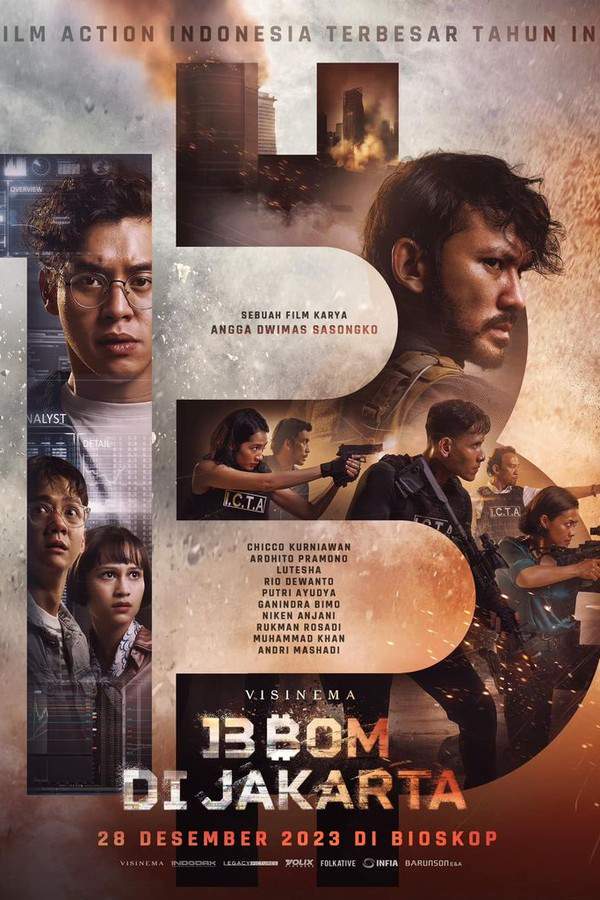
A team races against time to stop a devastating attack on Jakarta as thirteen bombs threaten to destroy the city. They must decipher the plot and confront the mastermind behind the dangerous scheme to prevent catastrophe.
Warning: spoilers below!
Haven’t seen 13 Bombs in Jakarta yet? This summary contains major spoilers. Bookmark the page, watch the movie, and come back for the full breakdown. If you're ready, scroll on and relive the story!
Read the complete plot breakdown of 13 Bombs in Jakarta (2024), including all key story events, major twists, and the ending explained in detail. Discover what really happened, and what it all means.
An armored truck is struck by a shoulder-fired missile in the bustling heart of Jakarta, leading to a tragic scene where all security personnel inside are killed by the attackers. Astonishingly, the assailants manage to pry open the truck but leave the money scattered on the streets.
The Bureau of Counterterrorism, under the leadership of Damaskus, consists of officers Emil and a female officer named Karin, with Gita and Fajar assisting Karin. A dire situation arises when the Bureau’s network is hacked, and the terrorist leader delivers a chilling ultimatum to Karin: 13 bombs are planted throughout Jakarta, each poised to detonate every eight hours unless a ransom of 100 bitcoins is paid via Indodax.
The founders of this cryptocurrency exchange, [William](/actor/ ardhito-pramono) and Oscar, find themselves at the center of suspicion as Damaskus investigates possible ties to the terrorist organization. Their vision was to transform the financial landscape of Indonesia, but as they are interrogated by the Bureau, they grapple with proving their innocence. They propose to assist the Bureau in tracking the terrorists if their platform is used for the ransom. Yet, the terrorist leader's cunning proves to be more than they anticipated — this transaction is merely a trap, luring Bureau agents directly into the terrorists' lair.
As chaos unfolds in Jakarta, the initial bomb goes off at the stock exchange, drawing public attention and alarming the Bureau. To maintain their image, the terrorist organization broadcasts their message, portraying themselves as champions of the oppressed, fighting against systemic poverty and corruption. They demand attention from the government with their unyielding stance of extreme measures to restore equality, warning of more impending attacks.
Realizing the potential leverage of cryptocurrency knowledge, Damaskus considers utilizing William and Oscar. However, the young entrepreneurs decide not to return to the Bureau of Counterterrorism, fearing wrongful accusations. Compelled to gather evidence that could clear their names, they embark on a desperate journey to find their families and their equipment. Joining them is Agnes, William's girlfriend, who opts to assist them in evading both the police and terrorists.
Karin, meanwhile, suspects a mole in the Bureau after two previous hacks. She shares this concern with Gita, particularly eyeing Fajar. Yet, unbeknownst to them, Fajar is distracted by the crashing bitcoin prices throughout their investigation. Ultimately, as the narrative unfolds, the second bomb detonates in a Jakarta metro train, escalating the urgency of the situation.
When William and Oscar finally confront Arok, also known as Ismail — portrayed by Rio Dewanto — they learn he was once inspired by their cryptocurrency seminars. He articulates his vengeful cause, citing personal tragedies resulting from systemic corruption, and despite their best intentions of advocating for a transparent financial system, William and Oscar cannot condone Arok's violent methods. They initially offer money, but Arok reveals that their struggle is not about wealth but about justice, driven by his deeply personal grief.
As tensions rise, the terrorists target the international airport for their next bombing, causing a moral dilemma within their ranks. Waluyo, one of the tech leads in the organization, struggles with the collateral damage resulting from these attacks, and yet feels compelled to follow Arok's orders. A tragic turn occurs as Waluyo sacrifices himself while assisting William and Oscar, revealing that there’s a thirteenth bomb — a malicious malware designed to wipe out the country's financial system.
Caught up in a web of deception, William and Oscar discover that the mole is not Fajar but, astonishingly, Gita. This revelation strikes hard as they realize that Gita was tasked with tracking down the threats while being a part of the organization. Tension mounts when Gita's interference puts the entire Bureau on high alert.
The ensuing conflict culminates at an abandoned factory where both Emil and Karin partake in the dangerous rescue of William and Oscar, who bring forth the knowledge of the impending malware threat. In a sudden twist, Gita confronts Karin while trying to install the malware, leading to a tragic confrontation where emotions and motives collide.
In a dramatic climax, with the fate of the nation hanging in the balance, the group fights to stop the spread of the malware that threatens to ignite chaos. After a frantic race against time, Oscar and William ultimately succeed in deactivating the malware, saving countless lives.
Reflecting on the destruction and devastation caused by violence, the aftermath serves as a poignant reminder of the government's failures and the continuous cycle of despair that can lead frustrated citizens to extreme actions. While the immediate threat has been neutralized, the story exposes the deeper issues within society that may give rise to new conflicts in the future.
Last updated: June 11, 2025 at 06:37
Explore frequently asked questions about 13 Bombs in Jakarta (2024) with spoiler-rich answers covering the full plot summary, major story beats, character motivations, hidden details, and ending meaning. This movie summary FAQ helps explain confusing scenes, plot twists, and narrative decisions in clear, searchable detail.
The attackers never intended to steal the money. The armored truck attack was designed purely as a distraction and a demonstration of capability. By striking a high-profile target and leaving the cash untouched, they immediately signaled to authorities that this was not a typical robbery but the opening move in a much larger, more sophisticated terror operation.
The terrorist leader, Arok, deliberately used the Indodax cryptocurrency exchange for the ransom knowing the Bureau would attempt to trace the transaction. Rather than actually collecting payment, Arok designed the transaction to lure Bureau agents into a coordinated ambush at a pre-determined location, allowing the terrorists to strike at the investigators directly.
The terrorists' initial hack of the Bureau's network already demonstrated their technical superiority and inside knowledge.
The thirteenth bomb was not a physical explosive but a sophisticated malware designed to wipe out Indonesia's entire financial system. Arok intended this digital weapon to cause far more catastrophic damage than the physical bombings, potentially collapsing the country's economy and creating widespread chaos beyond the immediate casualties.
Waluyo's hesitation about attacking the airport and his moral objections to civilian casualties hinted at his knowledge of the malware's true destructive potential.
Gita is the mole within the Bureau, not Fajar as Karin initially suspected. Gita had been secretly working with the terrorist organization while maintaining her position as a Bureau officer, allowing her to track the investigation's progress and feed critical intelligence to Arok's group.
Karin's suspicion of Fajar was a misdirection; the real betrayal came from someone closer to the investigation who had access to sensitive information.
Arok, whose real name is Ismail, was driven by personal tragedy caused by systemic corruption in Indonesia. After attending William and Oscar's cryptocurrency seminars and believing in their vision for financial transparency, Arok became disillusioned when government corruption destroyed his life. He turned to terrorism not for wealth but as a twisted form of justice, using violence to draw attention to the oppression and inequality he experienced firsthand.
Arok's reference to William and Oscar's seminars during the confrontation revealed his connection to the cryptocurrency world and the ideological foundation of his grievance.
William and Oscar used their expertise in cryptocurrency and financial technology to trace and neutralize the malware before it could spread across Indonesia's banking infrastructure. Working frantically at the Bureau's headquarters, they managed to deactivate the destructive code in the final moments before it would have wiped out the country's financial systems entirely.
Arok's mistake was underestimating the very technological knowledge he admired, William and Oscar's expertise became the weapon to defeat his digital attack.
Waluyo, one of Arok's tech leads, experienced a moral crisis over the escalating civilian casualties and the planned attack on the airport. His sacrifice was both an act of redemption and a strategic move to help William and Oscar stop the catastrophic malware attack. By revealing the thirteenth bomb's true nature and assisting in the effort to deactivate it, Waluyo chose to prevent an even greater disaster at the cost of his own life.
Waluyo's earlier hesitation and moral objections during discussions about the airport bombing foreshadowed his eventual turn against Arok's plans.
Karin suspected Fajar primarily because he appeared distracted and emotionally unstable during the investigation, particularly when bitcoin prices crashed dramatically. His obvious preoccupation with the financial markets made him seem suspicious, especially given the case's connection to cryptocurrency. However, this was a red herring, Fajar was simply worried about personal financial losses, while the real mole, Gita, maintained a professional composure that concealed her true allegiances.
The Bureau's focus on Fajar's behavior allowed Gita to continue operating undetected while feeding information to the terrorists.
The stock exchange bombing served multiple strategic purposes: it demonstrated the terrorists' capability to strike any target in Jakarta, created immediate economic chaos, and forced the government to take the threat seriously. The attack was also designed to validate their narrative that they were fighting against a corrupt financial system, aligning with their message that the wealthy elite and institutions were the enemies of ordinary citizens.
The terrorists' subsequent broadcast message directly connected their actions to systemic economic injustice and corruption.
Agnes, William's girlfriend, chose to assist him and Oscar because she believed in their innocence and wanted to help them prove they were not involved with the terrorists. Her decision to join their dangerous quest to find their families and equipment was driven by loyalty and the practical need to clear their names, making her a crucial ally in navigating both the police and terrorist threats.
Agnes's action-oriented role in the film positioned her as the one who would ultimately take decisive action against Gita at the critical moment.
Arok viewed the international airport as a symbol of Indonesia's connection to global financial systems and corruption. By targeting the airport, he intended to create maximum economic disruption and demonstrate that no institution was beyond reach. However, this plan caused significant internal conflict among his followers, with members like Waluyo objecting to the massive civilian casualties such an attack would cause.
The internal disagreement over the airport bombing revealed the fractures within the terrorist organization and set the stage for Waluyo's eventual betrayal.
The twelve physical bombs were either detonated or defused during the Bureau's operation, with the stock exchange and metro train bombings causing significant casualties before authorities could respond. The thirteenth bomb, the malware, came closest to causing catastrophic damage but was successfully deactivated by William and Oscar at the Bureau headquarters in the final moments before it would have wiped out the country's financial infrastructure.
The dual nature of the threat, physical bombings combined with a digital attack, created the race-against-time climax that defined the film's resolution.
Still wondering what the ending of 13 Bombs in Jakarta (2024) really means? Here’s a spoiler-heavy breakdown of the final scene, major twists, and the deeper themes that shape the film’s conclusion.
The ending of 13 Bombs reveals that although the terrorist organization’s plan to detonate 13 bombs would have caused catastrophic destruction, their true aim was to expose the government’s failure to protect its people and to restore justice through chaos. The group's leader, Arok, who had a tragic personal history marked by loss and systemic injustice, believed that bombing was necessary to awaken the nation and dismantle the corrupt system. William and Oscar, the young founders of a cryptocurrency platform, initially get caught in the chaos when they are suspected of aiding the terrorists because of the Bitcoin transaction requested by the leader. However, their true goal is to clear their names and help stop the bombs by uncovering the organization’s network.
As the story unfolds, William, Oscar, and the others discover that the leader of the terrorist group, Arok—also known as Ismail—had attended their seminar and was inspired by their ideas of financial transparency. Despite his revolutionary goals, Arok believed that violence was the only way to fight systemic injustice, having suffered personal tragedies including the death of his wife and son. The terrorists' plan involved bombs that were meant to cause chaos to bring the government to its knees and force change.
William and Oscar decide to help the police by tracking down the remaining bombs and confronting the terrorists on their own, as they fear being framed or abandoned. They manage to locate the bombs and deactivate them, with the help of Waluyo, a loyal tech expert within the terrorist group, who ultimately sacrifices his life to protect William and Oscar.
The climax reveals that there was a mole within the police agency—Gita, who was secretly working with Ismail and passing information to him—contrary to initial suspicions of Fajar. Gita had been the one to give Ismail the malware, the final 13th bomb designed to destroy the financial system. As Gita attempts to install the malware, Karin intervenes, and Agnes shoots her to stop the attack. In the final moments, Gita expresses her personal pain—her sister's death due to systemic failure—justifying her actions as a desperate measure to awaken the government to its neglect.
The film concludes with the malware being stopped just in time, preventing the complete collapse of the country's financial infrastructure. The ending emphasizes that violence is not the solution, despite the terrorists’ intentions, and underscores the government’s failure to address inequality. The terrorists' plan to act as a reckoning serves as a grim reminder that unless systemic change occurs, unrest and extremism will continue to threaten societal stability. The final scene leaves viewers contemplating that true justice requires acknowledging systemic flaws and working toward real reform rather than destruction.
Last updated: June 25, 2025 at 09:02
Discover curated groups of movies connected by mood, themes, and story style. Browse collections built around emotion, atmosphere, and narrative focus to easily find films that match what you feel like watching right now.
Frantic missions where every second counts to prevent a catastrophic event.If you enjoyed the constant tension of 13 Bombs in Jakarta, you'll find more movies like it here. These films feature high-stakes thrillers with a literal or figurative ticking clock, focusing on desperate efforts to avert catastrophe in stories that share a similar gripping, fast-paced feel.
This thread gathers stories where a tangible deadline drives the entire plot. The narrative structure is a linear pursuit against time, often involving a team deciphering clues, facing technological threats, and overcoming systemic obstacles to stop a large-scale attack or disaster.
Movies are grouped here because they all create a specific, sustained feeling of urgency and high-stakes anxiety. They share a fast pace, a tense tone, and a focus on the logistical and emotional strain of a mission where failure is not an option.
Stories where saving the day comes at a heavy moral and societal cost.For viewers who appreciated the heavy emotional weight and complex ending of 13 Bombs in Jakarta, this section highlights similar movies. These stories deliver tense action but conclude with a bittersweet or bleak feel, often questioning the institutions involved and leaving a lasting impact.
The narrative pattern involves a central conflict that exposes deeper societal rot, such as government corruption or ethical collapse. While the protagonists may achieve their goal, the victory is tempered by significant loss, moral compromise, or the sobering realization that the underlying problems remain unsolved.
These films are grouped by their shared emotional journey and thematic conclusion. They blend high-intensity action with a heavy emotional weight, resulting in an ending that feels more contemplative and sobering than purely triumphant, focusing on the cost of victory.
Don't stop at just watching - explore 13 Bombs in Jakarta in full detail. From the complete plot summary and scene-by-scene timeline to character breakdowns, thematic analysis, and a deep dive into the ending - every page helps you truly understand what 13 Bombs in Jakarta is all about. Plus, discover what's next after the movie.
Track the full timeline of 13 Bombs in Jakarta with every major event arranged chronologically. Perfect for decoding non-linear storytelling, flashbacks, or parallel narratives with a clear scene-by-scene breakdown.
Discover the characters, locations, and core themes that shape 13 Bombs in Jakarta. Get insights into symbolic elements, setting significance, and deeper narrative meaning - ideal for thematic analysis and movie breakdowns.
What really happened at the end of 13 Bombs in Jakarta? This detailed ending explained page breaks down final scenes, hidden clues, and alternate interpretations with expert analysis and viewer theories.
Discover movies like 13 Bombs in Jakarta that share similar genres, themes, and storytelling elements. Whether you’re drawn to the atmosphere, character arcs, or plot structure, these curated recommendations will help you explore more films you’ll love.
13 Bombs in Jakarta (2024) Scene-by-Scene Movie Timeline
13 Bombs in Jakarta (2024) Movie Characters, Themes & Settings
13 Bombs in Jakarta (2024) Ending Explained & Theories
13 Bombs in Jakarta (2024) Spoiler-Free Summary & Key Flow
Movies Like 13 Bombs in Jakarta – Similar Titles You’ll Enjoy
The Night Comes for Us (2018) Complete Plot Breakdown
District B13 (2006) Complete Plot Breakdown
Java Heat (2013) Detailed Story Recap
Bangkok Dangerous (2008) Full Summary & Key Details
Double Team (1997) Plot Summary & Ending Explained
A Common Man (2013) Plot Summary & Ending Explained
Ticker (2001) Plot Summary & Ending Explained
Piano 17 (2006) Spoiler-Packed Plot Recap
Jakarta (2000) Ending Explained & Film Insights
Dus (2005) Plot Summary & Ending Explained
Shanghai 13 (1984) Ending Explained & Film Insights
Jakarta vs Everybody (2020) Story Summary & Characters
Jakarta (1988) Movie Recap & Themes
Thirteen Days to Die (1965) Plot Summary & Ending Explained
War on Terror: KL Anarchy (2023) Spoiler-Packed Plot Recap