Year: 1965
Runtime: 115 min
Language: English
Director: Michael Anderson
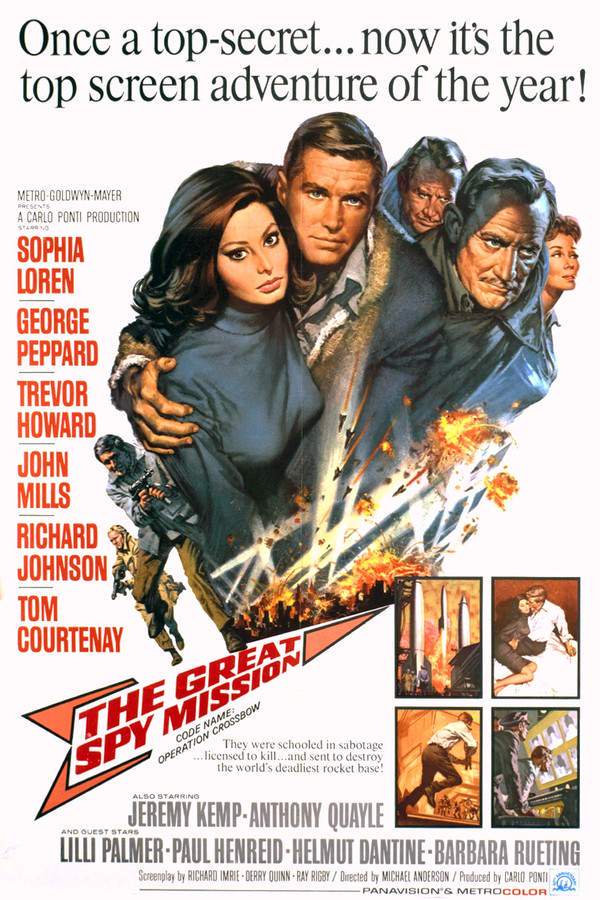
During World War II, London intercepts intelligence regarding a dangerous new weapon the Nazis are developing. To avert a potential disaster, the prime minister sends a team of three specialists on a covert mission. Disguised as German soldiers, they must infiltrate a suspected Nazi facility. The team faces extreme peril and must navigate a complex web of deceit, pushing their skills and commitment to the limit in this high-stakes operation.
Find where to stream, rent, or buy Operation Crossbow (1965) in the US with current JustWatch availability, up-to-date pricing, and platform listings for subscription, rental, and digital purchase options.
Warning: spoilers below!
Haven’t seen Operation Crossbow yet? This summary contains major spoilers. Bookmark the page, watch the movie, and come back for the full breakdown. If you're ready, scroll on and relive the story!
Read the complete plot breakdown of Operation Crossbow (1965), including all key story events, major twists, and the ending explained in detail. Discover what really happened, and what it all means.
As World War II raged on in 1943, Germany’s military strength was showcased with the inception of the V-1 flying bomb and V-2 rocket. Initially, the V-1 faced numerous technical setbacks, prompting the Germans to develop a crewed version for testing. Tragically, the test pilots who took on this challenging role met untimely fates during their flights. It wasn’t until the famed aviator Hanna Reitsch successfully piloted the craft that it became clear that the trim controls needed adjustments for varying speeds and weights.
In the meanwhile, Winston Churchill grew increasingly troubled by rumors surrounding the flying bomb and assigned his son-in-law, Duncan Sandys](/actor/duncan-sandys), to investigate. Sandys, convinced by intelligence reports and photographic evidence regarding the V-1’s existence, faced skepticism from scientific advisor Professor Lindemann. In a decisive response, Bomber Command initiated a risky raid on Peenemünde, aiming to obliterate the rocket complex.
As Germany shifted their production to the underground Mittelwerk facility in Southern Germany, they began concentrating on developing the more formidable V-2 rocket. Awareness grew within British intelligence that engineers from across occupied territories were being enlisted, leading to a plan to infiltrate the factory. A trio of male volunteers—a British national, an American, and a Dutch engineer, all proficient in German or Dutch—were rapidly trained and sent into Germany. However, a British officer, Bamford, was among those interviewed but not selected, while later he would be uncovered as a German undercover operative.
Upon parachuting into occupied Europe, the agents discovered that Robert Henshaw, part of their team, was now falsely identified as a Dutch sailor wanted for murder. His capture, along with his coerced agreement to assist the Germans, ended tragically when he refused to comply and was brutally executed.
Simultaneously, USAAF Lieutenant John Curtis found himself in a precarious situation, pretending to be the husband of Nora, a desperate woman fighting for custody of her children. Misled into believing her spouse was staying at a hotel, she sought answers that would lead her to unforeseen tragedy at the hands of another agent. As Curtis and fellow agent Phil Bradley infiltrated the rocket factory, the urgency grew. Bradley assumed the unassuming role of a porter, allowing him to blend in as his credentials came under scrutiny. Meanwhile, Curtis ventured deeper into the operation, entrusted with resolving critical vibration problems hindering the V-2’s success.
The relentless barrage of V-1 flying bombs wreaked havoc over London, with the city engulfed in chaos. The Royal Air Force rushed to execute a daring nighttime raid on the factory’s mobile platforms. The success of this operation depended heavily on the agents’ ability to locate and disable the menacing A9/A10 “New York rocket,” demanding an intricate understanding of the facility’s layout.
Bamford was on the hunt, scrutinizing photographs of the engineering staff in hopes of spotting someone he recognized. Despite his thorough examination, he found no leads, compelling him to order an exhaustive review of all employee records. As Curtis geared up to make his critical move, Bamford unwittingly unmasked himself, revealing his true identity as a spy embedded within the factory. Alarmed, and with Bradley captured, Curtis found himself in a fix, cornered in the powerhouse and compelled to hold a group of workers at gunpoint.
As tensions rose, Bamford used Bradley as leverage, demanding Curtis’s surrender while the air raid sirens sounded menacingly. In a last-ditch effort to communicate vital information, Bradley’s attempt tragically backfired, leading to dire consequences. In the chaos, Curtis defended himself against oncoming workers, but a moment of misfortune struck—after pulling a lever to open the launch doors, he got shot while trying to fend off his assailants.
As the German forces prepared for launch, their plans were thwarted when incoming bombs obliterated both the rocket and the facility. In the aftermath, Winston Churchill congratulated Duncan Sandys on a job well done, noting that the identities of the agents would remain an enigma. Churchill appointed Sandys as Minister of Works, charging him with the monumental task of overseeing the reconstruction of a city left in ruins.
Last updated: November 18, 2024 at 20:53
Explore frequently asked questions about Operation Crossbow (1965) with spoiler-rich answers covering the full plot summary, major story beats, character motivations, hidden details, and ending meaning. This movie summary FAQ helps explain confusing scenes, plot twists, and narrative decisions in clear, searchable detail.
Duncan Sandys was chosen because he was Winston Churchill's son-in-law, which gave him access to the highest levels of government. Churchill personally tasked him with investigating the rumors about the flying bomb after becoming increasingly troubled by the intelligence reports. Despite skepticism from scientific advisor Professor Lindemann, Sandys aggressively pursued the investigation using photographic evidence and intelligence reports to confirm the V-1's existence.
Earlier scenes establish Churchill's personal concern about the threat, making his decision to involve his son-in-law a logical choice.
Bamford was a British officer who was interviewed but not selected for the infiltration team. Later in the film, he is revealed to be a German undercover operative embedded within British intelligence. His discovery as a spy creates a critical crisis when he uses the captured agent Phil Bradley as leverage to demand John Curtis's surrender, putting the entire mission in jeopardy.
Bamford's earlier scrutiny of photographs of engineering staff foreshadows his deeper interest in the operation's personnel.
Upon parachuting into occupied Europe, Robert Henshaw was wrongfully identified as a Dutch sailor already wanted for murder. The Germans captured him and coerced him into agreeing to assist them. However, when he later refused to comply with their demands, he was brutally executed. His death demonstrates the high risk and fatal consequences faced by the undercover agents.
The briefing established that capture meant likely death, setting the tragic tone for Henshaw's fate.
The facility was destroyed during a bombing raid by the Royal Air Force. As German forces prepared to launch the V-2 rocket, incoming bombs from the RAF raid obliterated both the rocket and the underground Mittelwerk facility. This success was achieved through the combined efforts of the infiltrating agents and the air raid, though it came at the cost of the agents' lives.
The agents' primary objective was to locate and disable the A9/A10 'New York rocket' while the RAF prepared their attack.
British intelligence learned that engineers from across occupied territories were being enlisted for the V-2 project at the underground Mittelwerk facility. To gather intelligence and potentially sabotage the operation, they selected three volunteers, a British national, an American, and a Dutch engineer, all proficient in German or Dutch. Their mission was to infiltrate the factory and support the broader effort to destroy the Nazi rocket program.
The earlier bombing of Peenemünde had forced the Germans to relocate production underground, making direct bombing less effective.
The A9/A10, nicknamed the 'New York rocket,' was an advanced version of the V-2 rocket that the agents were specifically tasked with locating and disabling. The success of the RAF's nighttime raid on the factory's mobile platforms depended heavily on the agents' ability to identify and neutralize this particular rocket before it could be launched.
The description of the V-2 as a more formidable weapon than the V-1 establishes the stakes for targeting this specific rocket.
The agents' sacrifices remained anonymous despite the mission's success. John Curtis was shot while trying to fend off workers after pulling a lever to open the launch doors. Phil Bradley was captured and used as leverage by Bamford before the raid. The film ends with Churchill noting that the identities of the agents would remain an enigma, highlighting the anonymous nature of their sacrifice.
The narrative repeatedly emphasizes the life-or-death stakes and the high probability of death for undercover operatives.
Bomber Command launched the raid on Peenemünde in response to the growing threat posed by the V-1 flying bomb. After Winston Churchill tasked Duncan Sandys with investigating the flying bomb threat, Sandys convinced the Prime Minister to authorize the risky raid. The goal was to obliterate the rocket complex before the weapon could be fully developed and deployed against London.
Churchill's increasing concern about the flying bomb and Sandys's investigation set the stage for this desperate military action.
The V-1 flying bomb faced numerous technical setbacks during initial tests, prompting Germany to develop a crewed version for testing. When test pilots died during these dangerous flights, famed aviator Hanna Reitsch successfully piloted the craft, revealing that trim controls needed adjustment for varying speeds and weights. These technical challenges led Germany to shift focus toward developing the more formidable V-2 rocket, which used more advanced technology.
The early technical failures with the V-1 establish the motivation for the parallel V-2 development program.
USAAF Lieutenant John Curtis found himself pretending to be the husband of Nora, a desperate woman fighting for custody of her children. She was misled into believing her spouse was staying at a hotel and sought answers, leading her to tragedy at the hands of another agent. This subplot highlights the collateral damage and personal deception involved in the undercover operation.
Curtis's deception creates a moral complication that adds emotional weight to the mission.
Winston Churchill initiated the investigation by assigning his son-in-law Duncan Sandys to look into the flying bomb threats. After Sandys confirmed the V-1's existence, Churchill authorized the bombing of Peenemünde and supported the infiltration plan. In the aftermath of the successful mission, Churchill congratulated Sandys, appointed him as Minister of Works, and noted that the agents' identities would remain classified forever.
Churchill's personal involvement throughout the film underscores the high-level importance of stopping the rocket threat.
Discover curated groups of movies connected by mood, themes, and story style. Browse collections built around emotion, atmosphere, and narrative focus to easily find films that match what you feel like watching right now.
Films about covert agents risking everything behind enemy lines.If the tense, high-stakes spy mission of Operation Crossbow gripped you, explore more movies like it. These films feature covert operations, undercover agents, and high-risk sabotage attempts set against the backdrop of major wars, delivering suspenseful and urgent thrillers.
These narratives typically follow a specialized team or individual agent as they are sent on a critical, clandestine mission. The plot revolves around the intricate process of infiltration, maintaining a cover, gathering intelligence or executing a sabotage plan, all while facing the looming threat of discovery and death. The journey is marked by close calls, moral compromises, and often, significant sacrifice.
Movies in this thread share a tense, grim atmosphere driven by the life-or-death stakes of espionage. They feature fast pacing with urgent missions, a focus on meticulous planning under extreme pressure, and a heavy emotional weight stemming from the realities of war and the sacrifices required for victory.
Stories where success is achieved, but profound sacrifices are made.If you appreciated the bitter cost of victory in Operation Crossbow, you'll find similar resonance in these films. Discover movies where the mission is a success, but the ending is emotionally complex due to sacrifice and loss, blending triumph with tragedy.
The narrative arc follows a group or individual striving for a crucial, often noble goal. The plot builds towards a climax where the goal is achieved, but this success is undercut by the devastating price paid to get there—typically the loss of key characters. The ending acknowledges the victory but lingers on the emptiness and grief it created, leaving a powerful, somber impression.
These films are grouped by their shared emotional trajectory: a journey with high stakes and heavy weight that culminates in a bittersweet ending. They balance the satisfaction of a mission accomplished with the poignant sadness of sacrifice, creating a deeply resonant and thought-provoking viewer experience.
Don't stop at just watching - explore Operation Crossbow in full detail. From the complete plot summary and scene-by-scene timeline to character breakdowns, thematic analysis, and a deep dive into the ending - every page helps you truly understand what Operation Crossbow is all about. Plus, discover what's next after the movie.
Track the full timeline of Operation Crossbow with every major event arranged chronologically. Perfect for decoding non-linear storytelling, flashbacks, or parallel narratives with a clear scene-by-scene breakdown.
Discover the characters, locations, and core themes that shape Operation Crossbow. Get insights into symbolic elements, setting significance, and deeper narrative meaning - ideal for thematic analysis and movie breakdowns.
Discover movies like Operation Crossbow that share similar genres, themes, and storytelling elements. Whether you’re drawn to the atmosphere, character arcs, or plot structure, these curated recommendations will help you explore more films you’ll love.
Operation Crossbow (1965) Scene-by-Scene Movie Timeline
Operation Crossbow (1965) Movie Characters, Themes & Settings
Operation Crossbow (1965) Spoiler-Free Summary & Key Flow
Movies Like Operation Crossbow – Similar Titles You’ll Enjoy
Operation Mincemeat (2022) Story Summary & Characters
Operation Napoleon (2023) Full Summary & Key Details
Where Eagles Dare (1969) Movie Recap & Themes
The Eagle Has Landed (1977) Film Overview & Timeline
Operation Seawolf (2022) Detailed Story Recap
Operation Dunkirk (2017) Movie Recap & Themes
Operation Condor (1991) Story Summary & Characters
Triple Cross (1966) Spoiler-Packed Plot Recap
Operation Cross Eagles (1968) Plot Summary & Ending Explained
Operation Amsterdam (1959) Detailed Story Recap
Operation Double Cross (1965) Film Overview & Timeline
Secret Agent (1936) Spoiler-Packed Plot Recap
Operation Secret (1952) Full Summary & Key Details
British Intelligence (1939) Story Summary & Characters
O.S.S. (1946) Film Overview & Timeline