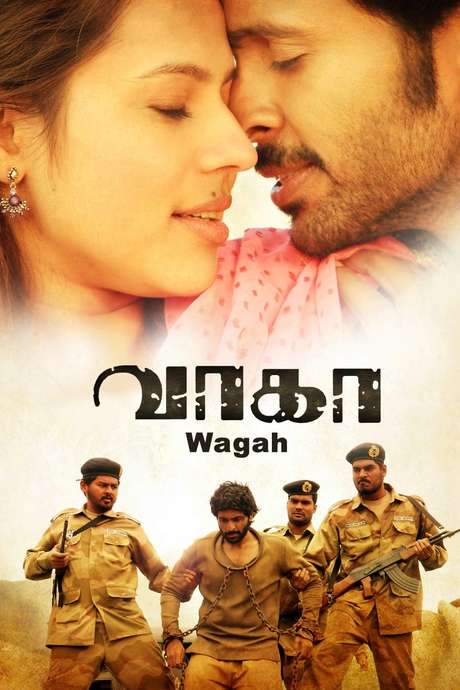
The film opens with a broadcast announcing the brutal decapitation of two BSF jawans by the Pakistan Army, while a third, Vasu, remains missing. The scene then cuts to a Pakistan Army base where the wounded Vasu is held, and he begins to recount the chain of events that led to his capture.
Vasu is a young man from a small town in Tamil Nadu who joins the BSF after finishing college, choosing this path to avoid working in his father Raj Kapoor's provision store. He is posted along the India–Pakistan border in Jammu and Kashmir, a region tense with conflict and daily risk. Early in his service, he encounters a shy and compassionate Kashmiri Muslim girl named Khanum Ranya Rao, and an instant pull develops between them. Khanum reciprocates his feelings, but she gently withdraws when he asks her to marry him, leaving Vasu with a mix of longing and uncertainty.
The next morning, the news of the two jawans’ decapitations spreads like wildfire, fueling anti-Pakistan sentiment and causing the Pakistani population in Kashmir to be urged to return homeland. Tasked with guiding and ensuring the safe return of all Pakistanis, Vasu is stunned to learn that Khanum is herself a Pakistani from Azad Kashmir who had come to India to visit her grandfather. When Khanum’s bus is set ablaze by protesters just a few kilometers from the border, she survives, and Vasu bravely escorts her to her home in PoK through an unguarded border crossing. Their journey takes a dangerous turn when Pakistani soldiers capture him, and he is imprisoned.
In the present day, Vasu discovers that he is not alone—there are twenty-three other BSF jawans being held prisoner. A brutal moment comes when he is forced to fight one of the fellow jawans, portrayed by Ajay Rathnam, and defeats him. Yet his victory is short-lived as he is dragged to a cliff to be shot. A compassionate Pakistan Army officer, whose daughter’s illness was cured by Indian doctors, secretly helps him escape, sparing his life.
Vasu and Khanum reunite in her village, where the danger intensifies as the ruthless anti-Indian commander Razzaq Ali Khan [Shaji Chaudhary] brutally wipes out Khanum’s family because he views her bond with an Indian soldier as treason. The two lovers flee toward the Indian border, pursued by Razzaq and the Pakistan Army. They confront the peril together, and Vasu ultimately subdues the pursuing force and defeats Razzaq without taking his life. Razzaq, defeated but unpersuaded, declares that his view of India and Indians will not change.
In a quiet rebuttal that underlines the film’s message, Vasu responds that, even as an Indian, he does not hate Pakistan or Pakistanis—he believes the cycle of hatred only deepens the conflict between the two nations. The pursuit eventually reveals a powerful truth: the 23 BSF jawans are alive in Pakistan, and Vasu helps secure their freedom. For his courage and humanitarian resolve, he is honored by both the President and the Prime Minister of India, a symbolic end that underscores the possibility of empathy crossing borders.
The film uses Vasu’s personal journey—rooted in duty, love, and restraint—to explore broader themes of national identity, forgiveness, and the human cost of war. The action builds steadily from a grounded border story to a larger, hopeful closing, where acts of mercy become a bridge between enemies and a reminder that courage can be defined by compassion as much as by combat.