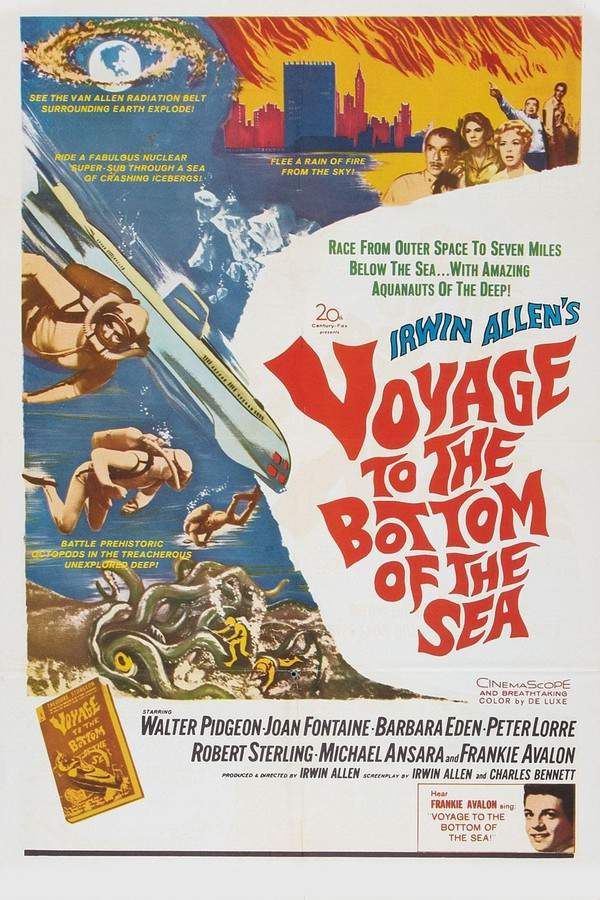
When a mysterious phenomenon engulfs the Earth in flames, Captain Harriman Nelson and the crew of a revolutionary submarine are humanity’s only hope. Nelson proposes a daring plan to extinguish the global inferno, but faces resistance from the United Nations and doubts within his own team. As they descend into the ocean's depths, he must battle skepticism and the psychological pressures of their mission to save the planet from total destruction.
Find where to stream, rent, or buy Voyage to the Bottom of the Sea (1961) in the US with current JustWatch availability, up-to-date pricing, and platform listings for subscription, rental, and digital purchase options.
Warning: spoilers below!
Haven’t seen Voyage to the Bottom of the Sea yet? This summary contains major spoilers. Bookmark the page, watch the movie, and come back for the full breakdown. If you're ready, scroll on and relive the story!
Trace every key event in Voyage to the Bottom of the Sea (1961) with our detailed, chronological timeline. Perfect for unpacking nonlinear stories, spotting hidden connections, and understanding how each scene builds toward the film’s climax. Whether you're revisiting or decoding for the first time, this timeline gives you the full picture.
Last updated: November 17, 2024 at 20:56
Find frequently asked questions about the Voyage to the Bottom of the Sea (1961) timeline, including chronological order, nonlinear jumps, cause-and-effect links, and scene sequence clarifications. This timeline FAQ helps explain when key events happen, how moments connect, and why the story unfolds in that specific order.
Admiral Nelson proposed the nuclear missile launch because the meteor shower had created a fiery belt surrounding Earth's atmosphere, causing global temperatures to rise catastrophically. The missile was intended to 'amputate' the inferno from orbit by dispersing the flames in the Van Allen Belt, which was the only way to stop the chain reaction of fires consuming the planet.
Earlier in the film, Nelson disputes Zucco's predictions about when the flames would naturally burn out, showing his belief that action was necessary.
Dr. Hiller was secretly aligned with Chief Scientist Emilio Zucco's position that the fires would eventually extinguish themselves. She sabotaged the Seaview because she believed Nelson's mission would fail and potentially make things worse. Her radiation badge revealed she had been exposed to dangerous levels of radiation while attempting to sabotage the nuclear reactor core, which confirmed her motive to stop the mission at any cost.
Hiller was noted to be secretly aligned with Zucco's stance, though this was not immediately apparent to the crew.
A meteor shower set off apocalyptic fires across the globe. The meteor shower triggered a chain reaction that drastically raised global temperatures, creating a fiery belt in the atmosphere that threatened to consume the entire planet.
The catastrophic ice fracture and the crew's emergence into a burning sky are the first visible signs of this crisis.
Captain Crane granted crew members the option to abandon ship because frustration among the crew had mounted to the point of threatening a mutiny. With the main generator sabotaged, the submarine forced to navigate a perilous World War II minefield without radar or sonar, and the mission seeming impossible, Crane and Nelson made the decisive choice to offer dissenters a way out rather than risk open rebellion.
The timeline shows crew frustration building alongside the series of obstacles they faced.
Miguel Alvarez, the scientist rescued from Ice Floe Delta, became convinced he was divinely chosen to destroy Earth. His belief in divine intervention drove him mad, leading him to threaten the crew with a bomb. This psychological break occurred during the intense mission pressure and escalating global crisis.
Alvarez was initially introduced as a fervent believer in divine intervention, which foreshadowed his later breakdown.
The hostile submarine gave chase into the Mariana Trench, but it was destroyed by the immense pressure of the deep ocean depths. The submarine imploded before it could attack the Seaview, eliminating the threat without the crew needing to engage in combat.
The Mariana Trench is established as an extremely deep and dangerous location earlier in the timeline.
Chief Scientist Emilio Zucco opposed Nelson's plan because he believed the flames would eventually extinguish themselves naturally. Zucco was convinced that the global fires would burn out on their own without the need for a risky nuclear intervention. He presented this viewpoint to the United Nations Scientific Committee and directly disputed with Nelson about inaccurate predictions regarding the burn-out point.
Zucco's opposition is introduced early when he stands firmly against the proposal at the UN meeting.
Captain Crane ordered the launch of a nuclear missile from outside the submarine, directing it toward the hazardous Van Allen Belt. The explosion successfully dispersed the flames that were threatening Earth's atmosphere, neutralizing the fiery belt and averting disaster. This validated Nelson's original plan and proved Zucco's wait-and-see approach would have been too slow.
The film builds to this climax after the crew overcomes all obstacles and reaches the Mariana Islands.
The Seaview was conducting crucial trials in the frigid Arctic waters and was directed by Admiral Harriman Nelson to maintain radio silence for a full 96 hours. This isolation was critical to the trials' success, but it meant the crew was completely unaware of the catastrophic meteor shower and global fire crisis unfolding above them while they were submerged.
This decision directly led to the crew's shocking discovery when they finally surfaced.
The hostile submarine was not built to withstand the extreme pressure at the depths of the Mariana Trench. When it pursued the Seaview into those depths, the water pressure became too great for its hull to withstand, causing it to implode and be destroyed before it could attack.
The Mariana Trench is established as an environment of immense pressure and danger.
The Seaview needed to reach the Mariana Trench because the launch position above the Mariana Islands required specific angles and trajectories that were essential for the nuclear missile to effectively reach and neutralize the fiery belt in the atmosphere. The location was critical to the mission's success, making the race against time to reach this position a central challenge.
The timeline emphasizes the urgency of reaching optimal launch position as a life-or-death decision.
The Seaview attempted to contact the President via the Rio-to-London telephone cable but only managed to access the London cable because contact with the U.S. had been severed for 35 hours. This communication failure added to the isolation and urgency of their mission.
The failed communication attempt occurs during the conflict with the giant squid.
Discover curated groups of movies connected by mood, themes, and story style. Browse collections built around emotion, atmosphere, and narrative focus to easily find films that match what you feel like watching right now.
Tense missions in claustrophobic subs facing external threats and internal distrust.If you enjoyed the high-stakes, underwater tension of Voyage to the Bottom of the Sea, you'll find more movies like it here. These similar sci-fi and action stories feature submarine crews battling extreme external dangers and internal betrayal in a race against time to prevent catastrophe.
Stories in this thread follow a linear, mission-driven plot where a submarine and its crew are the last line of defense. The narrative unfolds through a series of escalating crises, both from the hostile environment and from distrust among the crew, testing leadership and teamwork to the breaking point.
These movies are grouped by their unique combination of a claustrophobic submarine setting, a high-stakes plot with a clear objective, and the constant tension derived from both external perils and the psychological pressure of close confinement. They share a fast pace, high intensity, and a tense, urgent tone.
High-stakes scientific efforts to avert planetary annihilation against all odds.Fans of Voyage to the Bottom of the Sea will enjoy these other movies where a team races against time to stop a world-ending disaster. Discover similar action and sci-fi adventures featuring desperate scientific plans, skeptical authorities, and the immense pressure of being humanity's only hope.
The narrative pattern involves a clear, planet-wide threat that establishes immediate stakes. A protagonist with a controversial scientific plan must overcome institutional skepticism and internal doubts to assemble a team and implement the solution. The story is a linear sequence of obstacles testing the plan's viability and the team's resolve, culminating in a decisive final effort.
These films are united by their core premise of a global disaster and a focused, mission-oriented plot to prevent it. They share a high intensity, fast pacing, and a blend of scientific ingenuity with action-adventure execution, often exploring themes of hubris and resilience.
Don't stop at just watching - explore Voyage to the Bottom of the Sea in full detail. From the complete plot summary and scene-by-scene timeline to character breakdowns, thematic analysis, and a deep dive into the ending - every page helps you truly understand what Voyage to the Bottom of the Sea is all about. Plus, discover what's next after the movie.
Read a complete plot summary of Voyage to the Bottom of the Sea, including all key story points, character arcs, and turning points. This in-depth recap is ideal for understanding the narrative structure or reviewing what happened in the movie.
Discover the characters, locations, and core themes that shape Voyage to the Bottom of the Sea. Get insights into symbolic elements, setting significance, and deeper narrative meaning - ideal for thematic analysis and movie breakdowns.
Discover movies like Voyage to the Bottom of the Sea that share similar genres, themes, and storytelling elements. Whether you’re drawn to the atmosphere, character arcs, or plot structure, these curated recommendations will help you explore more films you’ll love.
Voyage to the Bottom of the Sea (1961) Plot Summary & Movie Recap
Voyage to the Bottom of the Sea (1961) Scene-by-Scene Movie Timeline
Voyage to the Bottom of the Sea (1961) Spoiler-Free Summary & Key Flow
Movies Like Voyage to the Bottom of the Sea – Similar Titles You’ll Enjoy
20,000 Leagues Under the Sea (1954) Complete Plot Breakdown
Underwater (2020) Plot Summary & Ending Explained
Fantastic Voyage (1966) Movie Recap & Themes
30,000 Leagues Under The Sea (2007) Spoiler-Packed Plot Recap
20,000 Leagues Under the Sea (1916) Movie Recap & Themes
The Mysterious Island (1929) Complete Plot Breakdown
Latitude Zero (1969) Detailed Story Recap
The Neptune Factor (1973) Movie Recap & Themes
Mysterious Island (1961) Story Summary & Characters
Below the Sea (1933) Spoiler-Packed Plot Recap
Terror Beneath the Sea (1966) Detailed Story Recap
Around the World Under the Sea (1966) Full Movie Breakdown
The Atomic Submarine (1959) Full Summary & Key Details
20,000 Leagues Under the Sea (1997) Full Movie Breakdown
The Amazing Captain Nemo (1978) Ending Explained & Film Insights