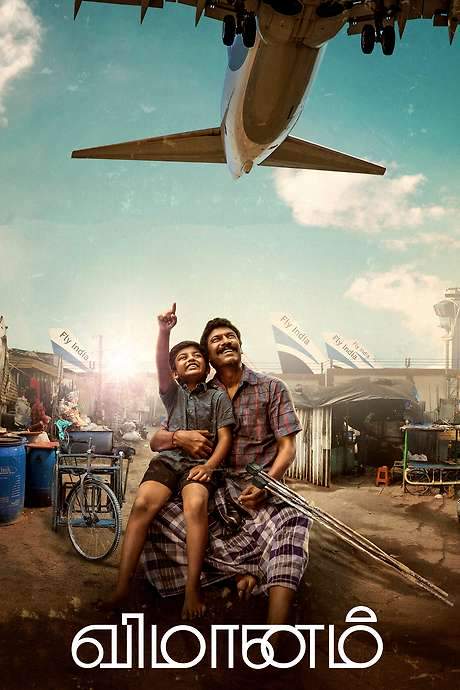
Professor J. Venkiteshwaran, Samuthirakani, receives the Padma Bhushan for the groundbreaking aircraft designs he created for the Indian Air Force, a moment of public triumph that sits beside a quieter, more personal call. On the line is the daughter of his old love, Janaki, who reveals that her mother is terminally ill and pleads for a final visit. The request tugs at the professor’s memories as he boards a train back to his hometown, and the film shifts into a long, carefully shaped flashback that remembers a different era of his life.
In the memory, a younger version of the man—known to friends as Venkidi—navigates a world where school bullying and the sting of a hearing aid make life difficult, yet his mind stays focused on machines and flight. He is drawn to aircraft with a single, stubborn devotion, repeatedly attempting to fly an aircraft he built with his own hands. Amid the noise of the village and the patience of a patient, steady love, he meets Janaki, a partner who believes in his dream even more than he does himself. Their partnership is built not only on affection but on a practical faith in the future that his talent might eventually unlock.
As the plan takes shape, Venkidi’s ambition presses forward with a bold, risky decision: he builds a new aircraft with Janaki’s support and, in a moment of desperation, steals her father’s car to source the necessary parts. The first flight of the improvised craft becomes a dramatic proof of concept, as the aircraft soars above his village, only to end in a crash that leaves his arm injured and his confidence shaken. The consequences ripple outward: Janaki’s father discovers the romance and forbids the couple from continuing their relationship, and the young inventor is soon detained as part of the fallout from the theft.
Behind bars, Venkidi learns that Janaki is bound for Singapore, where relatives await and where she is set to marry. The news sharpens the ache of separation, yet it paradoxically renews his resolve. After days in confinement, a chance to reconnect emerges, and he is granted a visit to Janaki. With the horizon of possibility narrowing, he climbs back into his old mission—this time with a new sense of purpose—and he steers the aircraft along the runway, flying past Janaki as she boards her flight. The moment is charged with longing and consequence: he crash-lands at the airport, and as police officers close in, he looks for one last word, one last glimpse of the woman who inspired his dream.
Returning to the present, the professor arrives in his hometown carrying the weight of those memories and the quiet satisfaction of a life spent chasing a dream. Janaki and her daughter accompany him, offering a personal coda to the long arc of his ambition. The final sequence resolves with a tangible fulfillment: the long‑held dream of flying the old aircraft becomes a shared moment with Janaki, a recognition that passion, memory, and perseverance can align to bring a life’s work back to the sky. In this convergence of past and present, the story emphasizes resilience, reconciliation, and the enduring power of a dream that refuses to fade.