Plot Explained Spoilers guaranteed!
Plot Explained

Browse by genre

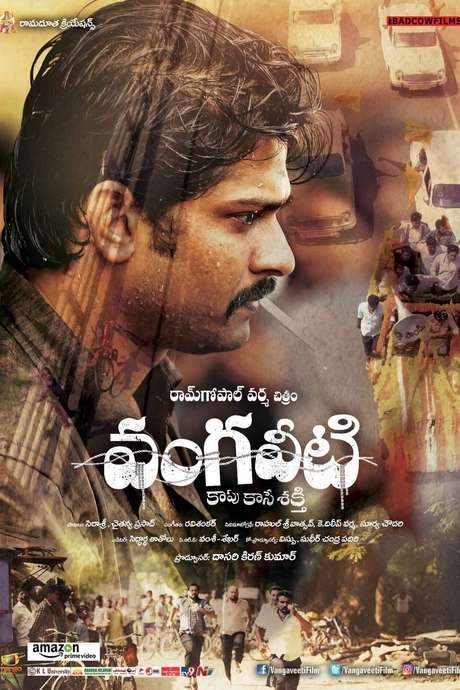
Vangaveeti (2016) movie poster

Plot Summary

Vangaveeti (2016) Plot Summary Explained

Release, runtime and language
2016 · 142 mins · Telugu
Directed by
Ram Gopal Varma
Starring
Naina Ganguly, Shri Tej, Sandeep Madhav, Vamsee Chaganti

The life story of slain legislator Vangaveeti Mohan Ranga Rao who was assassinated during the NT Rama Rao regime in 1989.

On this page (5)
  1. 1 Where to watch
  2. 2 What happens: full plot
  3. 3 Plot questions answered
  4. 4 Movie threads
  5. 5 Every angle

Where to watch

Where to Watch Vangaveeti (2016)

Where can you watch Vangaveeti? Stream, rent or buy it in the US, including on Google Play Movies and YouTube: current JustWatch availability with up-to-date prices.

Streaming availability powered by JustWatch

Full plot summary · contains spoilers

What Happens in Vangaveeti: Full Plot Summary

The whole story of Vangaveeti (2016) explained, from the opening scene to the final frame: every key event, every twist and what it all adds up to. Read it as a quick recap before the sequel, to check a scene you missed, or to finally understand what really happened.

Set in the 1970s in Vijayawada, this sprawling political saga centers on Ratna Kumari [as the wife of Vangaveeti Ranga] w/o Vangaveeti Ranga, a figure whose life becomes entangled with the city’s ruthless street politics. The story follows the rise of Radha, also known as “Bustand Radha,” who forges an alliance with the Communist Party of India and quickly embeds himself within the local power structure, working alongside Vijayawada’s party secretary Venkata Rathnam. As the years pass, a grinding power struggle unfolds over control of the crucial Vijayawada transport network, a resource that both sides crave and weaponize to expand their influence.

In a brutal turn of events, the year 1972 sees Venkata Rathnam murdered by Vangaveeti Radha and his supporters, igniting a fierce retaliation that culminates in the retaliation group’s murder of Radha himself. With Radha dead, Mohana Ranga steps forward to lead the United Independent Organization, drawing backing from student leaders Devineni Gandhi and Devineni Nehru. The power dynamics within this alliance prove unstable, and internal rivalries fracture the organization, paving the way for bitter feuds that splinter the political movement.

The fracture deepens when Mohana Ranga’s circle kills Devineni Gandhi in 1979, a blow that signals the dangerous shift from internal strife to raw political maneuvering. Mohana Ranga’s ascent continues into the early 1980s, as he launches a municipal campaign in 1981 after the Indian National Congress withdraws its official candidate in his favor. Meanwhile, Nehru becomes a rival voice, backed by the Telugu Desam Party (TDP), a group strongly associated with the Kamma caste, while Ranga cultivates a base among the Kapu community and frames himself as a champion of the downtrodden.

By 1985, Ranga is an MLA for the Congress Party, while Nehru secures a TDP seat and rises to ministerial power. The conflict intensifies in the early to mid-1980s as both leaders become deeply entangled in gang warfare, with the clash between Kamma and Kapu factions shaping the political map of the region during N. T. Rama Rao’s tenure as the first Kamma chief minister of Andhra Pradesh. The violence persists into 1988, when Devineni Nehru’s younger brother, Devineni Murali, is killed by Mohana Ranga’s associates in retaliation for earlier killings of Ranga supporters.

Tensions peak during a hunger strike in support of farmers, when a night-time attack on Mohana Ranga’s camp on December 25, 1988, is carried out by a group of rivals. The film traces how these titanic feuds—driven by shifting loyalties, caste dynamics, and shifting political allegiances—reshape local power and leave an enduring mark on the city’s history.

The film features performances by [Shri Tej], [Sandeep Madhav], and [Vamsee Chaganti], bringing the complex web of relationships and loyalties to life with contemporary energy and a sense of realism. The cast forms a backdrop to the central narrative, helping to illuminate how personal ambition, community identity, and political strategy intersect in a volatile era of Andhra Pradesh politics.

Last updated: October 09, 2025 at 15:53

Was this helpful?

Plot questions answered

Vangaveeti Plot Explained: Your Questions Answered

The questions people ask most about Vangaveeti (2016): what happens in the confusing scenes, why the characters do what they do, the twists, hidden details and what the ending means. Each answer contains spoilers.

Q1

Why was Venkata Rathnam murdered in 1972?

Venkata Rathnam was murdered in 1972 by Vangaveeti Radha and his supporters as they fought for control over the Vijayawada transport routes. The transport network was a crucial resource that provided both economic power and political influence in the city, making Rathnam's elimination a strategic move for Radha to consolidate control over these valuable networks.

Foreshadowing: Earlier in the film, Radha's alignment with the Communist Party positioned him near the city's power structure, foreshadowing his willingness to use violence to seize control.

  • venkata rathnam murder
  • vijayawada transport
  • radha politics
Q2

Why was Devineni Gandhi killed in 1979?

Devineni Gandhi was murdered in 1979 by Mohana Ranga's associates as part of the internal power struggle within the United Independent Organization. The UIO had split due to internal rivalries, and Gandhi's death marked a dangerous shift from internal factional conflict to political assassination, deepening the rift between Mohana Ranga's camp and his rivals.

Foreshadowing: The seeds of this conflict were planted when Mohana Ranga took over the UIO after Radha's death, as tensions between the student leaders were already present.

  • devineni gandhi murder
  • uio split
  • mohana ranga
Q3

What caused the rivalry between Mohana Ranga and Devineni Nehru?

The rivalry between Mohana Ranga and Devineni Nehru originated from their shared leadership of the United Independent Organization after Radha's death. When Gandhi was murdered in 1979, the organization split completely, with Ranga and Nehru becoming bitter enemies. Their conflict was further intensified by caste politics, as Nehru aligned with the Telugu Desam Party (representing the Kamma caste) while Ranga positioned himself as a Kapu leader championing the downtrodden.

Foreshadowing: The early alliance between Ranga and Nehru as student leaders supporting the UIO contained the seeds of their future betrayal.

  • mohana ranga
  • devineni nehru
  • rivalry
  • caste politics
Q4

What role did the Kamma-Kapu caste conflict play in the story?

The Kamma-Kapu caste conflict was the underlying driver of the political violence throughout the film. The rivalry between Mohana Ranga (Kapu) and Devineni Nehru (Kamma) shaped political alliances, electoral strategies, and gang warfare. This caste divide became particularly potent during N.T. Rama Rao's tenure as the first Kamma chief minister of Andhra Pradesh, as both leaders leveraged their community identities to build political bases and legitimize their violence against rival factions.

Foreshadowing: The early divisions between communist politics and local power dynamics already hinted at the caste underpinnings that would surface.

  • kamma
  • kapu
  • caste conflict
  • n.t. rama rao
Q5

Why was Devineni Murali killed in 1988?

Devineni Murali, the younger brother of Devineni Nehru, was murdered in 1988 by Mohana Ranga's associates as retaliation for earlier killings of Ranga's supporters. This assassination represented a major escalation in the ongoing vendetta between the two rival camps, intensifying the cycle of violence that had defined their conflict since the late 1970s.

Foreshadowing: The pattern of retaliatory killings was established early in the story, starting with Venkata Rathnam's murder and Radha's subsequent death.

  • devineni murali
  • revenge killing
  • 1988
Q6

Why was Mohana Ranga's camp attacked during his hunger strike?

Mohana Ranga's camp was attacked on December 25, 1988, while he was conducting a hunger strike in support of farmers. The attack was carried out by rival political groups seeking to eliminate him during a vulnerable moment. This assault demonstrated how political violence could disrupt even peaceful protest movements, highlighting the extent to which caste-based enmities had corrupted the political system.

Foreshadowing: The attack came after years of escalating violence between Ranga's Kapu faction and Nehru's Kamma-backed group.

  • hunger strike
  • farmers protest
  • attack camp
Q7

How did Mohana Ranga rise from gang leader to Congress MLA?

Mohana Ranga rose from leading the United Independent Organization (a group with alleged criminal connections) to becoming a Congress MLA through strategic political maneuvering. After taking over the UIO following Radha's death, he cultivated a base among the Kapu community by positioning himself as a champion of the downtrodden. In 1981, when the Indian National Congress withdrew its official candidate in his favor, he won the municipal election, marking his transition from street-level gang leadership to formal political office.

Foreshadowing: The alliance with student leaders and the backing from certain political factions foreshadowed his eventual mainstream political acceptance.

  • mohana ranga congress mla
  • political rise
  • vijayawada
Q8

Why was Vangaveeti Radha killed after murdering Venkata Rathnam?

Vangaveeti Radha was killed in 1973 as retaliation for his murder of Venkata Rathnam. After Radha orchestrated Rathnam's assassination to gain control of the Vijayawada transport routes, a rival group retaliated by killing Radha himself. This created the first major cycle of revenge in the film's narrative, demonstrating how each assassination triggered further violence in an endless chain of vendettas.

Foreshadowing: The murder of Venkata Rathnam was explicitly described as an act that would trigger fierce retaliation from rival factions.

  • vangaveeti radha murder
  • retaliation
  • transport routes
Q9

Why was control of the Vijayawada transport network so important?

The Vijayawada transport network was a crucial economic and political resource that both factions coveted. Control over the transport routes provided not only substantial revenue but also the ability to move people, goods, and ultimately voters, making it a tool for expanding political influence. The struggle for this transport network was the initial catalyst for the violent conflicts that defined the entire narrative.

Foreshadowing: The early alliance between Radha and the Communist Party was explicitly tied to gaining influence over these transport networks.

  • vijayawada transport
  • transport network
  • political power
Q10

How did N.T. Rama Rao's tenure affect the political conflict?

N.T. Rama Rao's rise as the first Kamma chief minister of Andhra Pradesh intensified the Kamma-Kapu caste conflict that underpinned the violence between Mohana Ranga and Devineni Nehru. His tenure provided political legitimacy to the Kamma community while making the Kapu community feel marginalized, driving Ranga to position himself as a Kapu champion. This political environment fueled the gang warfare that persisted throughout the mid-1980s.

Foreshadowing: The early rivalry between the two leaders was already taking shape as caste politics began to dominate regional politics.

  • n.t. rama rao
  • chief minister
  • andhra pradesh politics

Movie threads

More Movies Like Vangaveeti, by Mood & Story

Curated lists built around what makes Vangaveeti tick: the same mood, the same kind of story or the same emotional payoff. Each list explains why these movies belong together.

Political gangster sagas like Vangaveeti

Stories of violent rivalries and power struggles within the corridors of power. If you liked the high-intensity gang warfare and political power struggles in Vangaveeti, explore more movies like it. These films depict brutal rivalries, revenge cycles, and the gritty reality of power-hungry figures operating within a political landscape.

  • tense
  • brutal
  • gritty
  • revenge-driven
  • oppressive
  • tragic
  • Tone: tense, brutal, tragic
  • Pacing: fast, relentless
Why these movies?

The story pattern: These narratives typically follow the rise and fall of ambitious figures entangled in violent rivalries. The plot is driven by a cycle of revenge, shifting alliances, and escalating conflicts, often set against a specific historical or socio-political backdrop that adds depth to the power struggle.

Why they belong together: Movies are grouped here for their shared focus on the brutal mechanics of power, where political ambition is pursued through gangland tactics. They create a tense, oppressive atmosphere defined by betrayal, revenge, and the inevitable tragic arc of their protagonists.

Movies with tragic anti-hero downfalls like Vangaveeti

Gripping tales of powerful figures whose ambition leads to an inevitable, violent end. For viewers who appreciated the heavy emotional weight and tragic ending of Vangaveeti, this collection highlights similar stories of powerful figures on a collision course with destiny. Find more movies about doomed anti-heroes whose lives end in violence.

  • tragic
  • gritty
  • doomed
  • intense
  • heavy
  • fatalistic
  • Tone: tense, tragic, bleak
  • Pacing: fast, building relentlessly
Why these movies?

The story pattern: The narrative pattern follows a character's ascent to power, which is inextricably linked to their fatal flaws—often pride, vengeance, or unchecked ambition. The story is propelled by escalating conflicts, creating a foreboding atmosphere that makes their eventual downfall feel both shocking and inevitable.

Why they belong together: These films are connected by their profound focus on a tragic character trajectory. They share a heavy emotional weight, a tense and gritty tone, and a pacing that accelerates towards a sorrowful, definitive ending, leaving a lasting impact on the viewer.

Every angle

Vangaveeti (2016) Explained: Plot, Timeline & Characters

Everything about Vangaveeti in one place: what happens in the plot summary, the timeline in chronological order, the characters and meaning and a spoiler-free summary. What's After the Movie adds the cast, box office and post-credit scenes.

Coming soon on iOS and Android

The Plot Explained Movie Summary App

Plot summaries, endings explained and timelines on your phone. Catch up on any movie in minutes, save your favorites and never miss a twist again.

Be the first to know when we launch. Your email stays private, always.

Learn more about the app