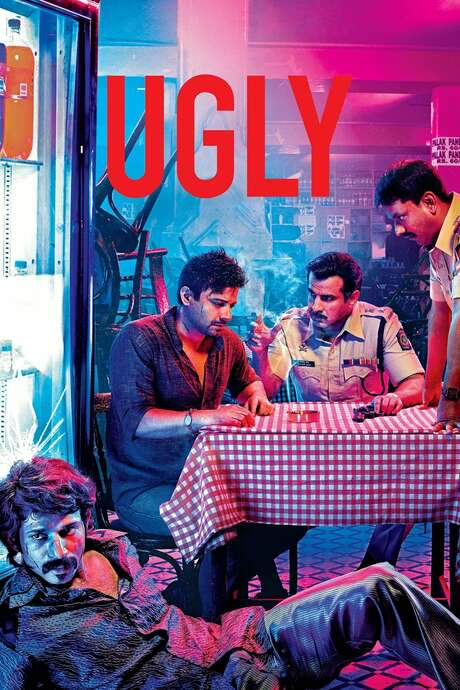
Kali Anshika Shrivastava is a 10-year-old caught between the fractured lives of her parents, Shalini Bose Tejaswini Kolhapure and Rahul Kapoor Rahul Bhat. On a Saturday, the one day Rahul is allowed to spend with her, they set out to see a cartoon film, pausing along the way to meet Chaitanya Mishra Vineet Kumar Singh, Rahul’s friend and aspiring actor, for a quick audition. Kali, trusting yet wary, refuses to go with Chaitanya and stays inside the car as Rahul steps away to fetch him. She asks Rahul to return soon, and the clock seems to slow as a routine trip teeters toward something darker.
As Rahul and Chaitanya hurry to Chaitanya’s home, Kali’s absence triggers a frantic search. The door of the car is found open, and a street-wide inquiry begins. Kali’s disappearance unfolds among a crowd of anxious faces, with Rahul and Chaitanya pleading with strangers and retracing steps. A mask vendor, Shrilal, becomes a tense pivot in the pursuit when Chaitanya notices that Shrilal possesses Kali’s iPhone and asks for answers—answers Shrilal cannot or will not give. A sudden chase follows, culminating in a tragic moment when Shrilal is struck by a vehicle and dies, leaving more questions than answers in its wake.
The police become involved, and Rahul and Chaitanya are hauled in for questioning by an inspector. It is revealed early on that Kali’s stepfather, Shoumik Bose Ronit Roy, is deeply connected to Kali’s life—bringing a charge of family fragility into the investigation. The investigation quickly broadens into a web of personal history, since a flashback reveals that Shoumik, Rahul, and Shalini shared a college bond in which Shalini was drawn to Rahul’s magnetism while Shoumik endured a certain unfulfilled affection. The distance between the lovers and the potential for violence emerges as a central branch of the mystery.
In the present tense, Shoumik’s presence intensifies the discussion around Kali’s fate. Kali’s mother Shalini, who has long felt unmoored by financial insecurity and strained by Rahul’s unemployment as an aspiring actor, is shown, in flashback, to have mixed a small amount of sleeping powder into Kali’s milk to win back a sense of control and satisfaction in a life that has offered little stability. Rakhi Malhotra [Surveen Chawla], a close friend of Shalini with her own turbulent affair involving Rahul, enters the fray as a figure who uses Kali’s disappearance to her advantage, leveraging the promise of a ransom to stabilize her own precarious situation. Rakhi is a struggling actress who becomes entwined in the crime’s maelstrom and, at one point, manipulates another round of money moves to secure her own escape.
Meanwhile, Rahul’s bond with Kali is strained as money troubles mount. Chaitanya, burdened by debts, makes a false ransom call to Rahul for Rs. 10 Lacs; the call is tracked, and Rahul finds himself drawn into a dangerous game where every motive is suspect. Shoumik presses Rahul to reveal Kali’s location, but the truth remains elusive as the narrative toggles between present danger and past betrayals. It surfaces that Shalini, driven by greed and discontent, negotiates with her own father for a large ransom—65 lacs in total—while secretly coordinating with Siddhanth [Siddhanth Kapoor], her brother, who is a local smuggler with his own financial ambitions. The plan is muddied by miscommunication and deception, and what begins as a desperate attempt to secure Kali’s safe return spirals into a larger scandal of manipulation and exploitation.
As the pieces shift, Shalini’s world begins to crumble. The family’s secrets explode in a confrontation where Shalini shoots Shoumik in the shoulder after learning of the ruse surrounding the ransom. Siddhanth is caught with the ill-gotten money, and Rakhi, along with Chaitanya, disappears with part of the loot. The police, still chasing fragments of the truth, receive a cryptic lead that eventually points toward a deserted market area.
The narrative crescendos when a Lucknow-based call alerts investigators to Kali’s possible location, prompting a final, tense pursuit. A detective and Shoumik converge on the same abandoned market district, where Kali’s fate is finally revealed. She is found bound and discarded, her body deteriorating in the harsh conditions—found deceased, her life cruelly ended after days of captivity. The inspector informs Shoumik that Kali had been present in that location all along, a victim of neglect, drugging, and the cruel calculus of a world driven by money and deceit. Kali’s death underscores a stark, unsettling truth: the cycle of greed and betrayal among the adults surrounding her left a vulnerable child to fall victim to their own choices.
In the end, the film presents a stark meditation on morality and culpability. The characters—each influenced by money, pride, love, and fear—are depicted as participants in a broader, unforgiving reality. The movie does not offer a simple villain; rather, it suggests that the consequences of greed, betrayal, and desperation can render everyone complicit in a tragedy that costs an innocent life. The tragedy serves as a sobering reminder of how a string of personal decisions can unravel a family, exposing the fragility of trust and the fragility of life itself.