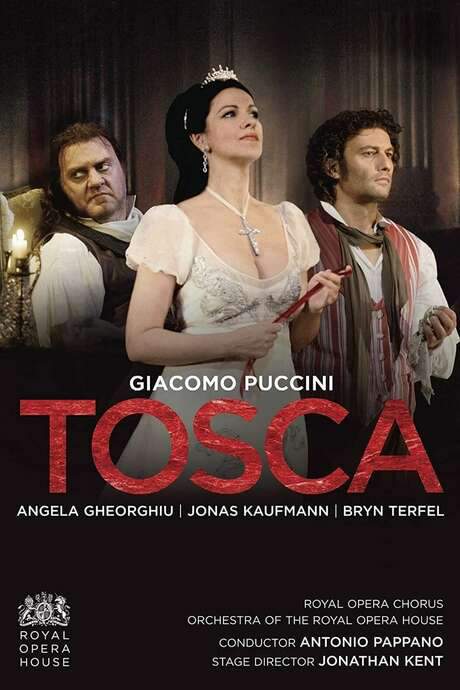
In What's After the Movie, we explore the intricate and tragic story set in Rome during June 1800. The narrative begins with Cesare Angelotti, an escaped political prisoner, who finds refuge in the Church of Sant'Andrea della Valle. Secured by a hidden key his sister had concealed for him, Angelotti hides in his family's private chapel, trying to evade the police. During this tense moment, the talented painter Mario Cavaradossi arrives to work on a portrait of Mary Magdalene, a piece inspired by Angelotti's sister, the Marchesa Attavanti, whom Cavaradossi had seen praying in the church. As the story unfolds, Angelotti emerges from his hiding spot, and Cavaradossi recognizes him, promising to help him escape. He quickly guides Angelotti back into the chapel just as Floria Tosca, portrayed by Angela Gheorghiu, appears outside, calling to him.
Tosca, who is also Cavaradossi's lover, immediately displays her possessiveness and suspicion. She questions him about his conversation and reminds him of their upcoming rendezvous that very evening. Tension erupts when Tosca notices a likeness of the Marchesa Attavanti in the painting and mistakenly believes Cavaradossi has been unfaithful. Despite her anger, Cavaradossi assures her of his loyalty and love. As Tosca departs, Angelotti re-emerges, and their secret meeting is momentarily disrupted by a signal indicating that the police have discovered Angelotti's escape. The pair then flees to Cavaradossi’s home, but their hideout's tranquility is soon shattered by the arrival of Baron Scarpia, the ruthless chief of secret police, portrayed by Bryn Terfel.
The police arrive searching for Angelotti, and Scarpia's suspicion is confirmed when he finds a fan bearing the Attavanti crest, which Tosca had left behind. She is devastated, realizing her lover's peril and suspecting her own involvement. Her emotional turmoil prompts her vow for revenge, and she leaves as the church begins its service, filled with worshippers. Scarpia, meanwhile, orders his men to follow Tosca, misled into believing she may be hiding Angelotti with Cavaradossi, and he openly declares his intention to manipulate Tosca for his own cruel pleasure.
In Act II, the story shifts to the opulent chambers of Scarpia at Palazzo Farnese. The villainous officer dreams of controlling Tosca as he anticipates how much he will enjoy having her at his mercy. His men report that Angelotti remains at large, but they have caught Cavaradossi instead. Scarpia interrogates the defiant painter, whose resilience only fuels the chief's suspicions. As Tosca performs at a royal concert outside, Scarpia summons her, and she arrives just as Cavaradossi is being led away to be tortured. The anguished scene becomes more intense when Cavaradossi, battered and barely conscious, confronts Tosca about her betrayal, just as the news of Napoleon’s victory over Scarpia's side arrives, transforming the political landscape and complicating the personal stakes.
Realizing the danger her lover is in, Tosca is forced to reveal Angelotti’s hideout under pressure from Scarpia, who is also increasingly captivated by her. Meanwhile, Cavaradossi, desperate and furious, defiantly proclaims his disdain for tyranny, drawing the wrath of Scarpia who immediately orders his execution. Scarpia, ever manipulative, offers Tosca a cruel choice: surrender herself and save Cavaradossi, or see her lover killed. She refuses to yield, calling on her faith and love, and a struggle ensues as Scarpia's advances become more insistent. Just then, Spoletta, the police agent played by Hubert Francis, brings news that Angelotti has committed suicide to escape capture, leaving Tosca with no choice but to capitulate. She agrees to Scarpia’s terms, relents to his demands, and tricks him into writing her a safe-conduct pass for Cavaradossi to be released. As she prepares to escape, Tosca unexpectedly retaliates, stabbing Scarpia with a knife when he attempts to assault her physically. She seizes the safe-conduct, gathers her courage, and flees the scene.
In the final act, set at dawn, Cavaradossi is on the brink of execution on the ramparts of Castel Sant'Angelo. He secures a private farewell letter for Tosca and braces himself for death, overwhelmed by despair. Tosca, arriving just in time, recounts what has transpired. Together, they dream of future freedom, cherishing their love amidst the chaos of war and political upheaval. As the soldiers prepare to fire, Tosca urges Cavaradossi to fake his death convincingly, and she watches from a distance as the shot rings out. However, when Cavaradossi remains motionless, she realizes the terrible truth—he has truly been executed, and her fears are confirmed. In her heartbreak and rage, she vows to meet her fate before God and, with a desperate cry, leaps from the battlement, symbolizing her tragic end.
Throughout this story, themes of love, betrayal, political unrest, and vengeance intertwine, portraying the tragic depths of human resilience and despair amid turbulent times. The powerful music and performances, especially from the cast including Jonas Kaufmann, make this an unforgettable tale of passion and sacrifice.