Plot Explained Spoilers guaranteed!
Plot Explained

Browse by genre

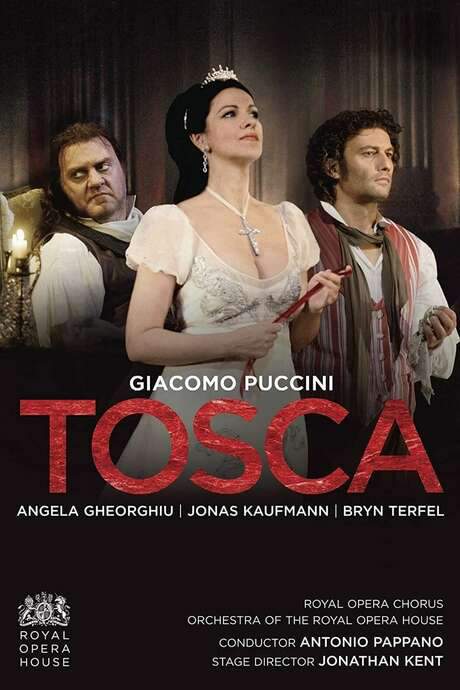
Tosca (2011) movie poster

Timeline

Tosca (2011) Timeline Explained – Every Event in Order

Release, runtime and language
2011 · 128 mins · Italian
Directed by
Jonathan Haswell, Jonathan Kent
Starring
Zhengzhong Zhou, Jonas Kaufmann, Angela Gheorghiu, Orchestra of the Royal Opera House, Jeremy White, Lukas Jakobski

2011 Royal Opera House staging of Puccini’s Tosca, conducted by music director Antonio Pappano with the Royal Opera Chorus and Orchestra. The principal cast features Angela Gheorghiu as Tosca, Jonas Kaufmann as Cavaradossi, and Bryn Terfel as Scarpia. Visually, the production contrasts a grand church ceremony, a shadowy study with a hidden torture chamber and the hopeful light of a Roman dawn, heightening Tosca’s love, Cavaradossi’s idealism and Scarpia’s ruthless obsession. Drama, passion and exquisite music.

On this page (4)
  1. 1 Events in order (11)
  2. 2 Timeline questions answered
  3. 3 Movie threads
  4. 4 Every angle

11 events in order · contains spoilers

Tosca Timeline: Events in Chronological Order

Every key event of Tosca (2011) in order, scene by scene, with when and where it takes place. Use it to untangle flashbacks, time jumps and parallel storylines, to refresh your memory before the sequel or to find the exact scene you are thinking of.

  1. Angelotti escapes and seeks refuge in Sant'Andrea della Valle

    Cesare Angelotti, a political prisoner, rushes into the church to escape capture. He finds a hidden key for his sister and hides in his family's private chapel, aware that the police are searching for him. His escape marks the beginning of the unfolding events in Rome, June 1800.

    When
    Rome, June 1800
    Where
    Church of Sant'Andrea della Valle
  2. Cavaradossi begins painting Mary Magdalene

    The painter Mario Cavaradossi arrives to work on his portrait of Mary Magdalene within the church. He recognizes Angelotti and promises to help him, establishing a connection between their stories. The painting is inspired by Angelotti's sister, the Marchesa Attavanti.

    Where
    Church of Sant'Andrea della Valle
  3. Tosca arrives and suspects Cavaradossi

    Floria Tosca, Cavaradossi's lover, arrives at the church and confronts him about his conversations, jealous of any possible infidelity. She is suspicious about his interactions, especially after recognizing the Marchesa Attavanti in his painting. Their tension reveals her concerns and love.

    Where
    Church of Sant'Andrea della Valle
  4. Angelotti re-emerges and escapes

    Angelotti reappears after Tosca leaves and attempts to escape again. As police discover his hiding spot, he commits suicide to avoid capture, intensifying the urgency in the narrative. His death occurs as authorities close in.

    Where
    Church of Sant'Andrea della Valle
  5. Police and Scarpia arrive at the church

    Baron Scarpia, the chief of secret police, arrives searching for Angelotti, and he finds a fan with the Attavanti crest, implying Cavaradossi's involvement. Tosca's suspicion deepens, and Scarpia begins to manipulate her to locate Angelotti.

    Where
    Church of Sant'Andrea della Valle
  6. Scarpia plans to manipulate Tosca

    In his chambers at Palazzo Farnese, Scarpia anticipates controlling Tosca. He receives news that Angelotti is dead and Cavaradossi has been captured, setting the stage for his manipulative plans to seize Tosca’s loyalty and obedience.

    When
    Evening
    Where
    Palazzo Farnese, Scarpia's chambers
  7. Cavaradossi is tortured and confesses

    While being interrogated and tortured, Cavaradossi refuses to betray Angelotti but is eventually broken by the pain and the threat of execution. He admits to his connection with Angelotti, which escalates Scarpia's plans for his death.

    Where
    Palazzo Farnese
  8. Tosca agrees to Scarpia's trap

    Faced with the possibility of losing Cavaradossi, Tosca reluctantly agrees to Scarpia's demand for her to give herself to him if she wants her lover to be spared. She pretends to comply, but secretly plans her own revenge against him.

    Where
    Palazzo Farnese
  9. Tosca kills Scarpia and escapes

    When Scarpia attempts to force himself on Tosca, she uses a knife to stab him, killing him in her desperation. She then takes the safe-conduct pass, which allows her to escape, leaving behind her tormentor’s dead body.

    Where
    Palazzo Farnese
  10. Cavaradossi faces execution

    On the morning of his execution, Cavaradossi writes a farewell letter to Tosca and prepares to be executed on the ramparts of Castel Sant'Angelo. He is overcome with emotion and despair as he awaits his fate.

    When
    Dawn
    Where
    Castel Sant'Angelo
  11. Tosca's desperate attempt and death

    Tosca arrives to warn Cavaradossi and convinces him to fake his death. After the soldiers fire, she witnesses his apparent death, but when she realizes she has been betrayed and that he is truly dead, she jumps to her death from the battlement.

    Where
    Castel Sant'Angelo

Last updated: August 19, 2025 at 05:16

Was this helpful?

Timeline questions answered

Tosca Timeline Explained: Your Questions Answered

When does it happen, and why in that order? The questions people ask about the chronology of Tosca (2011): time jumps, flashbacks, cause and effect between scenes and the correct order of events, each answered with spoilers.

Q1

Why does Tosca tell Scarpia where Angelotti is hiding?

Tosca reveals Angelotti's hiding spot because Scarpia is torturing Cavaradossi in the next room and she can hear his screams. She believes that if she gives Scarpia the information, he will stop the torture and spare Cavaradossi's life. However, Scarpia has no intention of keeping his promise, once he gets what he wants, he orders Cavaradossi's execution anyway.

Foreshadowing: Scarpia's cruel nature was already evident when he declared his intention to possess Tosca while in his chambers.

  • tosca
  • angelotti
  • scarpia
  • torture
  • cavaradossi
  • betrayal
Q2

How does Cavaradossi actually die if the execution was supposed to be fake?

Scarpia tricks Tosca by giving her a fake execution. While Tosca believes Cavaradossi will be spared and only needs to fake his death by falling when the guns fire, Scarpia has ordered a real firing squad. When the soldiers fire, Cavaradossi is actually killed. The safe-conduct pass Tosca obtained was worthless, the execution was real all along.

Foreshadowing: Scarpia's manipulative nature is established early when he uses Tosca's jealousy about the painting to turn her against Cavaradossi.

  • cavaradossi
  • tosca
  • execution
  • fake death
  • safe-conduct
  • scarpia
Q3

Why does Tosca jump to her death at the end?

Tosca jumps from the battlement of Castel Sant'Angelo because she discovers that Cavaradossi has truly been executed, not faked as she believed. After witnessing him fall motionless when the guns fired, she realizes she has been betrayed by Scarpia. Overcome with grief, rage, and despair, she chooses to die rather than live without Cavaradossi, calling out to God as she leaps.

Foreshadowing: The tragic ending is foreshadowed by the opera's consistently dark tone and the impossibility of Scarpia showing mercy.

  • tosca
  • cavaradossi
  • death
  • jump
  • battlement
  • despair
Q4

Why is Scarpia obsessed with Tosca?

Scarpia is obsessed with Tosca because she is both beautiful and unattainable, he desires her physically but knows she loves Cavaradossi. He uses his power as chief of police to manipulate her, viewing her as a trophy he can force himself upon. His obsession combines lust with cruelty; he enjoys having power over her and specifically wants her to submit to him willingly as part of his control.

Foreshadowing: Scarpia declares his intention to have Tosca at his mercy while in his chambers in Act II.

  • scarpia
  • tosca
  • obsession
  • power
  • lust
  • manipulation
Q5

Why does Angelotti kill himself in the church?

Angelotti commits suicide when the police discover his hiding spot in the church. Rather than be captured and returned to prison, he chooses to take his own life. His suicide is prompted by the realization that escape is impossible, the police have surrounded the church and there is no way out.

Foreshadowing: The timeline establishes that police discover Angelotti's escape early, creating the urgency that drives his desperate actions.

  • angelotti
  • suicide
  • church
  • escape
  • police
  • capture
Q6

What does the fan with the Attavanti crest prove?

The fan bearing the Attavanti crest proves that Cavaradossi has a connection to the Marchesa Attavanti, Angelotti's sister. Scarpia finds this fan in the church and uses it to confirm his suspicion that Cavaradossi is hiding Angelotti. The fan also fuels Tosca's jealousy, as she mistakenly believes Cavaradossi has been unfaithful with the Marchesa.

Foreshadowing: Tosca's jealousy over the Marchesa's portrait is triggered when she sees the fan, setting her against Cavaradossi.

  • fan
  • attavanti
  • crest
  • cavaradossi
  • scarpia
  • evidence
Q7

Why does Tosca kill Scarpia?

Tosca kills Scarpia when he attempts to physically assault her after she agrees to his terms. She stabs him with a knife, using the very document he was writing, the safe-conduct pass, as a makeshift weapon. This act represents her final act of defiance and desperate revenge for all the suffering he has caused her and Cavaradossi.

Foreshadowing: Scarpia's advances become increasingly forceful, and Tosca's vow for revenge is established when she realizes her lover's peril.

  • tosca
  • scarpia
  • kill
  • knife
  • revenge
  • assault
Q8

What is the safe-conduct pass that Tosca obtains?

The safe-conduct pass is a document written by Scarpia that grants Cavaradossi freedom and allows him to leave Rome. Tosca tricks Scarpia into writing it by pretending to accept his demands, and she takes it after stabbing him. However, the pass proves worthless because Scarpia had already ordered a real execution, the document cannot save Cavaradossi from death.

Foreshadowing: Scarpia's duplicity is established throughout the opera as he manipulates everyone around him.

  • safe-conduct
  • pass
  • scarpia
  • tosca
  • cavaradossi
  • freedom
Q9

Why does Tosca agree to Scarpia's terms?

Tosca agrees to Scarpia's demand that she surrender herself to him because he threatens to kill Cavaradossi if she refuses. She believes that by complying, she can save her lover's life. However, her agreement is also a ruse, she plans to kill Scarpia after obtaining the safe-conduct pass, using the encounter as an opportunity for revenge.

Foreshadowing: Tosca's determination to protect Cavaradossi at any cost is evident from the moment Scarpia begins his manipulation.

  • tosca
  • scarpia
  • agreement
  • surrender
  • cavaradossi
  • sacrifice
Q10

How does Napoleon's victory affect the story?

Napoleon's victory over Scarpia's side arrives as news during Act II, and it fundamentally shifts the political landscape. Cavaradossi, inspired by this news, defiantly proclaims his support for tyranny's defeat. This political turn intensifies Scarpia's rage and desperation, making him more ruthless in his treatment of Cavaradossi. The victory also means the stakes are higher, Scarpia is fighting for a losing cause.

Foreshadowing: The political unrest in Rome during June 1800 establishes the dangerous environment in which all characters operate.

  • napoleon
  • victory
  • politics
  • scarpia
  • cavaradossi
  • tyranny
Q11

Why is Cavaradossi painting the Marchesa Attavanti?

Cavaradossi is painting a portrait of Mary Magdalene in the church, but he uses the Marchesa Attavanti as his model because he saw her praying there and was struck by her beauty. This innocent artistic choice becomes problematic when Tosca sees the portrait and mistakenly believes Cavaradossi has been unfaithful with the Marchesa. The painting also connects Cavaradossi to Angelotti, since the Marchesa is Angelotti's sister.

Foreshadowing: Tosca's possessiveness and jealousy are established early when she questions Cavaradossi about his interactions.

  • cavaradossi
  • painting
  • marchesa
  • attavanti
  • magdalene
  • tosca
  • jealousy
Q12

Why does Scarpia send men to follow Tosca?

Scarpia orders his men to follow Tosca because he suspects she may be hiding Angelotti with Cavaradossi. When Tosca leaves the church, Scarpia manipulates the situation to make her seem guilty of helping the escaped prisoner. This gives him leverage to pursue his personal vendetta against Tosca and Cavaradossi, using the search for Angelotti as a pretext for his cruel intentions.

Foreshadowing: Scarpia declares his intention to manipulate Tosca while in his chambers, viewing her as someone he can control.

  • scarpia
  • tosca
  • follow
  • police
  • angelotti
  • surveillance

Movie threads

More Movies Like Tosca, by Mood & Story

Curated lists built around what makes Tosca tick: the same mood, the same kind of story or the same emotional payoff. Each list explains why these movies belong together.

Grand Operatic Tragedies like Tosca

Sweeping stories where passionate love collides with ruthless power, culminating in devastation. If you were captivated by the passionate drama and tragic scale of Tosca, explore more movies that share this operatic intensity. This list features films with heavy emotional weight, high stakes, and a dark tone, where love and ambition are tested by cruel forces, leading to devastating conclusions.

  • tragic
  • passionate
  • grand
  • melancholic
  • suspenseful
  • oppressive
  • Tone: dark, passionate, tragic
  • Pacing: steady, building relentlessly
Why these movies?

The story pattern: Stories in this thread typically follow a relentless downward arc. A central romantic or idealistic bond is threatened by a powerful, often tyrannical, antagonist. The conflict escalates through betrayal and sacrifice, building suspense until it culminates in a final, catastrophic loss. The structure is often clear and steady, making the tragic outcome feel both shocking and inevitable.

Why they belong together: Movies are grouped here for their shared atmosphere of grand, passionate melodrama and their commitment to a dark, devastating tone. They connect through high emotional intensity, a steady but relentless pacing that builds towards tragedy, and a focus on themes like obsession, betrayal, and the high cost of love in a corrupt world.

Relentless Descents into Darkness like Tosca

Methodical narratives where hope is systematically extinguished by cruel circumstances. For viewers who appreciated the methodical suspense and oppressive atmosphere of Tosca, this collection features movies with a similar downward trajectory. These stories are characterized by a steady pace, high tension, and a dark tone where characters face tyrannical opposition with little chance of escape.

  • oppressive
  • suspenseful
  • bleak
  • desperate
  • tense
  • hopeless
  • Tone: dark, oppressive, suspenseful
  • Pacing: steady, methodical
Why these movies?

The story pattern: The narrative pattern is a controlled spiral into despair. An initial state of normalcy or hope is quickly shattered by the introduction of a ruthless antagonist. The middle act involves a series of traps, betrayals, and ordeals (like interrogation or torture) that systematically break down the protagonist's resolve. The finale offers no reprieve, concluding with a sense of total loss and the triumph of corrupt power.

Why they belong together: These films share a specific structural and tonal similarity: a dark, oppressive mood maintained by steady pacing that creates a sense of dread. The key connector is the experience of watching hope be systematically crushed, resulting in a profoundly bleak ending. They often feature strong violence and disturbing themes centered on power dynamics.

Every angle

Tosca (2011) Explained: Plot, Timeline & Characters

Everything about Tosca in one place: what happens in the plot summary, the timeline in chronological order, the characters and meaning and a spoiler-free summary. What's After the Movie adds the cast, box office and post-credit scenes.

Coming soon on iOS and Android

The Plot Explained Movie Summary App

Plot summaries, endings explained and timelines on your phone. Catch up on any movie in minutes, save your favorites and never miss a twist again.

Be the first to know when we launch. Your email stays private, always.

Learn more about the app