Plot Explained Spoilers guaranteed!
Plot Explained

Browse by genre

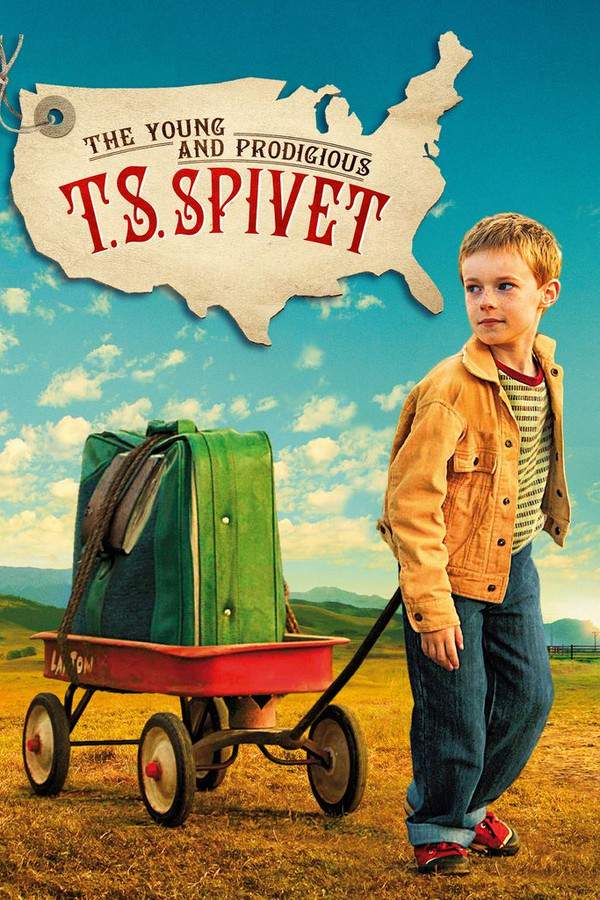
The Young and Prodigious T.S. Spivet (2015) movie poster

Plot Summary

The Young and Prodigious T.S. Spivet (2015) Plot Summary Explained

Release, runtime and language
2015 · 105 min · English
JustWatch #10,989 14
Directed by
Jean-Pierre Jeunet

A gifted 12-year-old inventor, T.S. Spivet, embarks on an extraordinary cross-country journey from his remote Montana home to Washington, D.C. Traveling incognito aboard a freight train, he aims to accept a prestigious award recognizing his groundbreaking invention: a perpetual motion machine. The remarkable trip tests his resilience and resourcefulness as he navigates new experiences and encounters diverse characters along the way.

On this page (6)
  1. 1 Where to watch
  2. 2 What happens: full plot
  3. 3 Plot questions answered
  4. 4 Movie threads
  5. 5 Movies like The Young and Prodigious T.S. Spivet
  6. 6 Every angle

Where to watch

Where to Watch The Young and Prodigious T.S. Spivet (2015)

Where can you watch The Young and Prodigious T.S. Spivet? Stream, rent or buy it in the US, including on Kanopy, The CW and Tubi TV: current JustWatch availability with up-to-date prices.

Streaming availability powered by JustWatch

Full plot summary · contains spoilers

What Happens in The Young and Prodigious T.S. Spivet: Full Plot Summary

The whole story of The Young and Prodigious T.S. Spivet (2015) explained, from the opening scene to the final frame: every key event, every twist and what it all adds up to. Read it as a quick recap before the sequel, to check a scene you missed, or to finally understand what really happened.

T.S. Spivet, portrayed by Kyle Catlett, is a bright young boy living in the isolation of a Montana ranch alongside his moody older sister, Niamh Wilson, his pretentious entomologist mother, Helena Bonham Carter, and his emotionally distant wannabe cowboy father, Callum Keith Rennie. Struggling with loneliness and often feeling belittled by those around him— including his envious schoolteacher— T.S. finds solace in creating amateur inventions and wandering the ranch with his loyal dog, Tapioca.

Haunted by the loss of his older brother Layton, played by Jakob Davies, T.S. grapples with a haunting past that deeply scars his family. He recalls a tragic accident from their childhood when a game with their father's gun led to Layton’s untimely death, a moment that T.S. believes he caused. Although this traumatic event isn't depicted on-screen, its impact lingers heavily over the family dynamic and T.S.'s psyche.

When T.S. learns that he has been awarded the Baird Award by the Smithsonian Institute for his creation of a perpetual motion machine, he makes the bold decision to escape his confining life. Skeptical about assuming his identity over the phone, Ms. Jibsen, the museum director played by Judy Davis, mistakenly believes T.S. is the son of the award's true winner. Despite his initial hesitation, T.S. sees this opportunity as a means to find his place in the world and sets off on an adventurous journey across the country.

Before departing, T.S. takes a moment to say goodbye to his brother's old room, a poignant shrine filled with forgotten toys and memories. As he sneaks away, neither his sister nor father acknowledges his departure, lost in their own lives.

T.S.'s adventure begins on a train, where he imagines conversations with Layton, momentarily losing himself in nostalgic memories amidst the sounds of the train. After a close call with a guard, he cleverly hides in an auction show camper, even mimicking a lifelike cardboard family to blend in. On his nightly escapades for food, he encounters a whimsical hobo named "Two Clouds," portrayed by Dominique Pinon, who shares a story about the journey of a sparrow and a pine tree, further inspiring T.S. to consider the paths people take in life.

A day later, as T.S. walks along the train tracks with his backpack, he's pursued by a mean-spirited policeman, played by Harry Standjofski, leading him to a daring climb atop a bridge. After a tense moment, T.S. narrowly escapes and soon finds a ride with a friendly trucker named Rick, played by Julian Richings, whose own history with post-traumatic stress disorder adds depth to their conversation. Rick encourages T.S. to seek medical attention for an injury he suffered earlier, demonstrating compassion amidst their unforeseen friendship.

Upon arriving in Washington, T.S. meets with Ms. Jibsen at the Smithsonian, where she remains skeptical of his accomplishments. In a moment of vulnerability, T.S. claims to be an orphan, fearing the confrontations that might arise from his family discovering his whereabouts. Despite Ms. Jibsen's overwhelming desire to take him under her wing, T.S. feels isolated even in a crowded room as he prepares to accept his award.

During the award ceremony, T.S. delivers an emotional speech, revealing to the audience the heartbreaking truth about Layton's fate, moving them to tears as he laments: > "Nobody ever even talks about Layton anymore, as if my brother never even existed." Little does he know, his mother has traveled all the way to witness her son’s moment.

The emotional reunion quickly escalates tensions, as Ms. Jibsen realizes she's lost control over T.S. to his family. Amidst a chaotic scene, his mother passionately embraces him, and T.S.'s father instinctively defends his son from harassment, showcasing the protective instincts of a caring parent.

Returning home brings new revelations, and T.S. shares in an epilogue that his family has welcomed a new baby. Utilizing his inventive spirit, he creates an even better perpetual motion machine, ingeniously using it to rock his infant sibling's cradle on the porch, indicating a new chapter of hope and continuity for the family.
Last updated: November 03, 2024 at 21:35

Was this helpful?

Plot questions answered

The Young and Prodigious T.S. Spivet Plot Explained: Your Questions Answered

The questions people ask most about The Young and Prodigious T.S. Spivet (2015): what happens in the confusing scenes, why the characters do what they do, the twists, hidden details and what the ending means. Each answer contains spoilers.

Q1

Why did T.S. Spivet run away to Washington D.C.?

T.S. decided to run away because he felt isolated and unvalued at home. After winning the Baird Award from the Smithsonian for his perpetual motion machine, he saw this as an opportunity to prove himself and find his place in the world. Despite Ms. Jibsen's skepticism over the phone about his identity, T.S. viewed the award as a chance to escape his confining life on the Montana ranch and gain recognition that he never received from his family.

Foreshadowing: Earlier in the film, T.S. is shown feeling belittled by his family and teacher, establishing his desire to escape and be recognized.

  • T.S. Spivet
  • Washington D.C.
  • Baird Award
  • running away
  • Smithsonian
Q2

How did Layton die in the movie?

Layton, T.S.'s older brother, died in a tragic accident involving their father's gun. When the brothers were playing with the gun as children, it went off and killed Layton. Although this event is not shown on-screen, it left a profound impact on the entire family, particularly on T.S., who believes he caused his brother's death.

Foreshadowing: T.S. is shown visiting Layton's old room, which remains preserved as a shrine filled with forgotten toys, hinting at the unresolved grief.

  • Layton death
  • T.S. brother
  • gun accident
  • family tragedy
Q3

Why does T.S. blame himself for Layton's death?

T.S. blames himself because he was playing with his father's gun alongside Layton when the accident occurred. He carries deep guilt over his brother's death, believing he is responsible for the tragedy. This guilt has shaped his entire psyche and contributed to his feelings of isolation within his family, as he feels he does not deserve their love or acknowledgment.

Foreshadowing: The film opens with T.S. living in his brother's shadow, creating inventions as a way to cope with his emotional pain.

  • T.S. guilt
  • Layton
  • self-blame
  • grief
  • brother's death
Q4

Why did T.S. claim to be an orphan at the Smithsonian?

T.S. claimed to be an orphan because he feared the confrontations that would arise if his family discovered his whereabouts. He was afraid his parents would be angry or disappointed upon learning he had traveled to Washington alone. Additionally, his deep-seated feelings of not belonging made him feel more like an orphan than a valued member of his family.

Foreshadowing: Earlier, T.S. sneaks away from home without saying goodbye to his father or sister, showing his expectation that they would not care or would react negatively.

  • T.S. orphan claim
  • Smithsonian
  • Ms. Jibsen
  • fear of family
Q5

What did T.S. reveal in his award speech?

During the award ceremony, T.S. delivered an emotional speech revealing the painful truth about Layton's death. He told the audience about his brother's fate and expressed his grief, stating that nobody talks about Layton anymore as if he never existed. This heartfelt revelation moved the audience to tears and explained why T.S. had been carrying such profound emotional weight throughout his journey.

Foreshadowing: Throughout his train journey, T.S. frequently imagines conversations with Layton, showing his unresolved grief and need to process his brother's death.

  • award speech
  • Layton death
  • emotional revelation
  • Baird Award
Q6

Why did T.S.'s mother come to the award ceremony?

T.S.'s mother traveled to Washington D.C. to witness her son's moment of recognition. Despite their emotionally distant relationship at home, she wanted to support T.S. and see him receive his award. Her surprise appearance led to an emotional reunion, during which she passionately embraced T.S. and his father defended him from harassment, showing the family's underlying love and protective instincts.

Foreshadowing: The tension between T.S. and his family hint at deeper feelings that have been suppressed due to the family tragedy.

  • mother
  • reunion
  • award ceremony
  • Helena Bonham Carter
Q7

What changed when T.S. returned home?

When T.S. returned home, the family had welcomed a new baby, symbolizing hope and continuity. This new beginning helped heal the family's wounds from Layton's death. T.S. used his inventive spirit to create an improved perpetual motion machine that rocks his infant sibling's cradle, showing his growth and integration back into the family.

Foreshadowing: The epilogue returns to the ranch setting, contrasting with T.S.'s earlier escape, now showing him content in his family role.

  • return home
  • new baby
  • family reconciliation
  • perpetual motion machine cradle
Q8

What is the significance of the perpetual motion machine?

The perpetual motion machine represents T.S.'s genius and his desire to create something meaningful that will outlast him. It is the invention that wins him the prestigious Baird Award and gives him the confidence to leave home. At the end, he improves upon his original design to rock his baby sibling's cradle, symbolizing how his talents can contribute to his family's future rather than serve as an escape from his problems.

Foreshadowing: T.S. is shown creating various amateur inventions throughout the film, establishing his inventive passion as his defining trait.

  • perpetual motion machine
  • Baird Award
  • invention
  • T.S. talent
Q9

Why is T.S. so isolated within his own family?

T.S. feels isolated because his family's grief over Layton's death has created emotional distance between all members. His mother is pretentious and emotionally distant, his sister is moody, and his father is emotionally distant. T.S. also contributes to his isolation through his guilt over Layton's death and his belief that he does not deserve love. The family has never properly addressed their collective trauma, leaving T.S. to cope alone.

Foreshadowing: The opening scenes establish T.S. wandering the ranch alone with his dog Tapioca, finding solace in inventions rather than family connection.

  • family isolation
  • emotional distance
  • grief
  • T.S. loneliness
Q10

What is the purpose of T.S.'s encounter with the hobo Two Clouds?

T.S. meets a whimsical hobo named Two Clouds during his nighttime quest for food. Two Clouds shares a story about the journey of a sparrow and a pine tree, inspiring T.S. to reflect on the different paths people take in life. This encounter reinforces T.S.'s decision to take his own path rather than remain stuck in his painful past, adding a whimsical philosophical moment to his coming-of-age journey.

Foreshadowing: The meeting occurs during T.S.'s nighttime adventures, a period where he is most vulnerable and open to introspection.

  • Two Clouds
  • hobo
  • sparrow and pine tree story
  • philosophical encounter

Movie threads

More Movies Like The Young and Prodigious T.S. Spivet, by Mood & Story

Curated lists built around what makes The Young and Prodigious T.S. Spivet tick: the same mood, the same kind of story or the same emotional payoff. Each list explains why these movies belong together.

Movies with Melancholy Whimsy like The Young and Prodigious T.S. Spivet

Childhood journeys that blend heartfelt wonder with the weight of grief. If you enjoyed the blend of adventure and heartfelt sorrow in The Young and Prodigious T.S. Spivet, this collection features similar family dramas and coming-of-age stories. Discover other movies like this where child protagonists navigate grief and fantastical journeys, balancing a whimsical spirit with a melancholic, bittersweet tone.

  • whimsical
  • melancholic
  • heartfelt
  • nostalgic
  • adventurous
  • lonely
  • Tone: bittersweet, melancholic
  • Pacing: steady, character-driven
Why these movies?

The story pattern: Stories in this thread often follow a child's external quest or adventure that runs parallel to an internal journey of processing loss or trauma. The narrative structure is typically a physical journey that serves as a metaphor for emotional healing, punctuated by encounters that test the protagonist's resilience and lead to a hard-won, hopeful resolution.

Why they belong together: These movies are grouped together because they share a specific emotional texture: the combination of whimsical, adventurous discovery with an underlying current of melancholy. They balance the lightness of a child's perspective with the heavy themes of grief, creating a bittersweet and deeply resonant viewing experience that is both uplifting and sorrowful.

Movies about Child Prodigy Journeys like The Young and Prodigious T.S. Spivet

Brilliant young minds venture alone into the wider world. For viewers who liked the story of a brilliant child traveling alone in The Young and Prodigious T.S. Spivet, this list features similar films about young geniuses on a mission. Explore movies like this where a gifted protagonist embarks on a solo adventure, using their intellect to overcome obstacles and find their place in the world.

  • lonely
  • heartfelt
  • adventurous
  • hopeful
  • resourceful
  • inventive
  • Tone: hopeful, heartfelt
  • Pacing: steady
Why these movies?

The story pattern: The narrative pattern involves a child prodigy, often isolated or misunderstood, who leaves their familiar environment to pursue a goal that validates their talent. The journey is a series of trials that test not just their intellect but their emotional fortitude, leading to self-discovery and often, reconciliation with their past or family.

Why they belong together: These films are connected by the central archetype of the child prodigy and the narrative structure of their solo quest. They share themes of intellect versus experience, the loneliness of being different, and the empowering, yet daunting, experience of a child operating independently in an adult world.

If you liked this

Movies Like The Young and Prodigious T.S. Spivet

Similar movies to The Young and Prodigious T.S. Spivet: the same genre, themes or kind of story. Each one comes with its own plot summary, timeline and ending explained.

Browse all movie summaries

Every angle

The Young and Prodigious T.S. Spivet (2015) Explained: Plot, Timeline & Characters

Everything about The Young and Prodigious T.S. Spivet in one place: what happens in the plot summary, the timeline in chronological order, the characters and meaning and a spoiler-free summary. What's After the Movie adds the cast, box office and post-credit scenes.

Coming soon on iOS and Android

The Plot Explained Movie Summary App

Plot summaries, endings explained and timelines on your phone. Catch up on any movie in minutes, save your favorites and never miss a twist again.

Be the first to know when we launch. Your email stays private, always.

Learn more about the app