Plot Explained Spoilers guaranteed!
Plot Explained

Browse by genre

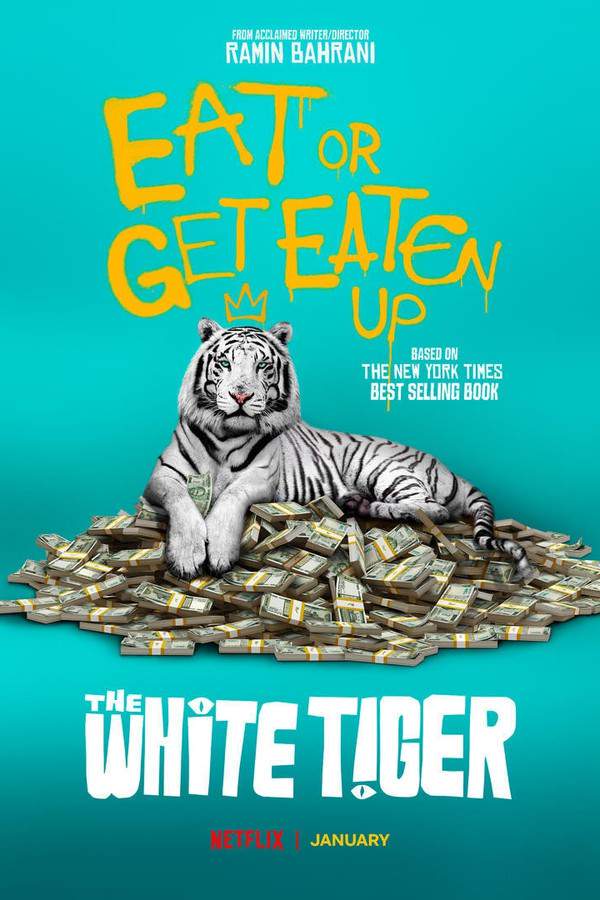
The White Tiger (2021) movie poster

Ending Explained

The White Tiger (2021) Ending Explained – Final Scene & Meaning

Release, runtime and language
2021 · 125 min · Hindi
Echo score 75
Loading streaming availability…
Directed by
Ramin Bahrani
Starring
Priyanka Chopra, Aaron Wan, Abhishek Khandekar, Adarsh Gourav, Ansuman Bhagat, Arun Khator

Balram Halwai, born into poverty in modern India, uses his intelligence and ambition to escape his circumstances and rise through the social ranks. His journey involves navigating a complex web of privilege, corruption, and the rigid structures of a deeply unequal society. He confronts the moral compromises necessary for advancement and the difficult choices that come with challenging the established order.

On this page (8)
  1. 1 Where to watch
  2. 2 What happens at the end
  3. 3 Final events in order
  4. 4 Ending questions answered
  5. 5 The book behind the movie
  6. 6 Movie threads
  7. 7 Movies like The White Tiger
  8. 8 Every angle
Loading streaming availability…

Ending explained · contains spoilers

What Happens at the End of The White Tiger?

How The White Tiger (2021) ends, what the final scene means, which earlier moments set it up and how to read the ending if the film leaves it open. The full ending explained, with every spoiler.

At the end of The White Tiger, Balram has fully embraced his transformation into the metaphorical white tiger, a symbol of independence, strength, and cunning. After murdering Ashok in a moment of revenge and liberation, he escapes the cycle of servitude that kept him trapped in what he calls "The Rooster Coop," a metaphor for the oppressive social and economic system that keeps the poor in their place. With Ashok's cash and his drive to succeed, Balram starts a new life as an entrepreneur in Bangalore, now free from his past bonds, but at a moral cost he accepts as necessary. His new business, The White Tiger Drivers, reflects how he's moved beyond the social constraints that once defined him, choosing to treat his drivers not as servants but as equals, in his own skewed way. The symbolic image of Balram locking eyes with a white tiger in the zoo cements his acceptance of his primal, feral power—recognizing that to truly climb out of society’s cage, one must sometimes embrace the darker, wild side within. Ultimately, Balram sees himself as part of a new wave of change for India, believing that the era of the "brown man and yellow man" has begun. Yet, this victory is tinged with darkness, showing that the cycle of corruption, violence, and inequality continues even as individuals like him succeed. His story suggests that social mobility often comes at a moral and ethical price, and that real systemic change remains elusive, lurking just beneath the surface of this brutal and unequal world. The final scene, with his drivers looking directly at the camera with fiery defiance, leaves viewers with the unsettling truth that the world's broken systems can sometimes be overwritten only through ruthless means—reminding us that the cycle of exploitation and corruption persists at the heart of society.

Last updated: June 25, 2025 at 08:44

Was this helpful?

The last 4 events

How The White Tiger Ends: The Final Events in Order

The last events of The White Tiger (2021) in chronological order, the run-up to the ending explained above. The complete timeline has all 15 events, scene by scene.

Open the full timeline
  1. Balram's Deceptive Ventures

    In a bid for financial independence, Balram starts generating fake invoices and secretly runs an unregistered taxi service. His entrepreneurial spirit clashes with the harsh realities of life as a servant, pushing him further into moral ambiguity.

    Where
    Dhanbad
  2. The Bitter Conflict

    With mounting pressure from the Stork family and Ashok's plans to replace him, Balram faces a critical decision. The Great Socialist's demand for a massive bribe leaves Balram reeling, leading to his breaking point.

    Where
    Dhanbad
  3. Murder and Escape

    In a moment of desperation, Balram confronts and murders Ashok with a broken whiskey bottle. Seizing the opportunity, he absconds with stolen money, embracing a new identity as he flees his past.

    Where
    Dhanbad
  4. A New Beginning in Bangalore

    Arriving in Bangalore, Balram utilizes the stolen funds to create his own successful taxi company. He embraces his newfound freedom while reflecting on the consequences of his actions and supporting his family back home.

    Where
    Bangalore

Ending questions answered

The White Tiger Ending: Your Questions Answered

The questions people ask most about the ending of The White Tiger (2021): what the final scene means, how the twist works, what happens to each character and how to read the ending. Each answer contains spoilers.

Q1

Why does Balram kill Ashok at the end?

Balram kills Ashok after the Stork brother threatens to kill his family if Balram continues to be a liability. Rather than waiting to be eliminated, Balram sees an opportunity to take control. When Ashok shows vulnerability by crying after the attempted bribery scandal, Balram seizes the moment to steal the money, kill Ashok, and escape to Bangalore. This act represents his complete break from servitude and his willingness to use violence to free himself from the cycle of oppression.

Foreshadowing: Earlier in the film, Balram's grandmother warns him that the powerful will crush him like a bug if he tries to rise above his station, hinting that Balram would need extreme measures to escape.

  • balram
  • ashok
  • murder
  • killing
  • escape
  • servitude
Q2

What is the Rooster Coop in The White Tiger?

The Rooster Coop is Balram's metaphor for the oppressive social system in India that keeps the poor trapped in servitude. Just as roosters in a coop wait to be slaughtered while watching others die before them, the lower classes remain obedient to the wealthy despite witnessing violence and exploitation around them. Balram describes how the poor accept their fate in a kind of collective hypnosis, too afraid to rebel even when they see others suffer.

Foreshadowing: The film opens with Balram describing how he and other servants watch the master family like roosters, establishing the central metaphor early.

  • rooster coop
  • metaphor
  • social system
  • poverty
  • servitude
  • oppression
Q3

What does the white tiger symbolize at the end of The White Tiger?

The white tiger represents Balram's acceptance of his own primal power and his transformation from a passive servant into a predator. In the zoo scene, Balram locks eyes with the white tiger and recognizes himself in it, a rare, wild creature that breaks free from captivity. The tiger symbolizes independence, strength, cunning, and the willingness to embrace darker impulses to survive and succeed. By accepting this animalistic side, Balram confirms he has fully transformed into someone who will do whatever it takes to escape his cage.

Foreshadowing: Balram is called a white tiger early in the film by the village teacher, who notes he is different from the others, planting the seed for his eventual transformation.

  • white tiger
  • symbolism
  • transformation
  • power
  • cunning
  • freedom
Q4

Does Balram actually achieve freedom at the end?

Balram achieves material freedom and social mobility, he escapes the village, starts a successful business in Bangalore, and no longer serves a master directly. However, his freedom comes at a tremendous moral cost: he murdered Ashok and potentially condemned his family to retaliation. The film suggests his freedom is incomplete because the systemic corruption and inequality he fought against remain intact. He has merely moved from the bottom of the pyramid to a predatory position within it, perpetuating the same exploitation he once endured.

Foreshadowing: Ashok's mother warns Balram that becoming like the masters won't save him, foreshadowing that his victory will be pyrrhic.

  • freedom
  • entrepreneur
  • mobility
  • moral cost
  • success
  • corruption
Q5

What happens to Balram's family after he kills Ashok?

The film implies Balram's family remains in the village under threat from the Stork brothers, who already used his family as leverage against him. By killing Ashok and stealing the money, Balram likely condemned his family to retaliation from the powerful patrons who controlled their lives. This is the price Balram accepts, he escapes to Bangalore while his family may suffer the consequences of his actions, representing the brutal choice between personal freedom and family loyalty.

Foreshadowing: Throughout the film, the Stork brothers threaten Balram's family to ensure his obedience, establishing that his actions will have consequences for those he loves.

  • family
  • threats
  • stork brothers
  • retaliation
  • village
Q6

Is The White Tiger ending happy or sad?

The ending is bittersweet. Balram technically wins, he escapes servitude, becomes a successful entrepreneur, and breaks free from the Rooster Coop. Yet this victory is darkened by murder, moral corruption, and the knowledge that systemic exploitation continues. His success requires him to become predatory like those who oppressed him. The final image of his drivers staring defiantly at the camera suggests a new cycle of ruthless ambition beginning, not genuine social change.

Foreshadowing: The film's dark tone and constant warnings about the cost of rising establish early that any victory will come with significant moral compromise.

  • bittersweet
  • ending
  • outcome
  • victory
  • moral ambiguity
Q7

What does the final scene with the drivers mean?

The final scene shows Balram's drivers staring directly at the camera with fierce defiance, suggesting they have adopted Balram's ruthless ambition and may follow his path to escape their own servitude. This unsettling image implies the cycle of exploitation continues, Balram has simply replaced one master with another. Rather than representing hope, the scene suggests that without systemic change, individuals will keep perpetuating the same brutal hierarchy through violence and cunning.

Foreshadowing: Balram explicitly states he will treat his drivers as equals rather than servants, hinting that his model will attract others seeking escape from the system.

  • drivers
  • final scene
  • defiance
  • cycle
  • exploitation
  • systemic change
Q8

Does Balram become like the corrupt people he hated?

Yes, Balram becomes a ruthless businessman who uses manipulation and exploitation to succeed, mirroring the very people he resented. He justifies treating his drivers well because it makes them more productive, not from genuine morality. He steals, lies, and murders to escape his circumstances. However, he is not identical to his former masters, his treatment of drivers shows some acknowledgment of their humanity. The film suggests he has neither fully transcended the corrupt system nor completely become part of it, leaving him in a morally ambiguous middle ground.

Foreshadowing: Balram's early resentment of the masters' corruption plant seeds of his own moral compromise.

  • corruption
  • moral compromise
  • success
  • exploitation
  • ambition
Q9

What does Balram mean when he says a new era has begun for India?

Balram sees himself as part of a new wave of Indians, the 'white tigers' who use intelligence and cunning to escape the traditional hierarchy rather than accepting their prescribed place. He believes the old system of British-style masters and passive servants is dying, replaced by ambitious individuals willing to break rules. However, this 'new era' is built on the same foundations of corruption and exploitation, suggesting Balram's vision of change is incomplete and perhaps self-serving.

Foreshadowing: Balram's description of wanting to run his own home rather than serve in someone else's hints at his larger ambition to reshape his place in society.

  • new era
  • india
  • change
  • ambition
  • social mobility
  • business

Movie threads

More Movies Like The White Tiger, by Mood & Story

Curated lists built around what makes The White Tiger tick: the same mood, the same kind of story or the same emotional payoff. Each list explains why these movies belong together.

Movies about ambitious social climbers like The White Tiger

Characters claw their way up from the bottom in a corrupt and unjust system. For viewers who enjoyed The White Tiger's intense focus on one man's ruthless rise from poverty. This collection features similar dramas and crime stories about cunning underdogs navigating corrupt systems, making difficult moral choices, and confronting the price of power.

  • ambitious
  • cunning
  • anxious
  • oppressive
  • rebellious
  • morally complex
  • Tone: dark, cynical, morally complex
  • Pacing: steady, methodical
Why these movies?

The story pattern: The narrative follows a linear or near-linear ascent of a protagonist from a low-status position. Key conflicts arise from the rigid social structures they must navigate and the ethical compromises required at each step. The climax often involves a decisive, transgressive act that secures their freedom but cements their moral ambiguity.

Why they belong together: These films are grouped by their shared focus on the psychological and moral journey of social climbing. They create a similar viewing experience of anxious tension, dark thematic weight, and a bittersweet resolution where success is inextricably linked to a loss of innocence.

Crime stories with social commentary like The White Tiger

A single criminal act becomes a radical critique of an entire social order. If you liked how The White Tiger used a murder to critique class struggle and corruption, explore these films. They share a similar structure where a personal crime is deeply intertwined with themes of social injustice, servitude, and systemic betrayal, resulting in a heavy, thought-provoking experience.

  • social injustice
  • betrayal
  • crime and punishment
  • oppressive
  • morally complex
  • rebellious
  • Tone: dark, oppressive, intellectually challenging
  • Pacing: steady, deliberate
Why these movies?

The story pattern: The plot is driven by a central crime that is contextualized by the protagonist's position within an unfair system. The narrative builds methodically to this act, showing it as an inevitable outcome of systemic pressure. The aftermath explores the consequences and the lingering question of whether the crime was a sin or a necessary rebellion.

Why they belong together: This thread groups movies where crime is a narrative vehicle for social critique. They share a dark, oppressive mood, a steady pacing that allows for thematic depth, and a bittersweet or ambiguous ending that refuses easy moral judgments, leaving the audience to ponder the larger societal implications.

If you liked this

Movies Like The White Tiger

Similar movies to The White Tiger: the same genre, themes or kind of story. Each one comes with its own plot summary, timeline and ending explained.

Browse all movie summaries

Every angle

The White Tiger (2021) Explained: Plot, Ending, Timeline & Characters

Everything about The White Tiger in one place: what happens in the plot summary, the timeline in chronological order, the characters and meaning, the ending explained and a spoiler-free summary. What's After the Movie adds the cast, box office and post-credit scenes.

Coming soon on iOS and Android

The Plot Explained Movie Summary App

Plot summaries, endings explained and timelines on your phone. Catch up on any movie in minutes, save your favorites and never miss a twist again.

Be the first to know when we launch. Your email stays private, always.

Learn more about the app